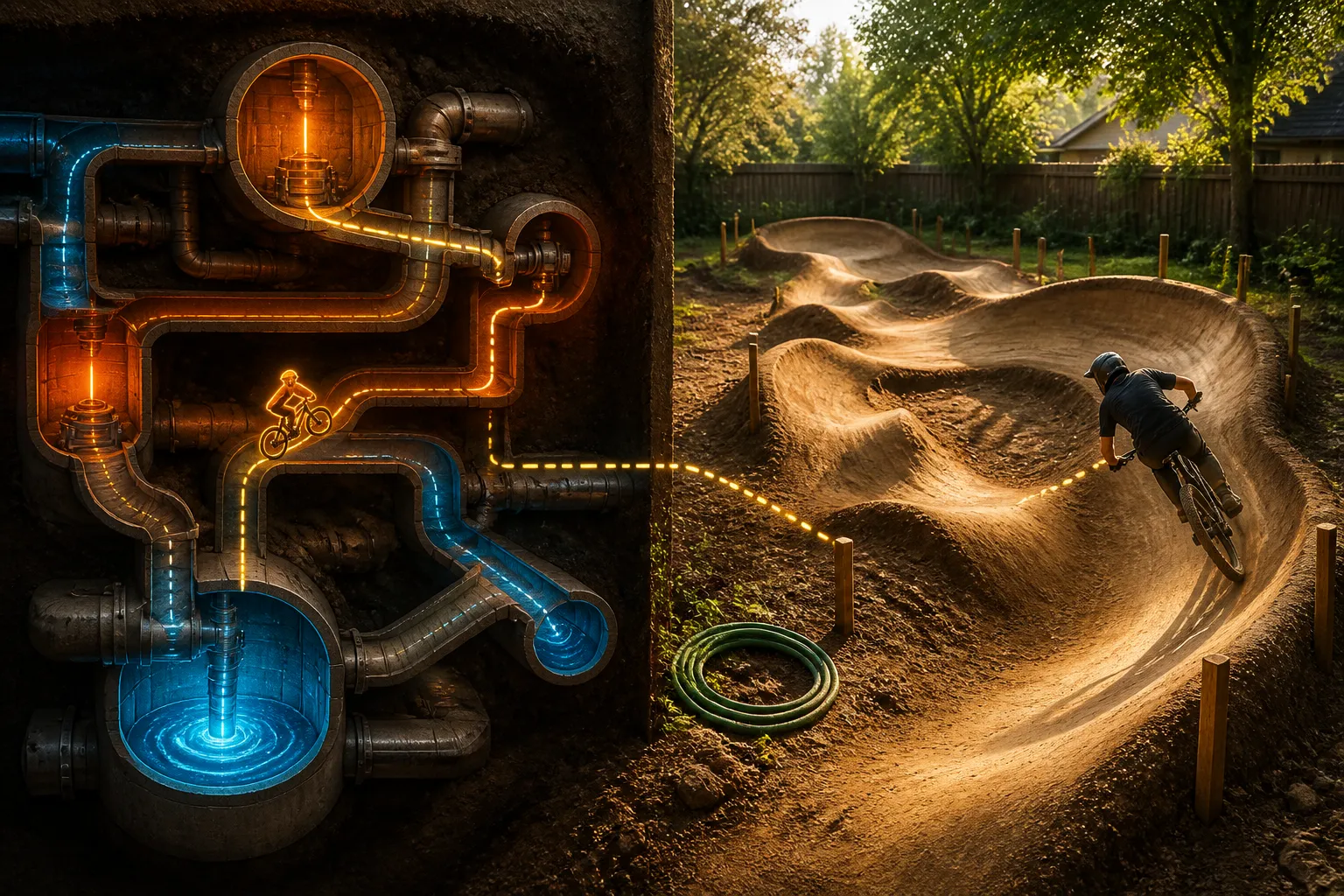
Dirt Pump names two very different kinds of route-making. In the game, players keep their speed through an underground network of pipes and pump chambers. In a backyard, a dirt pump track is a loop of rollers and banked corners that riders move through by shifting their weight rather than pedaling. Both reward a good line, but a shortcut through game geometry and a safe path across a yard ask for different kinds of care.

On the screen, the route is already built. The player’s task is to find the angle that makes it yield. The reported shortcuts exploit seams in a modular map, including doors whose checks can be approached from an unexpected side. A backyard starts with the opposite problem. Before anyone can ride a line, someone has to decide where it fits and where water will go.
The two views share a useful question: what must happen before the next turn works? In the game, the answer may be a precise dash or a brief opening in door logic. In the yard, it may be another metre of usable ground, compacted dirt, or a drain beneath a berm.
Speed changes the shape of the game
Stillness costs velocity in Dirt Pump. Its movement account describes wall jumps and boost slides as ways to reach parts of the level geometry, not just ways to arrive sooner. A wall jump works best at an approach angle between 20 and 70 degrees; charging straight at the wall gives little back. That makes a chamber feel different once a player knows where to carry speed into it.
Speedrunners found three major shortcuts in the underground pipe-and-chamber map. The reported routes make use of seams that were not fully sealed before launch. Six of the twelve pump chambers place pressure-check triggers on the far side of doors. Reach a door from another angle, and the check may never fire. That is a property of the map’s construction, not proof that every possible skip will remain available.
Three ways past a chamber
The Dry Bypass is a test of timing as much as direction. At a pipe junction near Chamber 3, the runner hugs the edge and dashes at a rumble cue. The reported opening lasts one frame. The Mud Skip takes a more visible route: flooding a Chamber 7 side tunnel raises the player over a gate and avoids a valve puzzle. Runners estimate that puzzle takes 40 to 90 seconds, depending on random variation, so the time saved is an estimate rather than a fixed prize.
At Chamber 11, the Pressure Clip uses repeated interactions with a broken gauge to put the door logic out of sync. The wall reportedly reads as passable for about two seconds before the final pump sequence is complete. These routes demand different skills: hearing a cue, setting up water, or working a short interaction window. All three are described as found flaws. The account does not establish that they work on every platform or on the current version of the game.
Drawing a line in dirt
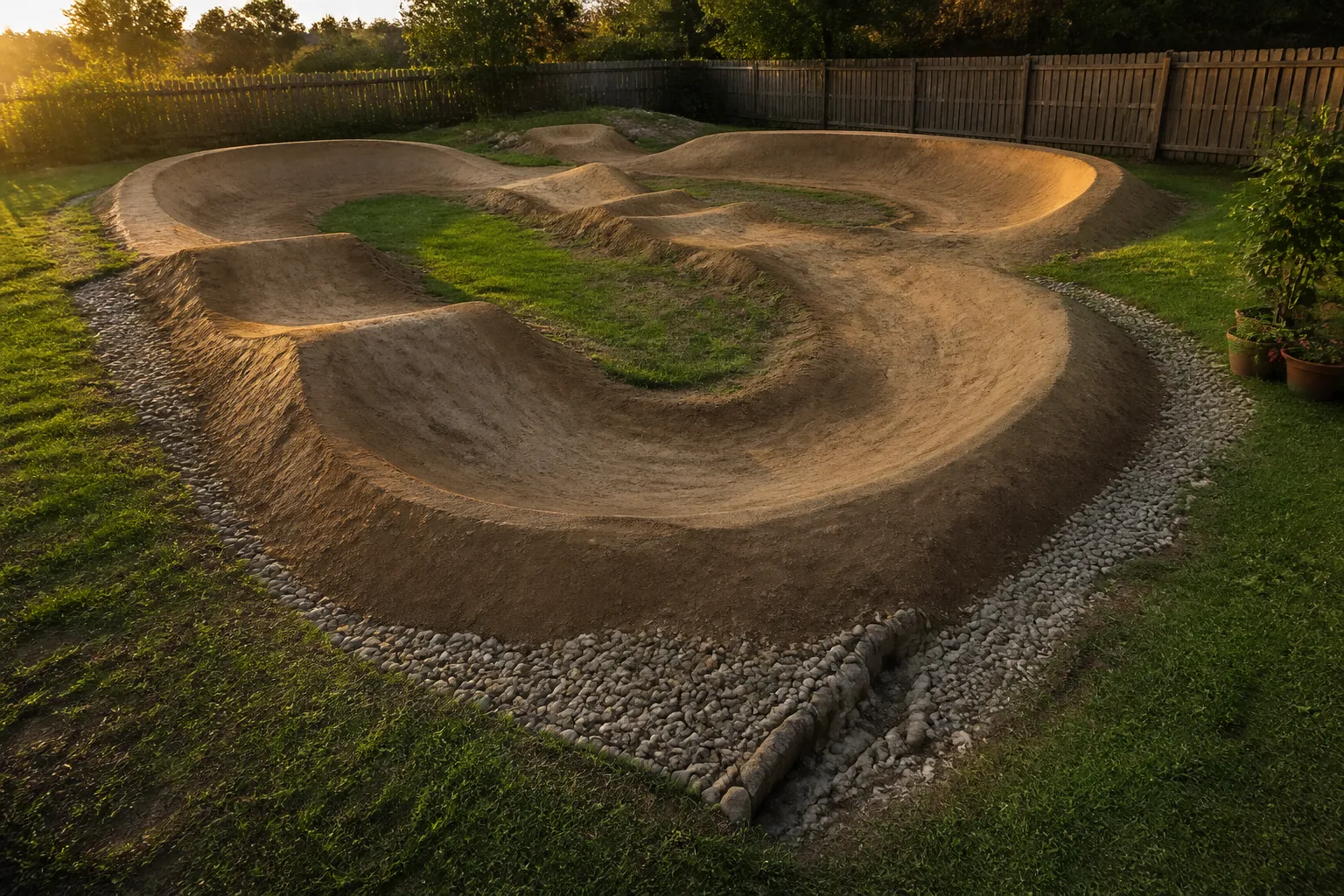
A backyard pump track gives its builder more freedom and more responsibility. USA Cycling describes the basic form as a continuous dirt loop of rollers and bermed corners, ridden by pumping rather than pedaling. Planning begins with a tape measure. About 6 m by 6 m is a cited minimum, but that means usable ground, not the yard’s total dimensions. Fences, trees, stairs and pools take space away. A sketch to scale can reveal that loss before the first shovel goes in.
The dimensions then start to govern the ride. One building guide suggests a berm radius of about 3 m. It gives rollers a length-to-height ratio of 10:1, putting a 30 cm roller about 3 m from the next. It also recommends a 2 to 3 percent grade for drainage. Dirt settles under compaction, so the guide calls for adding 50 percent more than the berm’s intended final height, plus a gravel-filled ditch at each berm’s base. A smooth-looking turn that holds water will not stay smooth for long.
Choose the route that fits
In the game, a possible route and an accepted route are separate questions. A diagonal approach may carry enough momentum through a soft-soil wall, but a leaderboard can set its own rules for using that opening. Before practicing a one-frame dash, a runner should check the current game version and the category rules. The available reports give no version, platform or last-verification date for each shortcut, and do not say whether the developers have fixed or accepted them.
In a yard, the shape of the available space is more useful than its headline area. Small-track guidance suggests a straight roller line for a long, narrow strip and a compact loop for a small rectangle. Low rollers and modest heights suit children and balance bikes; a compact loop can serve teens and mixed-age families. Leave room to enter, exit and stop, and consider whether someone can see the track from a patio or window. Starting small also leaves space to adjust a turn after people have ridden it.
What the route cannot tell you
A game shortcut can be tested again after a patch. A dirt berm is harder to undo. The backyard guides offer useful dimensions, but they do not provide dollar costs or settle permit, zoning, insurance or neighbor questions. They also leave soil type, local climate and long-term maintenance schedules open. Those gaps matter before a sketch becomes a pile of dirt.
Each Dirt Pump asks for attention to what lies just beyond the visible line. In a chamber, that might be a trigger on the far side of a door. In a yard, it might be water collecting at the bottom of the next turn. Finding an escape route is satisfying. Knowing what keeps it open takes another look.
Sources
- Dirt Pump's Gravity: The Incisive Mechanics of Flow | GoAndGame
- How Speedrunners Found Three Major Shortcuts in Dirt Pump | GoAndGame
- Arcades Revive and Thrive in Modern Gaming Culture | GoAndGame
- Arcade scorecard: New hooks and quieter fixes | GoAndGame
- How to Build a Backyard Dirt Pumptrack
- Small Backyard Pump Tracks for Home Riding
- How To Build a Backyard Pump Track | USA Cycling

Eliot Reed writes about the intricacies of virtual worlds, blending analysis with storytelling. As a house writer for GoAndGame, he delves deep into game mechanics and narratives, offering thought-provoking insights for players and developers alike.


