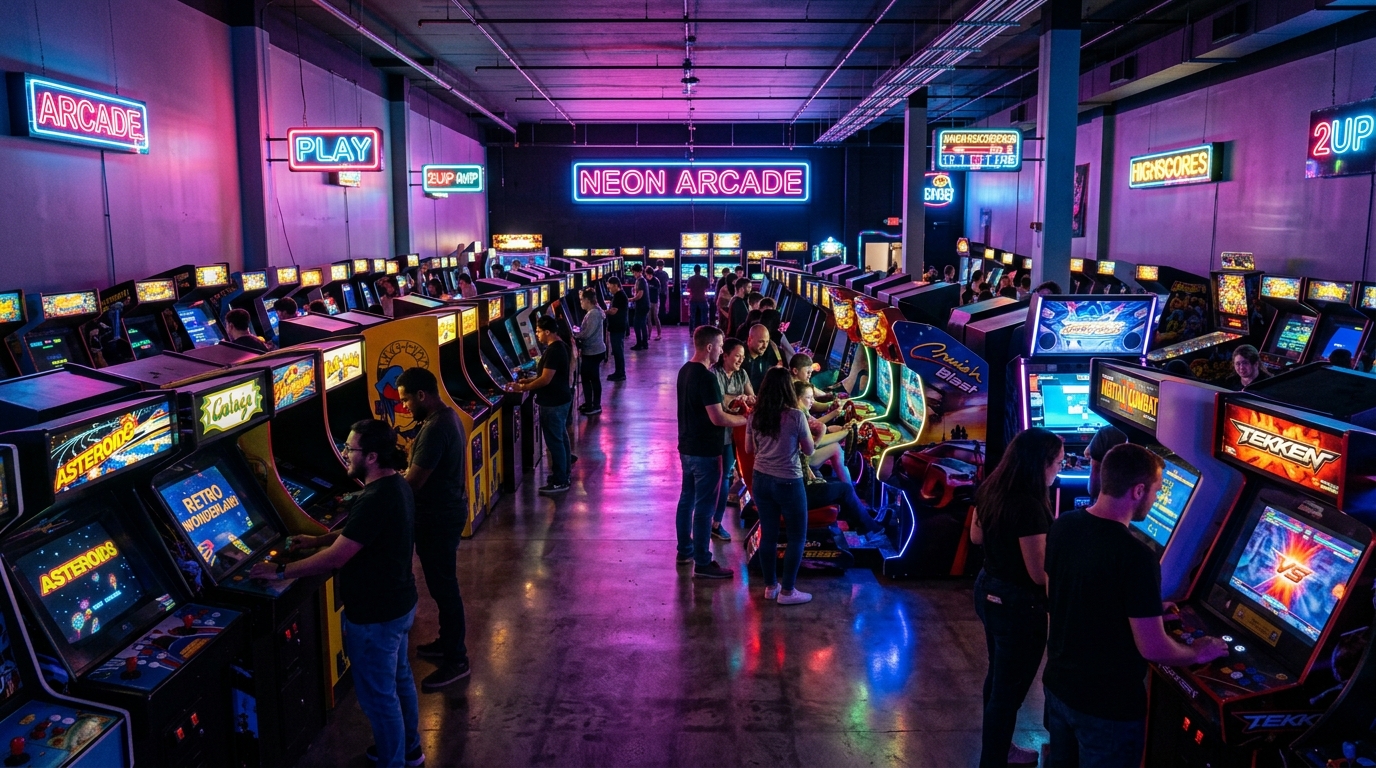
Arcades had nearly faded into memory, yet they have found a renewed pulse in today's gaming culture. Walk into almost any mid-sized city on a Friday night and you will likely find a neon-lit room packed with players chasing high scores, clinking glasses, and arguing over who gets the next turn on a classic cabinet. The resurgence is real, and it is more interesting than simple nostalgia.
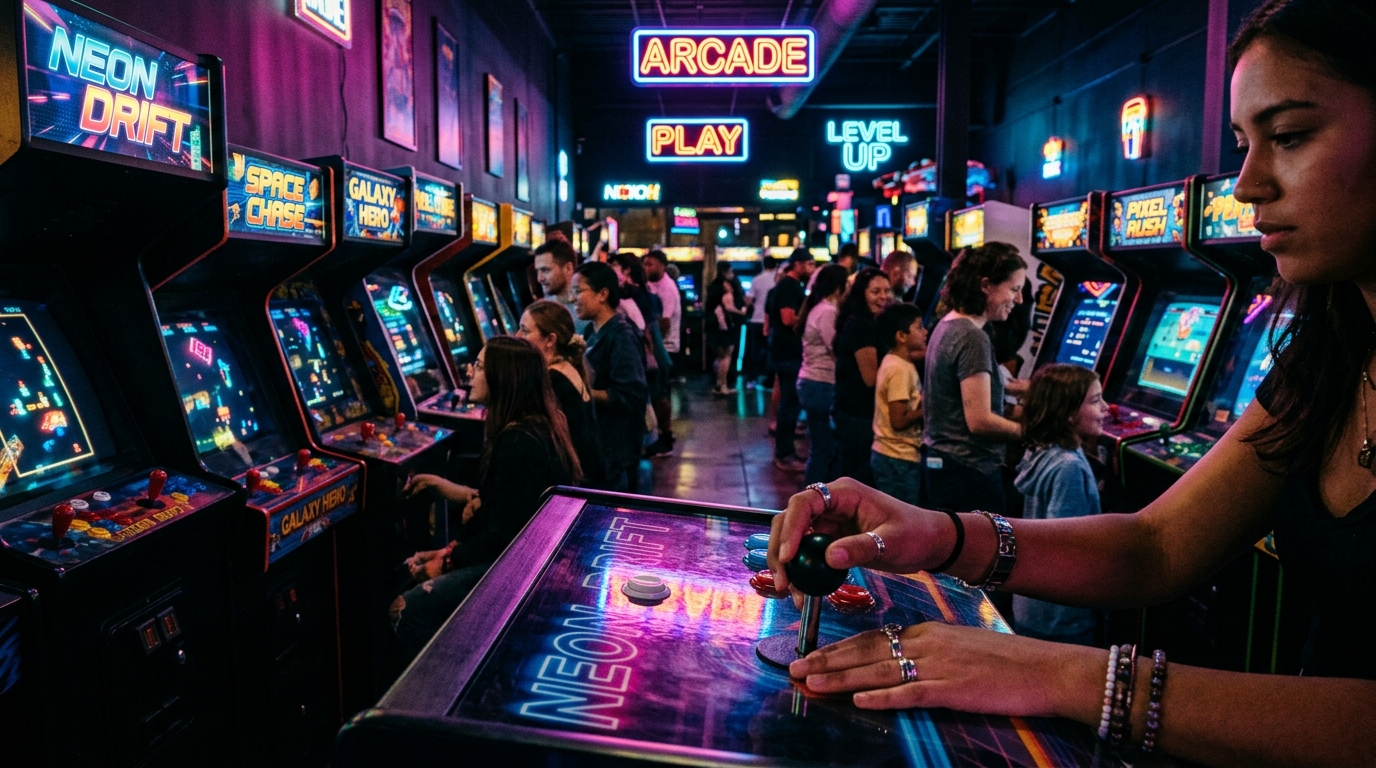
The Floor Is Alive Again
Across North America, Europe, and urban Asia, physical arcade venues are opening at a pace that would have seemed absurd a decade ago. They are not simply preserving old machines behind velvet ropes. They are curating full entertainment environments, mixing classic cabinets with rhythm stages, ticket redemption banks, and full food-and-drink service. The result is a social experience that a living room console simply cannot replicate. You can pause a game at home, but you cannot pause the crowd around you, the stranger trash-talking your score, or the bartender sliding you a drink between rounds.
According to a November 2025 industry analysis published by Made-in-China Insights, over 40 percent of new arcade visitors in the past year were under 30, suggesting that younger players are discovering these spaces without any firsthand memory of the original arcade era. Several high-profile venue openings in North America and Asia drew record attendance and sold out private event bookings within days of launch. The barcade format in particular, which pairs curated game selections with full bar service, has expanded its revenue model well beyond walk-in foot traffic, taking on corporate events, birthday parties, and product launches.
Hardware That Honors the Past Without Living in It
Modern arcade cabinets do something quietly impressive: they look old and run new. Manufacturers are reproducing the visual vocabulary of 1980s lithography, the bold side-art, the tilted marquee, the chunky control panel, while installing hardware underneath that would embarrass a mid-range gaming PC from five years ago. FPGA boards allow a single cabinet to carry dozens of titles without emulation lag. High-resolution displays are calibrated to mimic the bloom and scan-line texture of a CRT without actually using one. Cloud-connected leaderboards link a cabinet sitting in a bar in Austin to players in Tokyo chasing the same daily record.
What has not changed, and what operators say players specifically come back for, is the physicality. Buttons with tactile resistance, joysticks with a satisfying snap at the gate, steering wheels that push back. Touchscreens have colonized nearly every other part of daily life. The arcade offers the last mainstream venue where input still has weight.
Browser-based titles are carrying this same hardware philosophy into digital spaces. Games built around escalating difficulty, limited lives, and a single score column do not need elaborate tutorials. The constraint is the design. Try Dot Chomper for the maze-chase loop, or Segment Storm for the kind of geometric intensity that fills a screen without a single rendered polygon. Asteroids Remake updates the vector-shooter template with modern collision logic while keeping the original's merciless momentum.
Nostalgia as Design Language, Not Just Marketing Gloss
The smartest venues and developers treat retro aesthetics as a communication tool, not a costume. A CRT filter signals a certain pace. Chiptune audio signals a certain risk tolerance. When a player sees those elements, they already know the game expects quick decisions, limited margin for error, and a score worth defending. No onboarding screen required. The aesthetic does the briefing.
This shared vocabulary allows new titles to sit alongside their inspirations without apology. Go and Zap uses the visual grammar of early fixed-shooters to set expectations before the first button press. Star Dive pulls the scrolling-shooter template forward with modern hitbox precision and a difficulty curve that reveals new patterns on every run. Dirt Pump takes the racing line from coin-op classics and rebuilds it around a physics model that rewards study. None of these titles are hiding behind nostalgia. They are using it as a starting point and then going somewhere.
The distinction matters because it is why the resurgence has legs. Venues stocked only with original machines from 1982 are museums, and museums close early. Venues that treat the arcade tradition as a living design framework keep players coming back for new challenges dressed in familiar clothes.
Community, Competition, and the Leaderboard as Social Contract
Score-chasing has always been social, even when it looked solitary. The initials on a high-score table were a public message. Modern arcades have amplified that dynamic without losing it. Physical venues host weekly tournaments. Streaming platforms carry speedrun attempts to audiences who have never touched the original hardware. Discord servers maintain score ladders for browser titles the same way local regulars once maintained unspoken rankings on a single machine.
Hybrid competition is the next visible frontier. Several operators are testing location-based rewards, where playing a game in a specific physical venue unlocks exclusive content in the digital version of the same title. The idea rewards presence without punishing players who only have access to the browser version. It treats the physical and digital spaces as two rooms in the same building rather than competing products.
What makes this moment different from the nostalgia cycles that came before is the infrastructure behind it. Payment systems, loyalty programs, cloud leaderboards, and streaming distribution did not exist during the original arcade era. They give operators data to refine game selection and give communities tools to organize at scale. The arcade floor is alive again, and this time it has a network connection.
Sources

Alexandra Rivet explores the intricate interplay of games and culture for GoAndGame. A passionate storyteller, she delves into narratives with depth and curiosity. Her pieces often highlight the stories behind the pixels.


