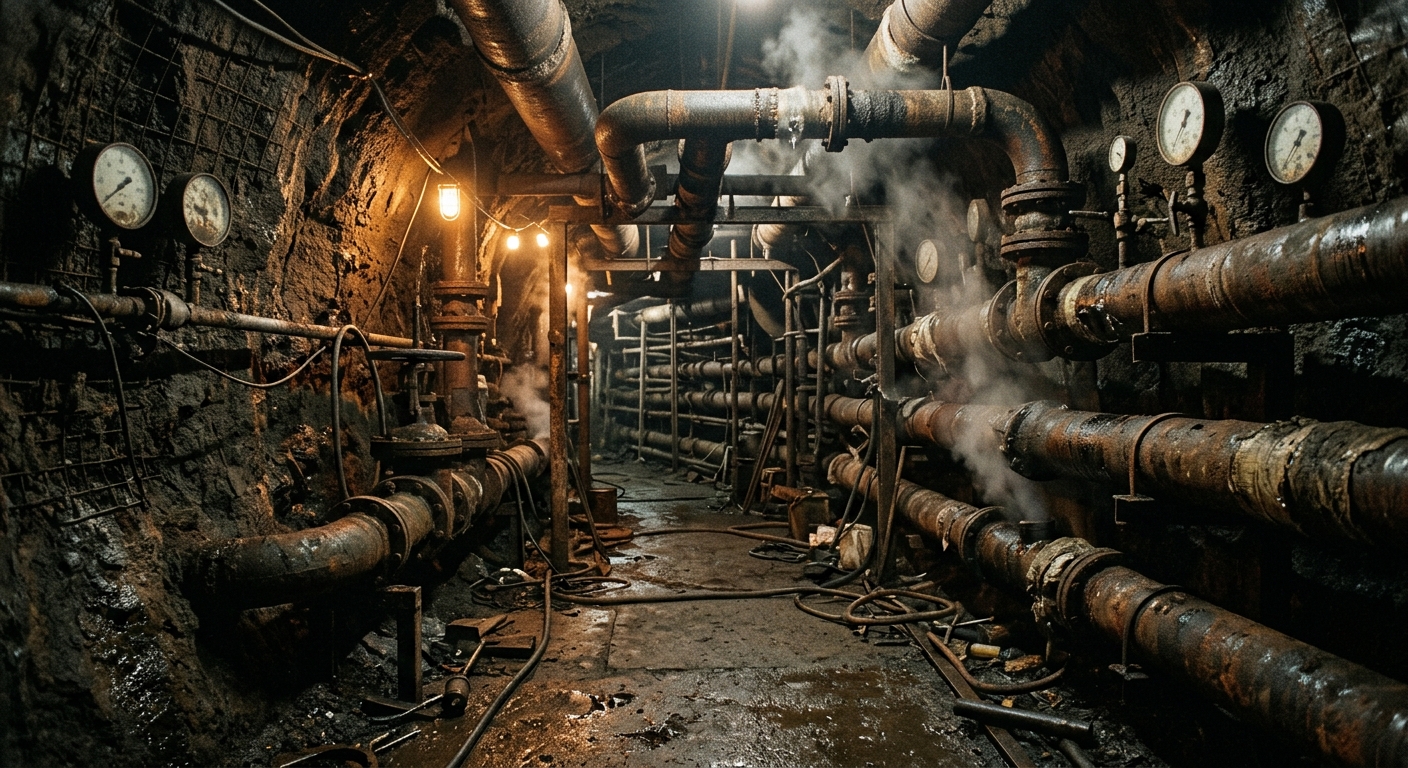
Most players treat Dirt Pump as a grinding endurance test. You redirect water, you open valves, you inch through twelve pump chambers while the pressure gauge climbs. The official route is slow by design. But the speedrunning community found another way through, and the shortcuts they uncovered are less about glitch-hunting and more about reading a map that was never fully locked down.
What Makes Dirt Pump's Layout So Shortcut-Friendly
The underground map in Dirt Pump was built from a modular pipe-and-chamber system. That modularity gave the developers flexibility during production, but it also left seams between segments that were never fully sealed before launch. Think of it less like a blueprint with hidden doors and more like a construction site where a few panels were never bolted flush.
The bigger mechanical unlock, though, is diagonal momentum. Unlike arcade-adjacent titles where wall geometry is treated as absolute, Dirt Pump lets players clip through soft-soil walls by holding a specific diagonal angle and maintaining speed. The speedrunning community started documenting this within weeks of the game going live. Once that trick was confirmed repeatable, the question shifted from can you clip to where does it save time.
There is also a structural flaw in how the game checks pressure completion. Six of the twelve pump chambers have their trigger zones placed on the far side of doors, not in front of them. That means a player who arrives at a door from an alternative angle bypasses the check entirely. The pressure mechanic, the whole point of the game's gating system, simply does not fire.
The Three Major Shortcut Routes and How to Execute Them
The first shortcut is called the Dry Bypass, and it cuts Chamber 3 out of the run completely. You hug the lower-left pipe junction, then dash rightward the moment you hear the ambient rumble cue. That audio flag is not cosmetic. It coincides with a one-frame window where the collision boundary relaxes, and a precise rightward dash during that window pushes you through the wall and into Chamber 4 without touching the Chamber 3 valve at all.
The second route, the Mud Skip, works differently. Instead of phasing through geometry, you use the game's own water mechanics against it. Intentionally flooding a side tunnel in Chamber 7 raises your vertical position just enough to walk over the locked gate that normally separates Chamber 7 from Chamber 9. The valve puzzle between them, which runners estimate costs forty to ninety seconds depending on RNG, never happens. You are simply above it.
The third shortcut, the Pressure Clip in Chamber 11, is the most technical of the three. Rapidly and repeatedly interacting with a broken gauge widget desynchronizes the door-state logic. The door's internal state and its visual state stop agreeing with each other, and for about two seconds the wall reads as passable even though the final pump sequence has not been completed. Threading that window consistently is what separates casual shortcut users from runners chasing top times.
Community Discovery and the Evolving Metagame
None of this started as speedrunning. The shortcuts emerged from a GoAndGame enthusiast forum thread that was originally focused on score optimization. A user posted a clip of an unintentional wall phase during a casual run, the thread pivoted, and within three months runners had mapped out all three major routes and organized them into competing any-percent categories.
The main split in the community is over the Pressure Clip. One camp bans it, arguing that desynchronizing door-state logic is a glitch and not a skill-based route choice. The other camp allows it, pointing out that consistent execution requires real technical precision. This mirrors debates in communities around other arcade-adjacent games, including those that have formed around GoAndZap and Segment Storm, where the line between smart routing and exploiting broken code is genuinely contested.
The metagame has not settled. Runners are currently testing whether the diagonal-momentum trick from the Dry Bypass can chain into a fourth shortcut inside the game's bonus pump chamber. That area was considered too tightly constructed to exploit, but the same assumption held about Chamber 3 before someone listened closely to the audio cues.
Developer Response and What It Means for Future Updates
GoAndGame's public position has been careful. The studio acknowledged the shortcuts exist and described them as "emergent play patterns consistent with our sandbox-adjacent design philosophy." That phrasing has been read by most of the community as a quiet endorsement, or at least a signal that the developers are not hostile to what runners are doing.
The patch record tells a slightly different story. A recent minor update quietly reinforced two collision boundaries in Chamber 7, closing one variant of the Mud Skip while leaving the primary route intact. The studio did not announce the change in the patch notes. Players noticed it when their established setups stopped working. That kind of silent adjustment suggests GoAndGame is watching the situation more carefully than its public statements suggest.
What the studio does next will shape how Dirt Pump ages. Games in this space tend to build lasting communities when player-discovered routes are treated as part of the game's identity rather than liabilities to be patched out. The shortcuts are not breaking anything that was working cleanly. They are paths through gaps that were already there, found by people paying close enough attention to hear a rumble cue and understand what it meant.
Sources

Mara Solis is a staff writer at GoAndGame covering board games, tabletop strategy, and the culture around competitive play. She has spent years logging hours at game tables from local hobby shops to international conventions. Her writing blends practical insight with a genuine enthusiasm for the communities games create.


