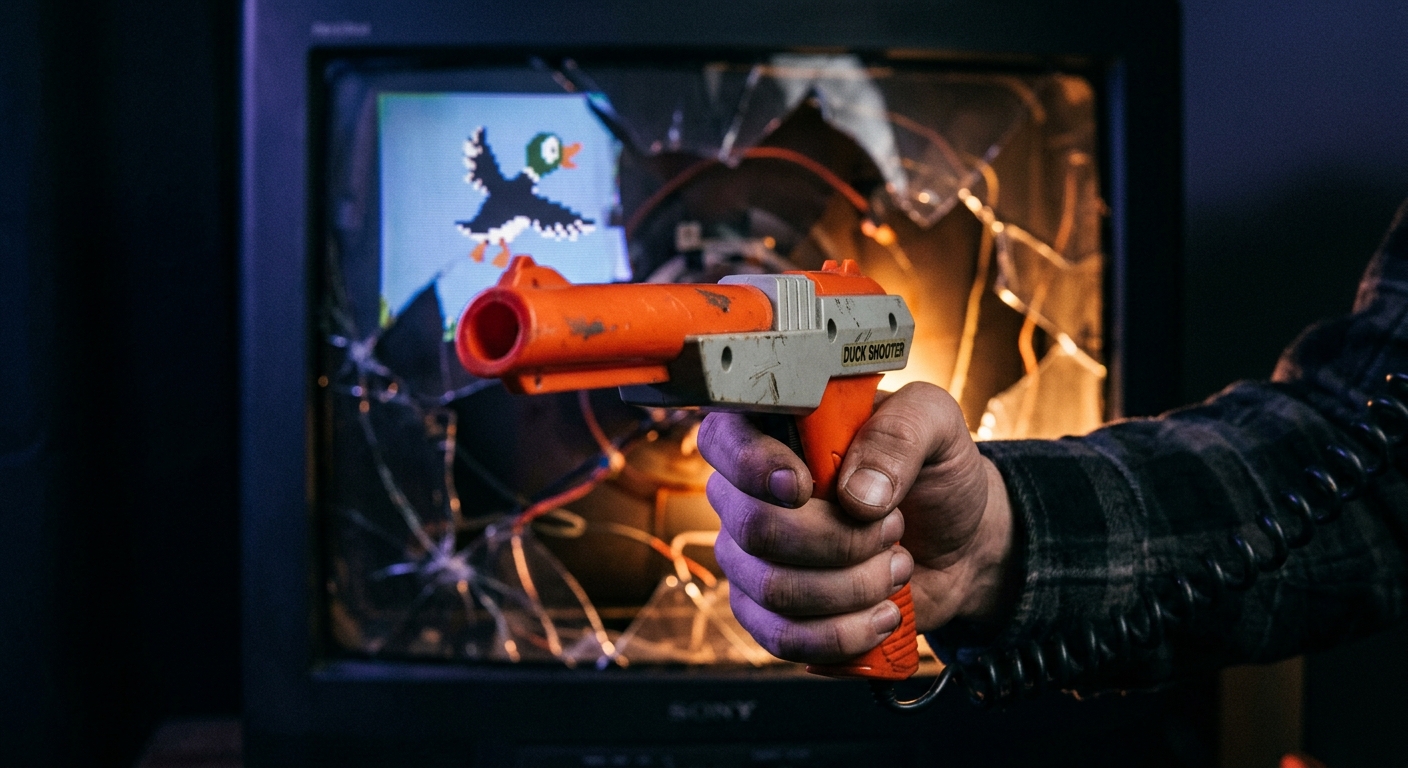
Pull the trigger on a Zapper pointed at a modern flatscreen and nothing useful happens. The gun clicks, the game runs, and the ducks fly home untouched. That failure is not a glitch and it is not fixable with a firmware update. It is physics, and understanding it is the price of admission for anyone who wants to take light-gun games seriously in 2024. The good news is that a surprisingly dedicated community of tinkerers, collectors, and genre devotees has spent years working out what actually gets these games playable again, and their answers range from beautiful to deeply practical.
Why Light Guns Stopped Working and Why That Still Matters
The NES Zapper operated on a single elegant trick. Pull the trigger and the CRT blanked to black for one frame, then drew a white square over each valid target. The gun's photodiode caught that precise flash. The console measured the timing and resolved exactly where the barrel was pointed. The whole chain depended on the cathode-ray tube painting one phosphor dot at a time, sweeping from top-left to bottom-right in a physical arc. LCD, OLED, and plasma panels illuminate pixels simultaneously, or in patterns that destroy the timing signal entirely. There is no flash to catch because there is no sweep to catch it from.
This is not a peripheral problem. It is a display problem, and it made every classic light gun a decorative object the moment the last CRT left the living room. Duck Hunt still loads. The Zapper still clicks. But the photodiode receives a wall of undifferentiated light rather than a timed pulse, so the game registers hits at random or not at all.
That would be a footnote if the light-gun genre were merely nostalgic, but it produced some genuinely distinct game design. Point Blank's absurdist minigame chains, Time Crisis's cover mechanic, House of the Dead's B-movie pacing built around resource management under pressure. None of that translates to a standard controller without losing the core interaction. The genre represents a vocabulary of play that disappears completely when the hardware chain breaks. Knowing why it broke is the first step toward rebuilding it.
The CRT Option: Sourcing, Setup, and Sanity Preservation
The most direct path back to authentic play is to keep or acquire a working CRT, and that market has become unexpectedly complicated. What was curbside-free a decade ago now has a real price tier. A 27-inch Sony Trinitron in solid condition routinely sells for more than the console you plan to connect to it. Smaller sets stay more affordable, but anything under 20 inches creates its own accuracy problems: the target squares shrink to the point where even a well-calibrated gun struggles at normal playing distance.
Setup involves more than composite cables. The gun needs a room with controlled ambient light. Bright windows or overhead fluorescents can swamp the photodiode and cause misses that feel random until you close the blinds. Screen brightness and contrast settings on the CRT itself affect registration in ways that vary by gun model. The Zapper is relatively forgiving. Some third-party guns from the 16-bit era require calibration software or test ROMs to find the right contrast band, and tracking down those resources is its own minor research project.
The logistics deserve honest assessment before committing. CRTs are heavy, often requiring two people to move safely, and their internal capacitors can hold dangerous charges long after unplugging. DIY repair without proper training is genuinely risky. Phosphor lifespan is finite and replacement parts for specific chassis are increasingly hard to find. The CRT path is the gold standard for authenticity, but it is a commitment, not a casual weekend fix.
Modern Alternatives: IR Guns, Camera Systems, and the G'AIME Approach
The contemporary revival has produced several distinct technological answers. IR guns like the Sinden Lightgun mount a small camera on the barrel and use computer vision to track a white border printed around the game image on your flatscreen. The border is the reference frame. The gun calculates where the barrel points relative to that frame in real time, works on any display, and supports a wide emulated library. The cost is that you run Sinden software on a PC, configure border overlays, and accept a small latency introduced by the vision processing pipeline.
A different approach comes from products like the G'AIME Time Crisis Lightgun, which markets itself as an AI-powered, self-calibrating gun engineered to detect your screen intelligently and deliver unparalleled accuracy at around ninety dollars. The pitch is plug-and-play access for players who want dedicated arcade hardware without becoming Linux system administrators. The trade-off is typically a narrower compatibility list and less community-driven configurability than open-platform solutions. For a player whose goal is Time Crisis on a flatscreen in an afternoon rather than a months-long build project, that trade-off is often worth making.
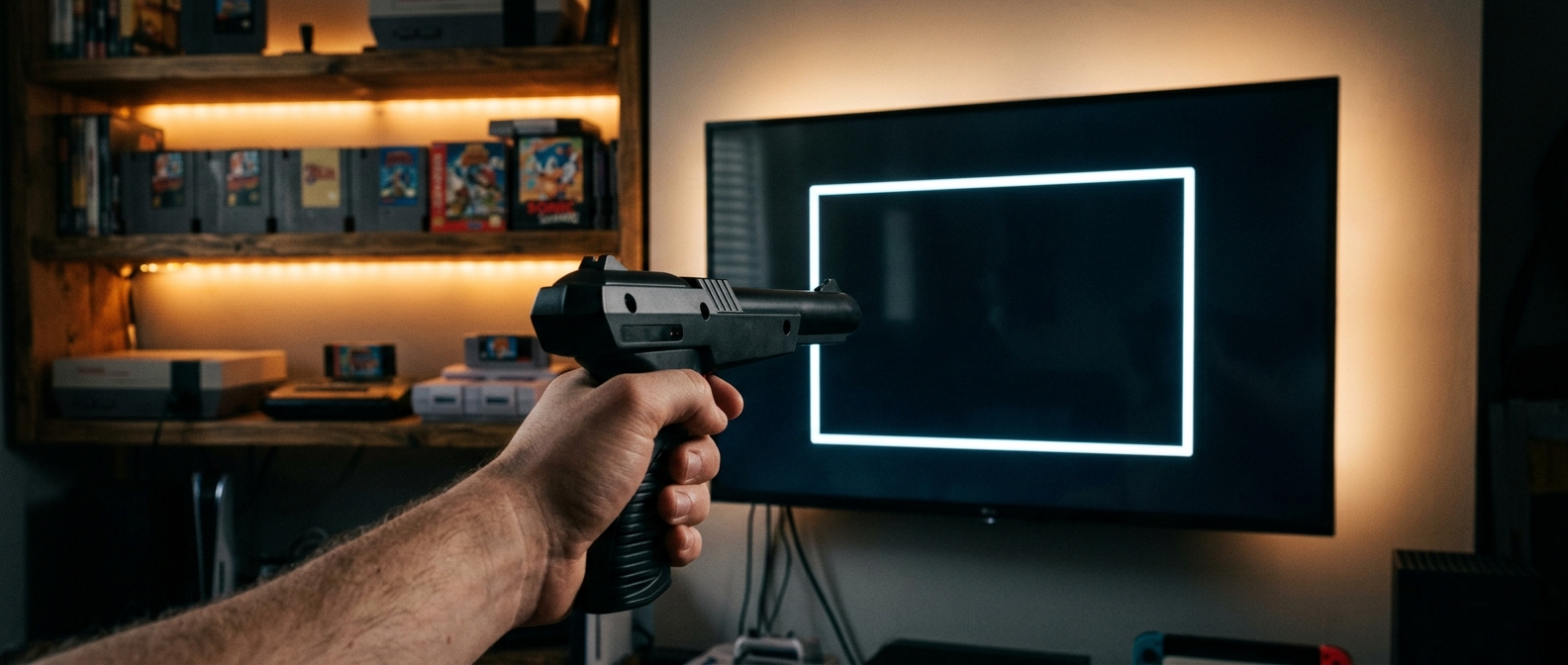
Camera-based sensor-bar systems, popular in custom MAME cab builds, represent a third category. These typically need per-game calibration and work best in stable lighting. The arcade-adjacent modding community has produced sophisticated open-source firmware for these setups, and forums like Beakz Buildz contain years of accumulated knowledge about which combinations of hardware, emulator, and display type produce the most reliable results. The learning curve is steep and the ceiling is high, which is exactly the proposition that community-driven projects thrive on.
No modern alternative perfectly replicates the zero-latency, hardware-native feel of a Zapper on a real CRT running real cartridge code. What they offer is playability on hardware you actually own, in a living room sized for modern furniture, without the logistics of CRT acquisition. For most players returning to the genre after years away, a well-configured modern alternative delivers enough fidelity that the actual design ideas of Point Blank or Area 51 come through clearly. And those ideas are what made the genre worth preserving in the first place.
Game Selection, Emulation, and Building a Practical Play Library
Not all light-gun games survive the transition to modern hardware equally. Titles designed with generous hit detection and large target zones, Duck Hunt being the obvious example, translate more forgivingly to IR or camera-based systems where sub-pixel accuracy is harder to guarantee. Point Blank, which demands precise aim at small targets as a structural feature, exposes every millisecond of input lag and every fraction of calibration error. Knowing your library and matching it honestly to your hardware capability is a real part of building a satisfying setup, not an afterthought.
Emulation opens the catalog considerably but introduces its own complexity. MAME supports an enormous range of arcade light-gun titles, and many accept mouse input as a gun substitute, which IR and camera-based guns can emulate with varying accuracy depending on the driver. Console emulators like RetroArch have light-gun input support, but the configuration menus assume familiarity with concepts like input driver selection and core-specific settings. Budget real time for setup and testing. Expecting plug-and-play from a MAME light-gun configuration will produce frustration rather than fun.
Building a practical library also means being honest about which experiences are fundamentally arcade-adjacent in nature. Time Crisis with a foot pedal and a real cabinet is a different activity from Time Crisis on a flatscreen with an IR gun in the living room. Neither is wrong. The resurgence documented across communities like Beakz Buildz suggests that players are increasingly comfortable with that distinction, engaging with the genre's interaction design even in imperfect modern contexts. You can also get a taste of fast-reflex arcade action in browser-friendly form through games like GoAndZap or the pattern-reading challenge of Dot Chomper, which share some of that quick-trigger decision energy even without a gun peripheral.
The light-gun legend does not require a perfect recreation to survive. It requires enough fidelity that the game's actual ideas come through, and on that measure, the options available today are better than they have been at any point since the last CRT left the showroom floor. Pick the approach that matches your patience level, your budget, and your living room, and then point the thing at something and shoot.

Mara Solis is a staff writer at GoAndGame covering board games, tabletop strategy, and the culture around competitive play. She has spent years logging hours at game tables from local hobby shops to international conventions. Her writing blends practical insight with a genuine enthusiasm for the communities games create.


