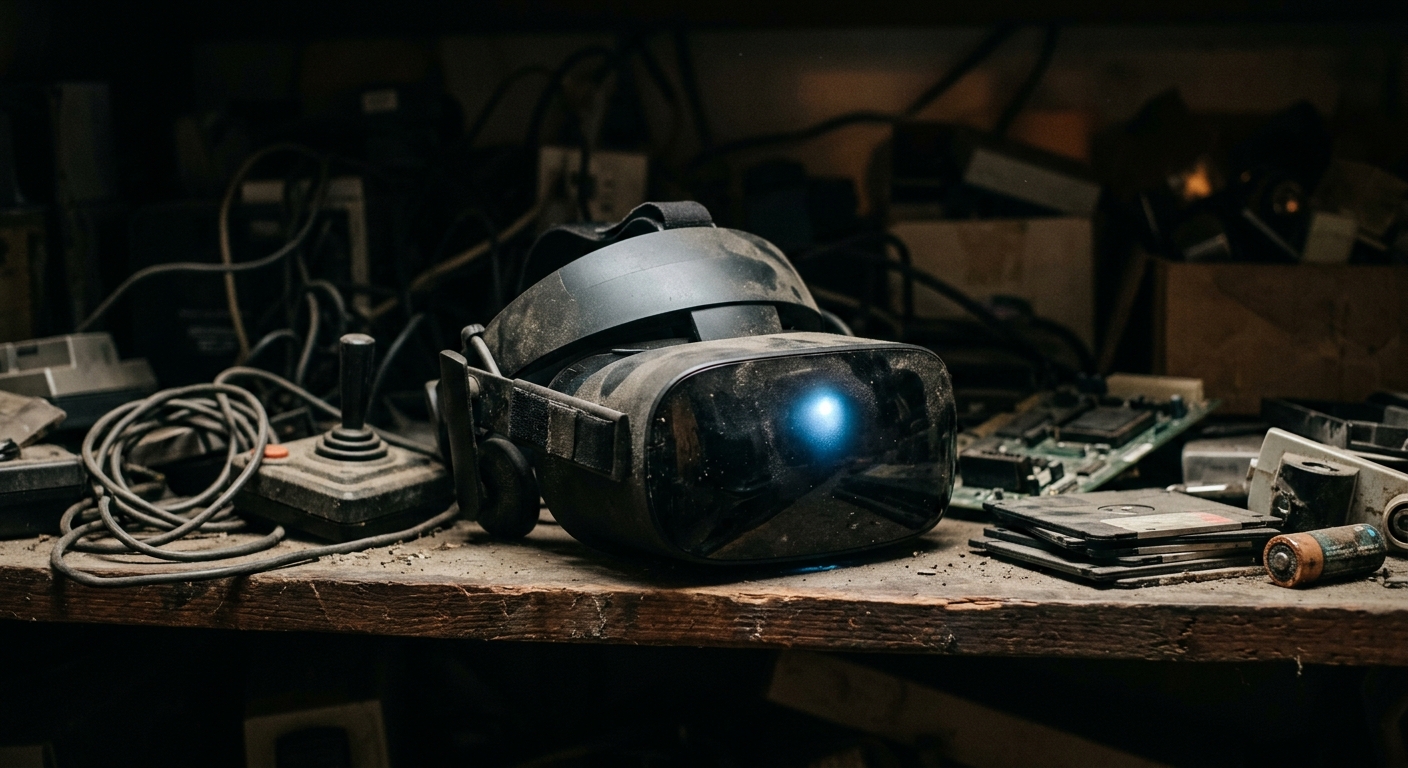
Virtual reality has long inhabited the future, a technological horizon forever 'just around the corner.' For decades, each new iteration of head-mounted displays has arrived with the same breathless promises: total immersion, a revolution in entertainment, the dawn of a new computing era. Yet, from the clunky arcade machines of the 1990s that promised escape but delivered motion sickness, to Nintendo's ill-fated Virtual Boy, to the crowdfunded enthusiasm for the Oculus Rift, and now Meta's multi-billion-dollar investment in Reality Labs, the narrative remains stubbornly consistent. The technology improves, the hype cycle resets, and mainstream adoption remains elusive.
Industry analysts, even those who praise genuinely improved optics and lighter form factors for 2025, consistently revise shipment forecasts downward. This pattern suggests a fundamental disconnect: hardware maturity has not translated into market acceptance. The gap between what VR could be and what it is for most consumers refuses to close.

The Hardware Trap and the Price Ceiling
The economics of consumer electronics typically follow a predictable path. New technologies emerge at a premium, then costs fall rapidly, allowing entry-level devices to hit psychologically significant price points, such as the $199 game console or the $99 MP3 player. This threshold allows a platform to achieve critical mass. Virtual reality, however, has consistently failed to find this floor.
Modern, capable VR headsets still command prices ranging from $300 to well over $3,500. This is not arbitrary. A truly immersive and comfortable VR experience demands simultaneous advances in high-resolution display panels, precise spatial audio, sophisticated inside-out tracking cameras, and powerful onboard processing. Each of these components has its own complex cost curve, which does not collapse with the same speed as a single-component product like a smartphone screen. The cumulative cost remains stubbornly high.
Even in commercial contexts, where businesses theoretically have deeper budgets and clearer return-on-investment calculations, price sensitivity acts as a primary barrier. Research published in Frontiers in Virtual Reality confirms this. If businesses with a strategic rationale struggle with the cost, the problem becomes far more severe when targeting an individual consumer buying a device for leisure. The hardware itself seems to resist the democratizing force of mass production.
Content Gravity and the Platform Chicken-and-Egg Problem
A platform without compelling software is merely expensive hardware, and ambitious software cannot thrive without a robust installed base. This creates a classic chicken-and-egg dilemma, a circular trap that has strangled promising VR content ecosystems before they could establish the deep libraries necessary for sustained engagement. Developers are hesitant to invest millions in high-fidelity experiences if the potential audience is too small to recoup costs.
The arcade era offered a partial, if limited, solution to this conundrum. Location-based entertainment venues could amortize the high cost of specialized VR hardware across thousands of individual plays. This model allowed developers to create visually ambitious, dedicated experiences, such as complex space-flight simulators or elaborate shooting galleries, confident that the revenue per unit play would justify the investment. Titles like early iterations of Star Dive exemplified this approach, offering experiences unattainable at home.
Today, standalone VR storefronts frequently rely on ports of flat-screen games, often with motion controls simply bolted on. This strategy satisfies neither dedicated VR enthusiasts, who seek ground-up spatial design, nor casual consumers, who can already play these titles more comfortably on a traditional television. Both audiences feel underserved, leading to chronically weak engagement metrics and a content library that feels more iterative than revolutionary. The unique promise of VR remains unfulfilled by content designed for different mediums.
Comfort, Ergonomics, and the Body's Veto
Even if price points fall and compelling software emerges, the human body retains a powerful veto. A significant minority of users experience nausea due to vestibular conflict, the mismatch between visual input and inner ear sensation. Beyond this, extended sessions often result in facial pressure, neck strain, and a distinct form of eye fatigue. These are not software bugs; they are fundamental physiological responses that no patch can remedy.
Ergonomic studies consistently show that most consumer VR users limit their sessions to well under thirty minutes. This practical ceiling fundamentally restricts the scope of narrative or social experiences developers can design. A two-hour film, a lengthy game arc, or a deep social interaction all require sustained investment, which must then be engineered around mandatory breaks that inevitably fracture immersion. The technology demands a commitment from the user that few are willing or able to give for long periods.
Recent trends from the VR industry entering 2025 emphasize lighter pancake lens designs and improved weight distribution. This focus correctly identifies comfort as a specification as critical as resolution. However, headsets remain highly visible objects that conspicuously mark their wearers in shared domestic spaces. This adds a social friction layer, a public awkwardness, that a smartphone or laptop simply does not impose. The device itself remains an imposition on the body and the social environment.
Retail and Enterprise Signals: Reading the Tea Leaves
The trajectory of VR in the retail sector offers a crucial bellwether for its commercial viability. Here, use cases like virtual try-on, showroom simulations, or staff training present a concrete and measurable return-on-investment argument. Yet, expert research cited in Frontiers in Virtual Reality indicates that retailers consistently report significant barriers. These include implementation complexity, resistance from staff, and integration costs that frequently outweigh the theoretical gains. The practical realities of deployment often clash with the optimistic projections.
In specialized enterprise deployments, such as healthcare simulation, military training, and architectural visualization, VR has indeed generated genuine success stories. These applications highlight the technology's power as a precise, high-value tool. Such deployments have also been instrumental in keeping several VR hardware companies financially viable. However, these markets are inherently small and niche. They do not generate the volume economics required to drive down component costs for the broad consumer segment. The specific needs of a military trainer do not translate to the mass market appeal needed for a device to sit in every living room.
This pattern suggests a future for VR that diverges sharply from the early evangelists' forecasts of ubiquitous household penetration. Instead, VR may follow a trajectory closer to professional 3D printing or industrial augmented reality. It will become a powerful, valuable tool that serves specific high-value verticals exceptionally well. This outcome is commercially sustainable for the companies involved, but it presents an anticlimactic narrative for an industry that has spent three decades promising to replace reality itself. The grand vision gives way to pragmatic utility, a quiet victory rather than a revolution.
Sources

Julian Thorne is a seasoned house writer for GoAndGame, known for his deep dives into obscure game mechanics and industry trends. He often explores the sociological impact of gaming, blending critical analysis with historical context.


