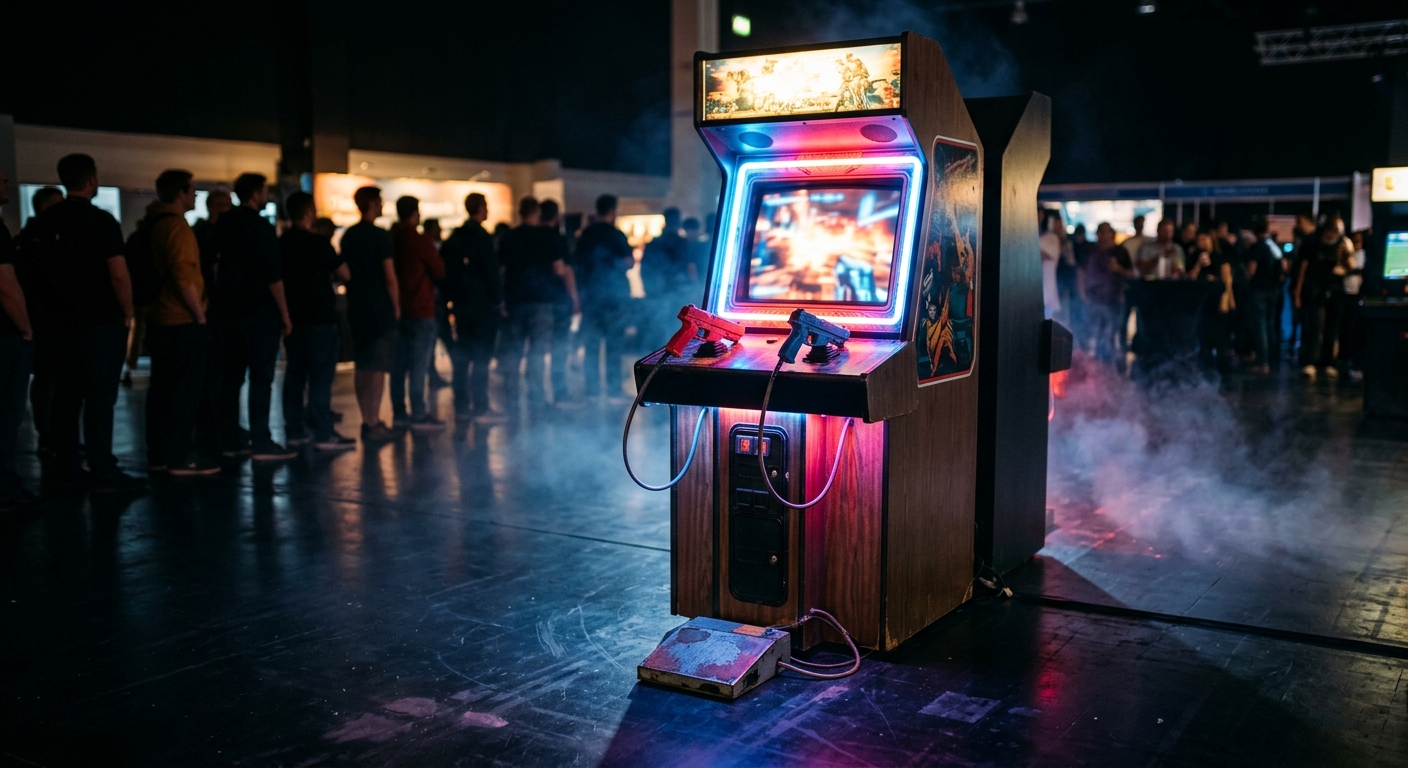
Time Crisis turns 30 in 2025, and Namco is not letting the milestone pass quietly. A confirmed presence at EAG 2026 has the amusement industry paying closer attention than it usually does to anniversary announcements, because the light-gun genre has spent the better part of two decades searching for a reason to matter again. The question is not whether nostalgia is real. It is whether nostalgia is enough.
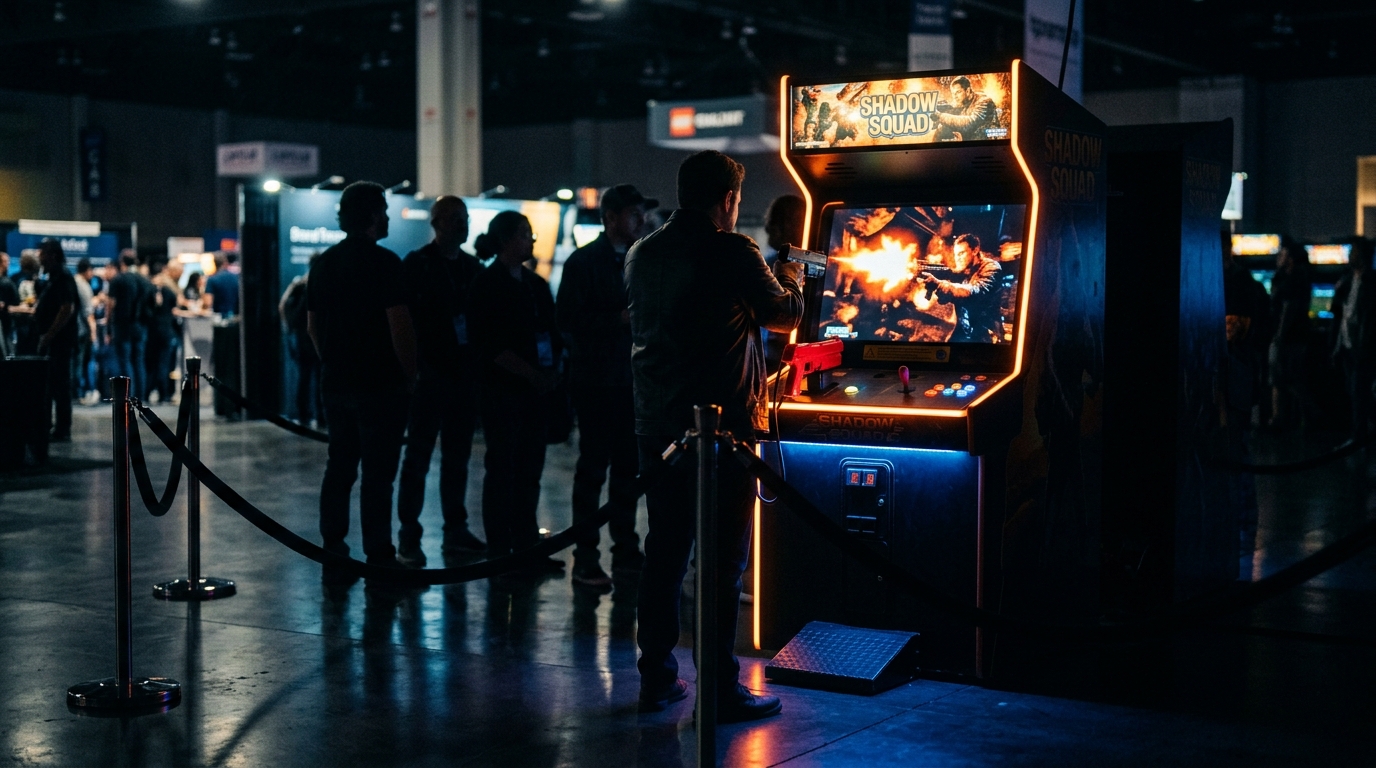
Thirty Years in the Crosshairs
The original Time Crisis landed in 1995 as a direct answer to Sega's Virtua Cop, and it differentiated itself with a single mechanical idea that proved almost absurdly durable: a foot pedal that let players duck behind cover. That pedal is still the series' identity three decades later. Original cabinets still earn on route, which is genuinely unusual for a genre that display technology, cultural politics, and changing player habits should have killed several times over.
The anniversary gives Namco a marketing hook, but it also creates an obligation. Whatever arrives at EAG 2026 has to honor thirty years of the franchise while convincing buyers, operators, and players who have never touched a gun cabinet that this is something worth their floor space and their credit. That is a harder brief than it looks on a press release.
What EAG 2026 Signals for the Industry
The European Amusements and Gaming Expo draws buyers from family entertainment centres, bowling complexes, cinema foyers, and seaside arcades. That venue mix is exactly what determines whether a new cabinet achieves broad placement or sits in a handful of dedicated arcade venues while the manufacturer quietly revises its sales forecast. Confirmed Time Crisis content at EAG has generated genuine anticipation, not the polite interest that usually greets catalogue refreshes.
The geography of the announcement matters too. Namco chose a European trade show rather than saving the reveal for IAAPA or Japan Amusement Expo. That choice signals the company sees real commercial potential in markets where gun-game culture has historically faced more friction than in North America or Japan, where the format's popularity has always been more durable. EAG 2026 is also set to feature a new Pop'n Music cabinet, meaning the show is shaping up as a broader argument that speciality input devices, guns, coloured buttons, motion controllers, still belong on the floor alongside ticket redemption and cranes. Namco is not making that argument alone.
For fans of the wider shooter genre in arcade settings, titles like GoAndZap and the community around Segment Storm have kept the appetite for fast, reflex-driven arcade action visible even during the years when dedicated gun hardware was scarce. That existing player base is not nothing.
The Light-Gun Genre's Long Struggle Back
The commercial collapse of light-gun games in the early 2000s had two causes that reinforced each other badly. First, the infrared and photodiode gun systems of the era depended on CRT screens, and as operators switched to flat-panel displays, accuracy fell apart. Second, post-Columbine sensitivity made venue owners cautious about prominently positioning gun-shaped peripherals, particularly in family-oriented spaces. The genre did not disappear entirely. House of the Dead kept earning, Ghost Squad found a loyal niche, and the Wii Remote gave a generation of younger players some exposure to the basic mechanics without an arcade visit. But the dedicated gun-game section, once a staple of any serious arcade floor, largely vanished.
Modern camera-based and infrared-array systems have largely solved the display-compatibility problem. A new Time Crisis cabinet can be built around contemporary LCD technology without sacrificing shot accuracy, which removes one of the two structural barriers that defined the genre's decline. The cultural question is harder. Players who grew up on console and PC first-person shooters are accustomed to free-roaming environments and persistent progression. An on-rails, cover-based light-gun game offers something genuinely different, but whether that difference reads as refreshing or limiting depends almost entirely on how the experience is framed and priced at the point of play.
It is also worth noting that the space for skill-based, reflex-driven arcade games has not collapsed. Titles like the Asteroids remake have demonstrated that players will engage with mechanically demanding arcade formats when the feedback loop is tight and the design respects their time. Light-gun games have the same potential. The delivery mechanism just needs updating.
Nostalgia as Both Asset and Liability
The 30th anniversary framing is smart, and it is also a trap. The players most energised by the announcement are those who remember feeding coins into the original cabinet, ducking behind that plastic barrier and feeling genuinely clever for surviving a stage. Those players are not the demographic that will determine whether a new release earns back its placement cost. The players who matter most commercially are the ones encountering the franchise for the first time, and for them the anniversary means nothing except a number on a marquee.
Anniversary-driven arcade revivals have gone both ways in recent years. Updated classics and spiritual successors have found healthy placements when the underlying game feel was modernised rather than simply repackaged. They have also stalled when heritage became a substitute for design thinking, producing products that felt like museum pieces with better screens. Namco's brand equity is real and genuinely valuable, but the design assumptions baked into the original Time Crisis formula, long credit-draining learning curves, campy hostage plots, solo-oriented cabinet layouts, may need revisiting for venues where operators have limited floor space and players have limited patience.
If EAG 2026 reveals genuine mechanical evolution alongside the anniversary celebration, new cover mechanics, cooperative modes built for two or three players standing side by side, narrative ambition that goes somewhere beyond the series' cheerfully ridiculous plotting, the industry response could shift the conversation for the entire light-gun category. If the reveal is primarily a nostalgia package with updated visuals, the category stays where it has been: surviving, not growing.
What a Real Revival Would Require
One strong title is not a revival. Industry veterans are consistent on this point. A sustainable light-gun comeback requires multiple manufacturers committing to the format so that operators feel confident dedicating floor space to a gun-game section, knowing that software support will continue and that the section can be merchandised as a coherent attraction rather than a single cabinet island. Time Crisis can anchor that section. It cannot be the only thing in it.
The redemption question keeps coming up in operator conversations. Ticket output has been grafted onto shooter formats before, with results that range from genuinely additive to actively corrosive to the experience. The recurring debate is whether adding prize incentives to a skill-based game enriches the player loop or shifts the motivation away from mastery entirely. There is no clean answer, and the right call probably varies by venue type.
Location-based entertainment centres and immersive entertainment venues represent the most promising newer context for high-end gun hardware. Premium environments can justify higher per-credit pricing, and the physical drama of holding a gun peripheral, the weight, the recoil simulation, the peripheral vision of other players doing the same beside you, feels appropriate rather than awkward in those spaces. A well-designed Time Crisis cabinet with strong cooperative mechanics could function as a centrepiece attraction in that context rather than one machine among many.
Trade-show buzz is not nothing. It generates purchase orders and placement commitments that fund initial production runs. But the amusement industry has always had one real metric, and it is route earnings data six months after placement. That number, pulled from actual machines in actual venues, will tell the story of whether EAG 2026 marked a genuine inflection point for the light-gun genre or a well-executed birthday party. The foot pedal has survived thirty years. Whether it survives the next five depends on what Namco puts above it.
Sources

Priya Nambiar covers competitive gaming and emerging esports ecosystems for GoAndGame, with a particular focus on Southeast Asian scenes and grassroots tournament culture. She came up through community forums before moving into sports journalism, and that background shapes everything she writes.


