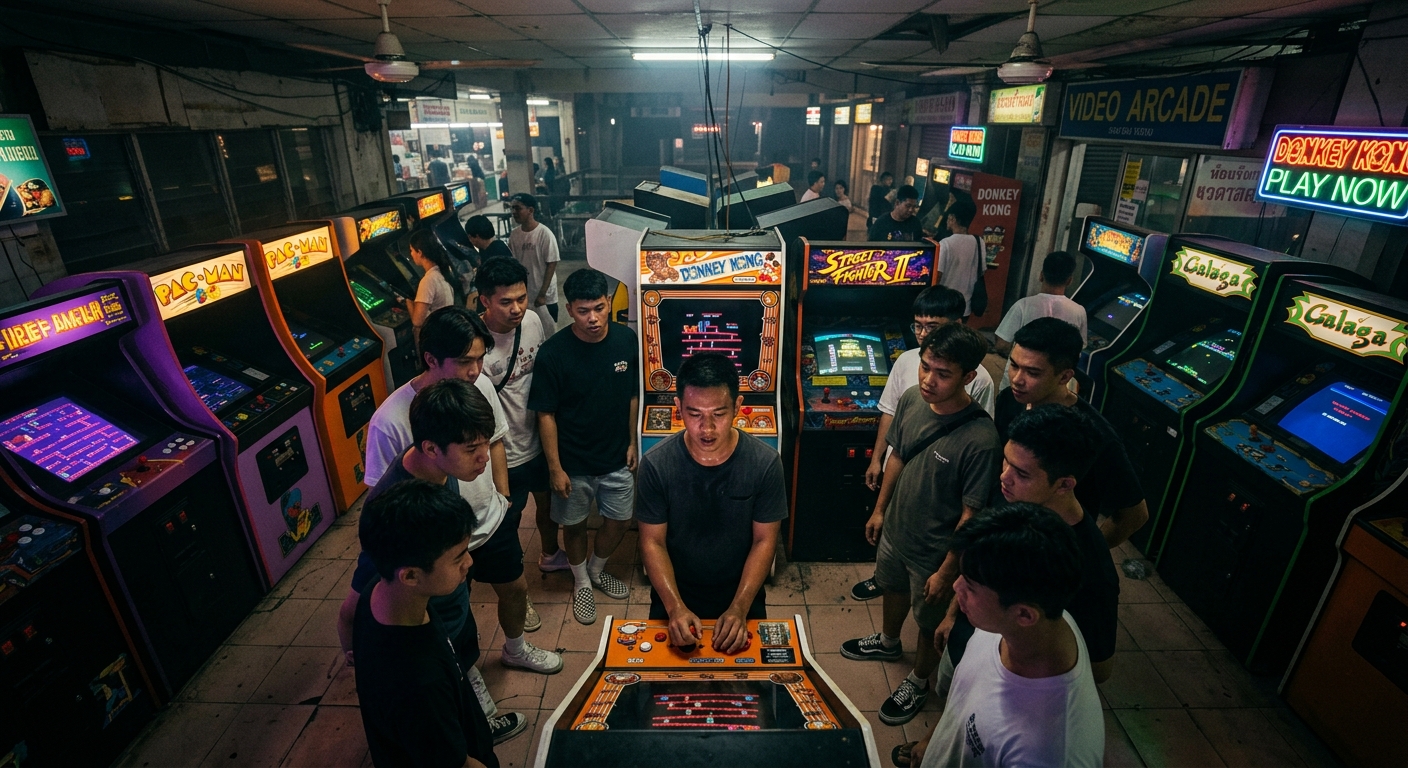
Somewhere on the second floor of a Quezon City mall, a Donkey Kong cabinet from the early 1990s is wearing out its joystick one more time. The monitor runs slightly warm in its color temperature. The regulars know the shift. They have memorized it the way they have memorized barrel arcs and fireball timing windows, which is to say completely, involuntarily, and without any expectation that a record body in Texas would ever care.
The Killscreen and What It Means to Chase It
The killscreen on the original 1981 Donkey Kong arcade cabinet arrives at Level 22, where a bug in the game's timer code cuts the session short regardless of what the player is doing right. No skill overcomes it. No routing shortcut reaches around it. It simply ends the run, and that finality is precisely why competitive players treat reaching it as the ceiling of the craft.
Getting there takes roughly forty minutes of near-continuous correct execution. Four board layouts cycle and escalate. Barrel patterns demand memorization. Fireball timings shift in ways that feel random until they do not. Spring trajectories follow logic that took years for any community to fully document. The physical and cognitive load is real, and the margin for error closes progressively tighter as the loop speeds up.
For competitors in the Filipino and Thai scenes, the killscreen carries a weight beyond the technical. Many of them grew up on bootleg PCB boards, hardware that diverged in subtle ways from the North American cabinets Twin Galaxies was built to adjudicate. Reaching the killscreen on that hardware means mastering a machine that was never quite supposed to be official, and doing so anyway. Several players have privately hit Level 22 in practice. Getting there under conditions any external body would accept as verified is a different problem entirely, and the gap between those two facts is where most of the underground scene's internal tension lives.
Twin Galaxies, Verification, and the Trust Gap
Twin Galaxies has long served as the institutional memory of arcade world records, operating a submission model that asks for video evidence, witness attestation, and adherence to hardware standards that reflect, mostly, what was available in North America and Japan in the 1980s. That model was never designed with regional variants in mind. It was designed for the machines Nintendo shipped to American operators, and everything else exists in relation to that center.
The organization's credibility took serious damage during the high-profile controversies of the 2010s involving record holders whose submissions were later disputed or overturned. The erosion of trust hit the Southeast Asian competitive community at a particularly bad moment, because many players had been approaching formal submission as a real pathway to international recognition. Watching that institution's authority crack made the cost-benefit calculation look very different.
Community leaders in Bangkok and Kuala Lumpur describe submission response times stretching into months, and adjudicators who are unfamiliar with regional cabinet variants rejecting runs on hardware technicalities that locals consider functionally equivalent to accepted boards. The frustration is not primarily about outcomes. It is about the sense that the process was not built to take them seriously in the first place.
The response has been pragmatic. Regional scorekeepers built their own infrastructure: spreadsheets, archived video channels, Discord-based witness pools. The resulting parallel record system operates entirely outside Twin Galaxies' jurisdiction, and it works. Runs get documented. Disputes get adjudicated. The history accumulates. What it lacks is the external stamp that would make it legible to audiences outside the region.
The Hardware Underground: Bootlegs, PCBs, and the Question of Authenticity
Southeast Asia absorbed enormous quantities of unlicensed Donkey Kong PCBs through the 1980s and into the 1990s, manufactured in Taiwan and Hong Kong and distributed through channels that left almost no paper trail. Some of those boards were faithful reproductions of the Miyamoto-designed original. Others ran on altered ROMs, with enemy speeds, point values, or stage sequences that diverged from the reference hardware in ways that are now genuinely difficult to reconstruct.
A small group of hardware archaeologists based in Chiang Mai and Cebu has spent years on this reconstruction project. They cross-reference chip markings against regional distributor records and oral histories from retired arcade operators. The result is a taxonomy of Southeast Asian Donkey Kong hardware that has no equivalent in Western collector literature. It is meticulous, community-driven scholarship, and it exists almost entirely outside academic or journalistic awareness.
The competitive stakes of this work are direct. A player who trained on a board with slightly slower fireballs developed muscle memory tuned to a machine that does not match any international reference standard. Their scores are, in some sense, extraordinary achievements on an undocumented instrument. Some competitors have responded by sourcing original Japanese Nintendo boards through gray-market channels and starting their training over in their thirties and forties. People who know them describe this as admirable and, quietly, heartbreaking, given what it implicitly says about the years of achievement it leaves behind.
The game itself, in its many regional forms, is worth examining as more than nostalgia. Anyone curious about what the classic arcade moment actually felt like might also look at Dot Chomper or Segment Storm for a sense of how that era's design logic translated into different competitive demands.
Community, Cafés, and the Social Architecture of the Scene
The North American retro competitive scene runs largely on conventions and purpose-built barcade venues, which means it is episodic and logistically demanding. The Southeast Asian Donkey Kong community grew inside a completely different social infrastructure: internet cafés, shopping mall arcades, neighborhood kopitiam spots where gaming is folded into ordinary communal life rather than separated from it. The scene did not need to build gathering spaces. The spaces already existed.
That Quezon City cabinet is something close to a pilgrimage site for the Manila cluster of competitors, who meet weekly under conditions that would look unremarkable to anyone who did not know what they were watching. Veterans in their fifties who first played the original cabinet as teenagers now coach players half their age. What passes between them is not only strategic knowledge but institutional memory about which era's hardware behaved which way, and what that means for reading a given score honestly.
Online streaming has begun pulling this localized culture outward. Several Thai and Indonesian Donkey Kong players have accumulated followings on regional platforms that dwarf their visibility on Twitch. The growth trajectory looks more intra-regional than transatlantic, which may be the more durable direction anyway. A scene that grows toward its own audience tends to develop on its own terms.
What Recognition Would Actually Mean
Ask players in the Southeast Asian scene whether they want formal international recognition and the answers get complicated quickly. The underground nature of the community is not just a condition they tolerate. For many, it is a source of identity, and the cohesion it produces is real. Official recognition by Twin Galaxies or any comparable body would bring sponsored events, media coverage from outlets that currently ignore the region, and outside competitors and investment. It would also change the scene's character, and longtime members know it.
The scores being posted in regional competitions are, by careful accounts from people with standing in both communities, genuinely competitive with the upper tier of globally recognized Donkey Kong achievement. At least two or three Southeast Asian players could plausibly place in the top ten of any honestly adjudicated international ranking. That is not a boast from inside the scene. It is an assessment from observers who have looked at the video.
What the community seems to want is not absorption into an existing hierarchy. It is acknowledgment on terms it has set itself, the recognition that decades of play on bootleg boards in Malaysian shopping malls and Philippine side-street arcades constituted real competitive history, whether or not any American record book was watching. The killscreen does not care who issued the PCB. Neither, ultimately, do the players chasing it.
Two Scenes, One Game
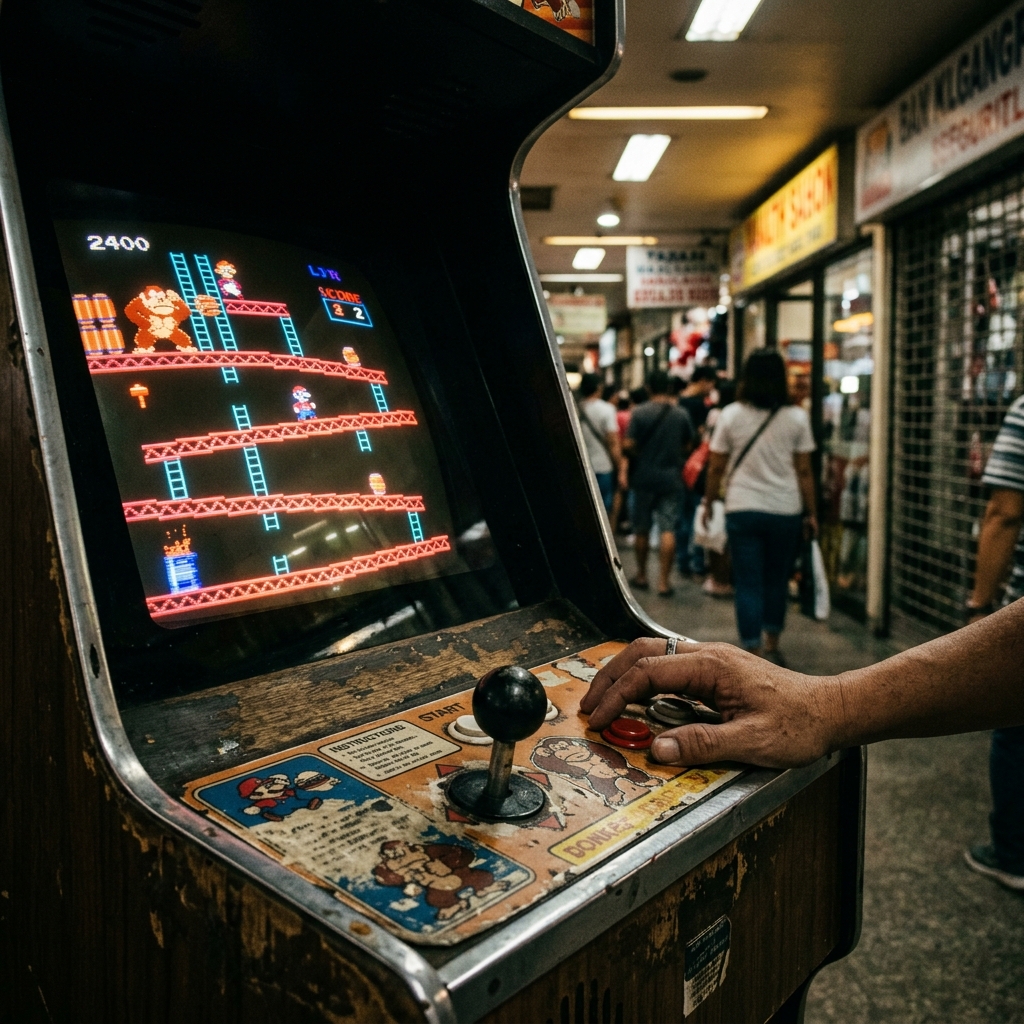

Two scenes, one game, forty years of divergence. The Western retro-gaming world has its conventions and its controversies and its record books. The Southeast Asian Donkey Kong underground has its cafés and its spreadsheets and its Quezon City pilgrimage cabinet. Both are chasing Level 22. Only one of them built the infrastructure to document it on its own authority, and that turn inward, born from necessity, may end up being the more lasting achievement.
Sources

Priya Nambiar covers competitive gaming and emerging esports ecosystems for GoAndGame, with a particular focus on Southeast Asian scenes and grassroots tournament culture. She came up through community forums before moving into sports journalism, and that background shapes everything she writes.


