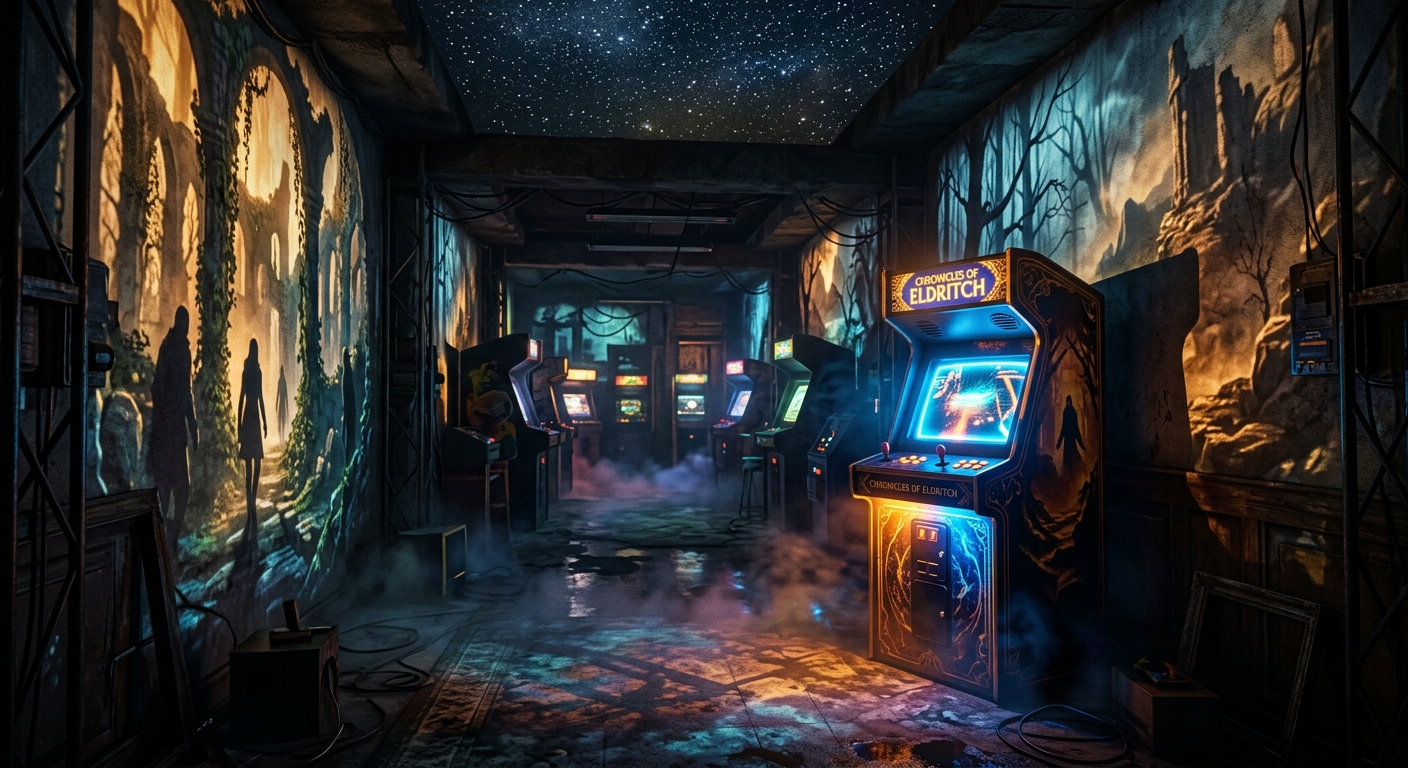
In gaming, telling a story can be as much about what you don't see as what you do. Ambient storytelling shifts the burden of narrative away from dialogue and cutscenes, letting the environment carry it instead. A field of stars implies isolation. A rising tempo implies dread. No text required. The approach is old in instinct and new in execution, and recent research is starting to formalize what designers have been feeling toward for decades.
The Room as Narrator
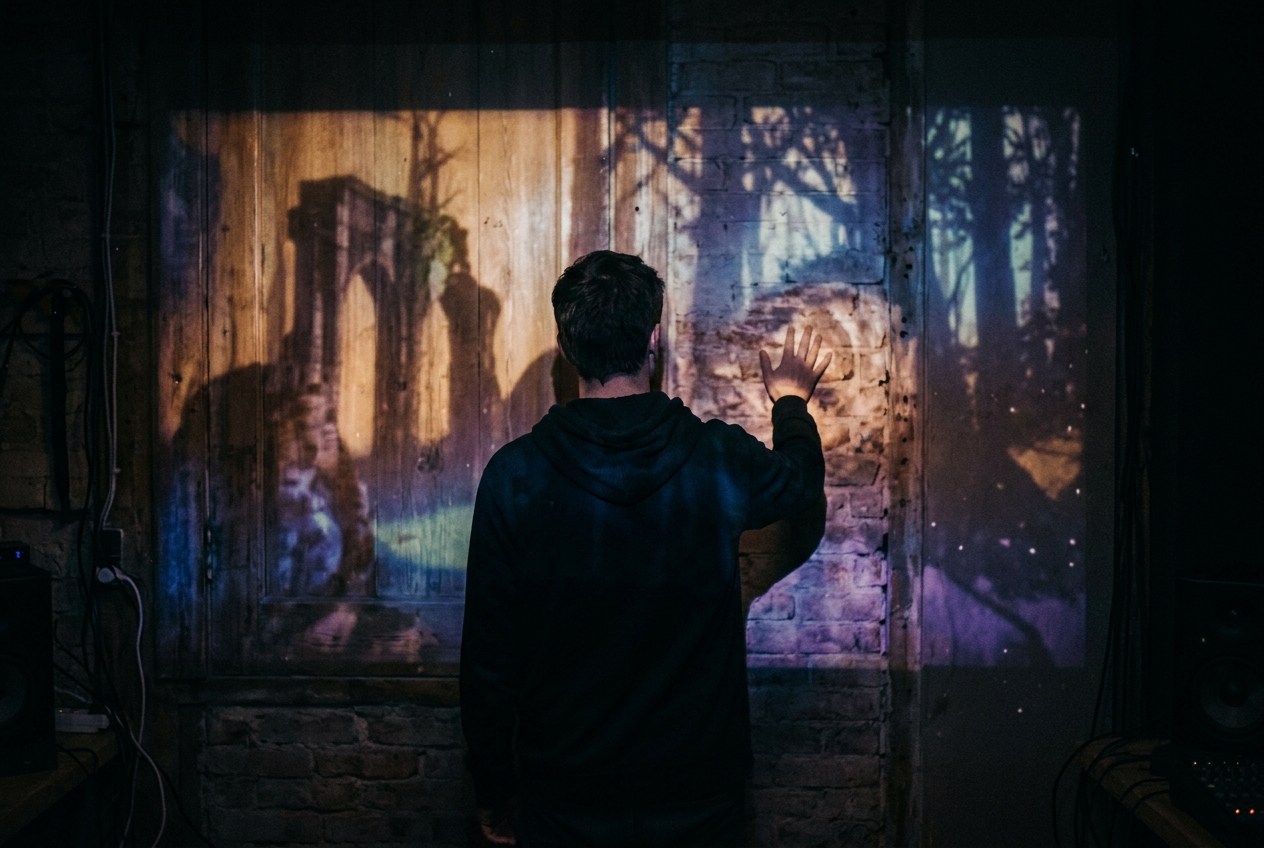
One system pushing this idea furthest is Storycaster, described in a 2025 paper from researchers at UCLA and Microsoft Research. The system turns a physical room into a responsive storytelling environment using cameras, projectors, and a generative AI narrator agent. Walls become canvases. Furniture becomes set dressing. A depth-sensing layer maps projected imagery onto the room's actual geometry, so a stone archway curves around a real doorframe rather than floating flat against it. The narrator agent listens for voice commands and reshapes the scene in response, swapping ambient audio, dialogue, and imagery to match the evolving story. In a user study of thirteen participants, the narrator and the audio were rated the most impactful elements, which says something important: the voice guiding the experience and the sound filling the room mattered more than the visuals.
For arcade designers, the implication is immediate. A cabinet that shifts its lighting color and audio bed based on a player's session length or score trajectory is a modest version of the same principle. The machine stops being a static box and becomes a stage that adjusts its mood without interrupting play.
Ambient Storytelling Versus Explicit Narrative
Explicit narrative hands the player a sentence. Ambient narrative hands the player a room and trusts them to read it. The difference in cognitive load is significant. When a cutscene explains that a city has fallen, the player watches. When the streets are empty, the music has dropped to a single low drone, and every shop window is dark, the player understands the same fact and feels it rather than receives it. That feeling sticks longer.
Classic arcade games already knew this. A scrolling starfield in a space shooter costs almost nothing to render and communicates speed, scale, and vulnerability simultaneously. The tempo of a sound effect tells a player the danger level before any on-screen indicator confirms it. Storycaster's contribution is to apply that same logic to the physical space around the screen, using model-context-protocol servers to coordinate light, sound, and projected image as a unified atmospheric output rather than three separate design decisions made at different points in production.
The challenge is proportion. Environmental storytelling fails when it competes with gameplay rather than supporting it. A wall projection that draws the eye away from the action every thirty seconds is not atmosphere; it is interference. The designer's job is calibration, finding the level at which the environment speaks just loudly enough to be heard without demanding to be watched.
Player Agency Within Atmospheric Worlds
Ambient storytelling only works if the world responds to the player in some perceptible way. A static backdrop, however beautiful, is wallpaper. The moment the environment reacts to a decision or a movement, it becomes a character. Storycaster handles this through live camera feeds that track physical presence and translate position into narrative shifts. Walk toward one wall and the scene it projects deepens. Step back and a different layer comes forward. The player's body becomes an input device for the story.
Arcade games have gestured at this for years through attract mode, the animated loop that plays when no one is at the controls. Attract mode is ambient storytelling aimed at the room rather than the player: it signals what the game is, what it feels like, and who it is for, all without asking anything in return. The moment a player inserts a coin, the contract changes. That transition, from spectator to participant, is the hinge that ambient design must protect. A clumsy shift breaks the spell. A smooth one makes the player feel the world noticed them.
Generative AI as Atmosphere Engine
Storycaster's use of generative AI means no two sessions produce the same room. The image generator, audio narrator, and scene creator components each introduce variability, so a player who returns the following week enters a recognizable system that feels fresh. That variability serves a practical purpose beyond novelty: it prevents the environment from becoming invisible through familiarity. When a background becomes predictable, the brain stops processing it. When it shifts, the brain re-engages.
The risk is coherence. Generative systems can produce elements that are individually plausible but collectively incoherent, a witch's cottage soundtrack playing under a chrome space station visual, for example. Storycaster addresses this through the narrator agent, which acts as an editorial layer, confirming that the generated pieces fit before committing them to the room. Designers working without a system that sophisticated need editorial discipline at the production level instead, building atmosphere palettes and enforcing them across every output channel before anything ships.
Designing for the Edge of Attention
Ambient storytelling challenges designers to treat peripheral elements as first-class narrative tools, not afterthoughts. The art printed on a cabinet's side panel. The direction a sound enters the mix. The color temperature of an idle screen. These details fall outside the player's direct focus, but they accumulate. A player who cannot explain why a game felt oppressive probably encountered a dozen peripheral choices that pushed in the same direction without ever announcing themselves.
Storycaster's user study noted that participants responded strongly to audio, which makes sense. Sound occupies peripheral attention more completely than vision does. A player watching a screen still hears the room. That means audio is the channel most available to ambient storytelling even in settings where projection mapping is not an option. A well-designed audio bed, one that shifts key or tempo in response to player state, delivers ambient narrative to any hardware that has a speaker.
The practical takeaway is simple: design the edges of the experience with the same intention you bring to the center. The wall behind the cabinet, the idle animation, the sound the machine makes when no one is playing. Those are not filler. They are the first thing a player encounters and the last thing they remember.

Alexandra Rivet explores the intricate interplay of games and culture for GoAndGame. A passionate storyteller, she delves into narratives with depth and curiosity. Her pieces often highlight the stories behind the pixels.


