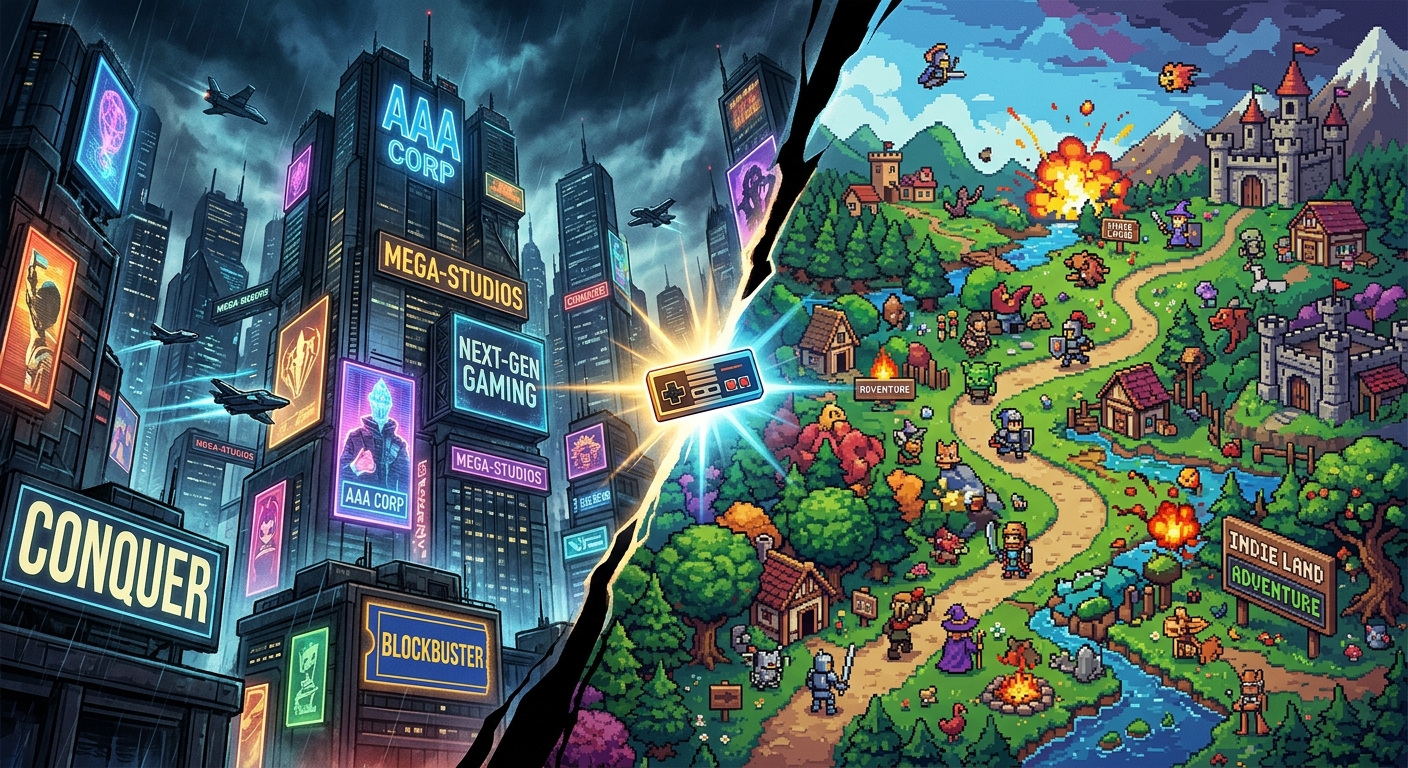
AAA budgets are ballooning. Call of Duty: Black Ops Cold War reportedly cost up to $700 million to produce, and the industry shed more than 10,000 jobs in 2024 alone. Against that backdrop, the question for small indie creators is not abstract: can a two-person studio with a sharp idea survive a market that keeps rewarding scale?
The AAA Gravitational Pull
AAA games today are colossal efforts built by thousands of developers over many years. The industry chases that scale because publishers have convinced themselves, and many players, that value equals hours and square miles. A 20-hour focused game gets called "short." A 90-hour open world with thin systems gets called "content-rich." That framing creates a gravitational pull that distorts everything around it, including how smaller studios pitch themselves to investors, press, and players.
The distortion cuts deepest at the discovery layer. Platform algorithms on storefronts favor titles with big marketing spend and pre-existing follower counts. An indie releasing the same week as a major open-world sequel can disappear from recommended feeds within 48 hours. That is not a content problem. It is a structural one, and it does not get fixed by making a better game alone.
Why 2025 Told a Different Story
Despite that structural pressure, 2025 offered real evidence that the calculus can shift. Into Indie Games reported in October 2025 that indie and AA titles had dominated the year's critical conversation in a way that felt genuinely unprecedented. Clair Obscur: Expedition 33 launched to nearly 150,000 concurrent players on Steam, two days after The Elder Scrolls 4: Oblivion was shadow-dropped, and still earned a Metacritic score of 91. Hollow Knight: Silksong drew close to 600,000 players at launch. Schedule 1, a smaller release with almost no pre-launch hype, exploded to roughly 460,000 concurrent players.
Those numbers matter because they contradict the assumption that players will always choose the largest sandbox available. Rolling Stone noted in January 2025 that games like Balatro and 1000xResist were not simply filling gaps left by AAA developers. They were actively pushing the industry toward new creative territory at a moment when big-budget titles like Concord were failing so fast their servers closed before many players finished a free trial.

The Arcade Lineage as a Competitive Advantage
The structural advantage of arcade-style design is economy. A small team can build a game around one strong mechanic, tune it until it sings, and ship without the overhead that comes with managing open-world asset pipelines. That focus is not a compromise. It is a craft choice, and players who find the right game feel it immediately. A tight scoring loop or a well-calibrated difficulty curve can keep a community active for years, long after an open-world game's map has been fully uncovered and set aside.
Studios like Strange Scaffold, which released 12 games in four years under Xalavier Nelson Jr., have proven that a sustainable release cadence is possible without chasing blockbuster scale. Nelson told Rolling Stone that the AAA model's core problem is the belief that "if you don't make a project too big to fail, you will fail," a self-fulfilling logic that travels down from AAA to AA to indie development, with only the dollar figures changing. Smaller studios that reject that logic entirely, and build around a single well-executed idea, have a genuine edge.
Survival Strategies for Small Studios
Survival requires treating discoverability as a design problem, not an afterthought. Successful indie studios tend to share a few concrete habits. They identify their core mechanic early and resist scope creep before that mechanic is fully proven. They build community during development, not after launch, so that a Day 1 audience already exists. They use early access and crowdfunding not just for funding but for feedback loops that improve the game before it faces a broader market.
The funding question is real. Rising development costs, even at the indie scale, mean that a studio burning through savings on a two-year project is taking genuine risk. Co-operative models, publisher partnerships focused on creative control, and grant programs from regional arts councils have all become part of how careful studios manage that risk without selling away their vision.
- Lock the core mechanic before expanding scope.
- Build a community during development, not only at launch.
- Use early access as a feedback tool, not only a revenue bridge.
- Explore grants and partnership structures that preserve creative control.
- Time releases to avoid direct collision with major AAA launch windows when possible.
None of those steps guarantee survival. But studios that skip them are not just making a harder road. They are ceding the one advantage they actually have over larger competitors: the ability to move carefully, stay close to their players, and make deliberate choices that a 500-person team cannot.
Two Looks at the Same Crossroads
The indie scene in 2025 sits at a genuine crossroads, and two honest readings of the moment are both correct at the same time. The first reading is optimistic. Infrastructure for indie success has never been more mature. Storefronts exist specifically to surface smaller titles. Critical outlets cover indie releases with the same seriousness they bring to blockbusters. And the commercial results from Expedition 33, Schedule 1, and Balatro show that players will find and pay for excellence at any budget level, given the chance.
The second reading is harder. Market consolidation, algorithm-driven discovery, and the sheer noise generated by AAA marketing campaigns still make it easy for a good small game to vanish. The studios that make it through are not just making better games. They are building audiences, managing risk with precision, and treating every release as a long-term relationship with players rather than a one-time launch event. That combination, creative focus plus operational discipline, is what the crossroads actually demands.
Sources

Alexandra Rivet explores the intricate interplay of games and culture for GoAndGame. A passionate storyteller, she delves into narratives with depth and curiosity. Her pieces often highlight the stories behind the pixels.


