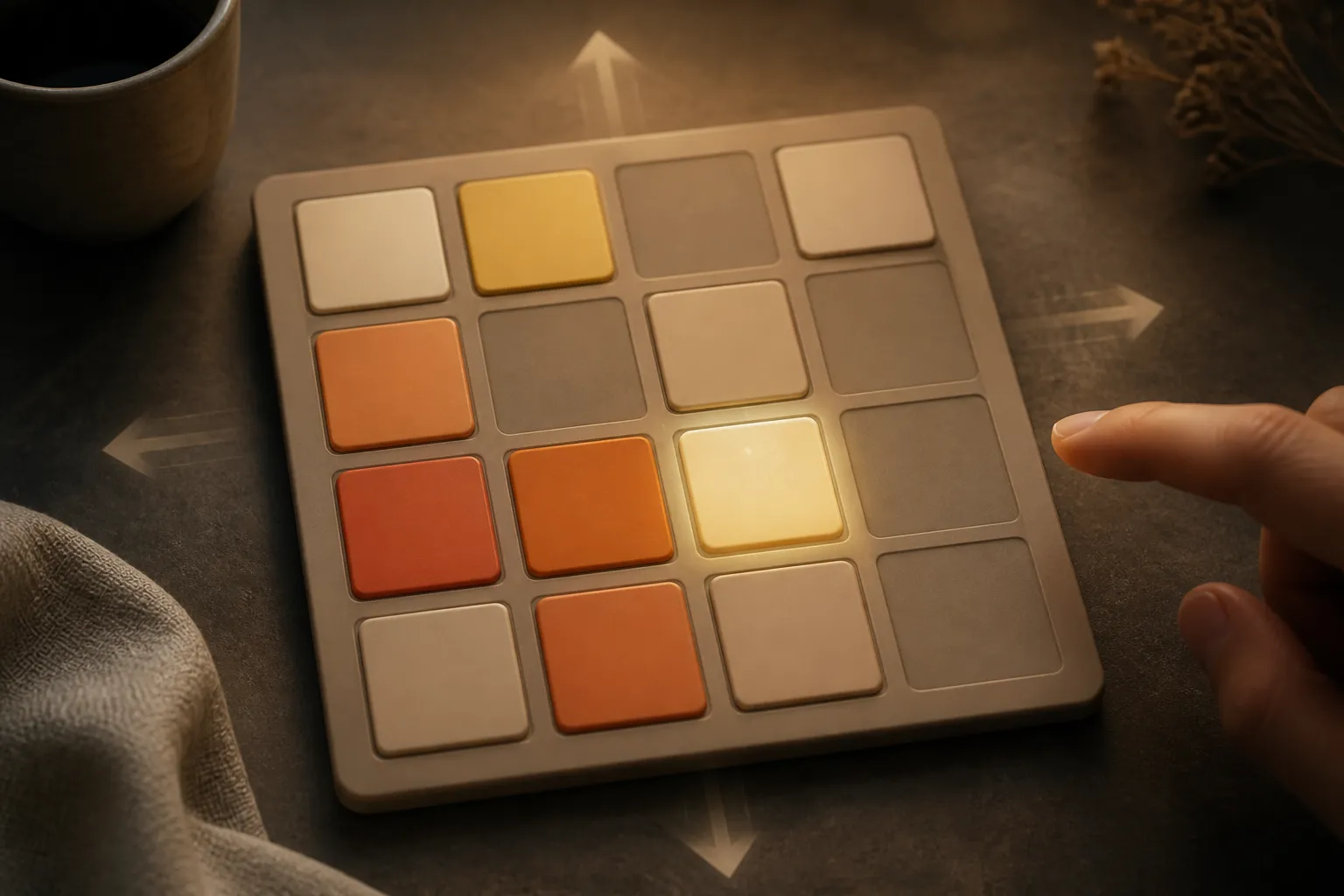
A 2048 board fits in a glance: sixteen squares, a few numbered tiles, and four directions to swipe. The moment after a swipe is harder to picture. A new tile appears somewhere on the grid, changing the choices available next. Gabriele Cirulli’s 2014 puzzle makes that cycle feel simple. Understanding the best move at every point is a much larger task.
- What the player controls: a swipe up, down, left, or right, provided it changes the board.
- What the player cannot control: the new tile that appears at random after a move.
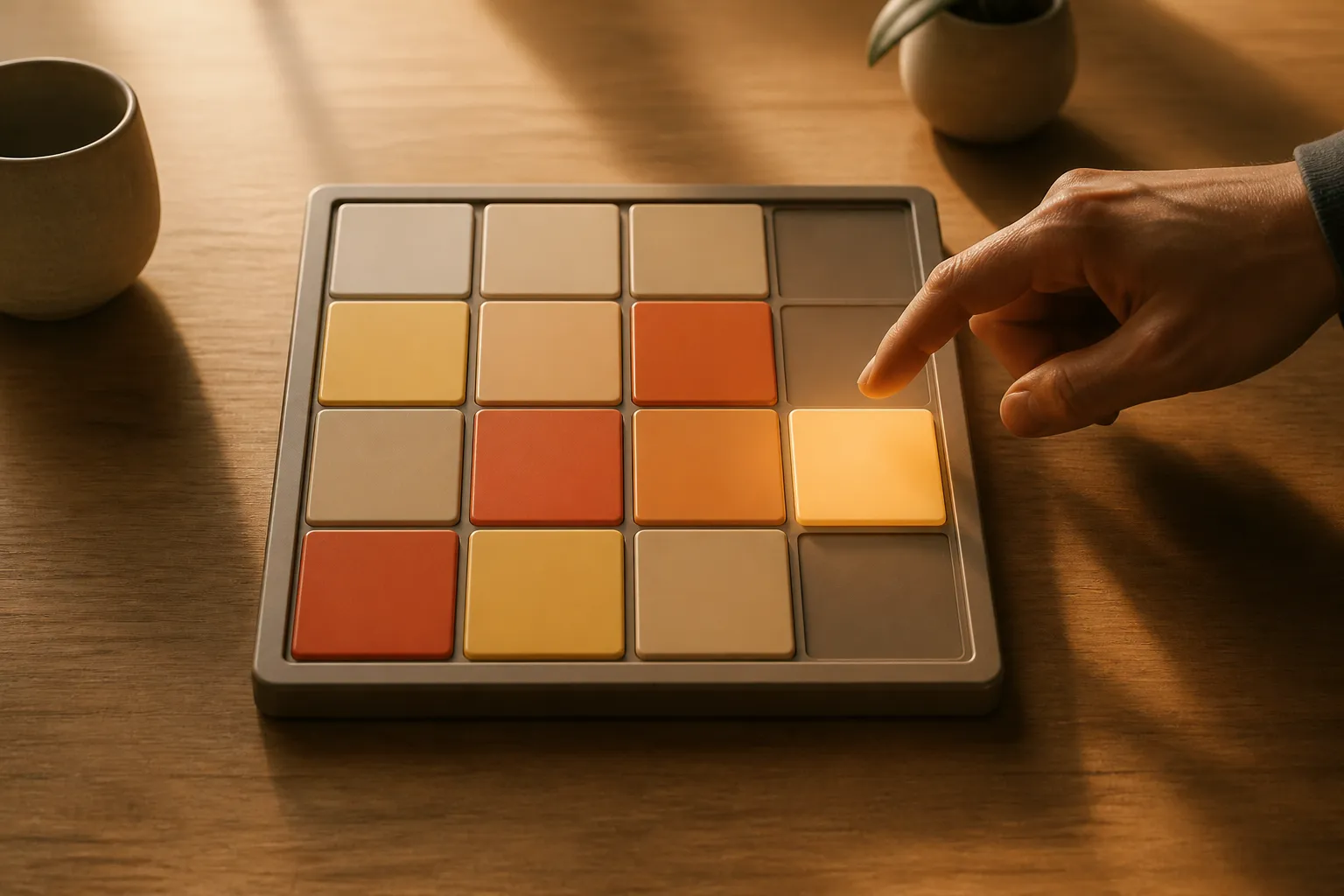
- What pays immediately: merges add to the score and can build toward a 2048 tile.
- What must be protected: room to make another useful move after the next tile appears.
Four directions, many possible futures
In 2048, equal numbered tiles combine when a swipe brings them together. The familiar target is a 2048 tile, though play can continue afterward for a higher score. Each turn asks for one of four directions, but a direction that leaves the grid unchanged is not a legal move. That small restriction matters when the board fills up. A swipe that looked like an escape on an open grid may no longer do anything.
The rules create a rhythm of intention and interruption. A player can arrange tiles for a promising merge, but cannot choose where the next tile lands. A move has to be judged twice: by what it accomplishes now and by the board it leaves for an uncertain next turn. The clean grid shows the result of the last decision. It does not show all the futures that decision has opened or closed.
A model for choices made under chance
One way to study that rhythm is a Markov Decision Process, or MDP. The name describes a framework for making a sequence of choices when outcomes involve chance. In 2048, a state is the current board, an action is a legal swipe, and transition probabilities describe the possible boards after a random tile appears. The reward can record score gained from merges.
The other two ideas look beyond the current turn. A state’s value expresses how promising it is under the goal being studied. A policy specifies which swipe to make from each board. Imagine an immense table with a board configuration in every row and a direction beside it. An optimal policy would fill that table with the best choices for a defined objective, such as reaching a target tile or maximizing score. Those objectives need not favor the same swipe on every board.
This makes “always merge” an incomplete instruction. A merge produces an immediate reward, but the space it creates and the tile arrangement it leaves also affect future choices. The model gives those future consequences a place in the calculation. It does not make them cheap to calculate.
The arithmetic behind the small grid
The number of possible boards grows faster than the grid suggests. If each of the sixteen cells is assigned one of seventeen possibilities, empty or one of the counted powers of two, the straightforward count is 1716. That is about 4.87 × 10¹⁹ arrangements. A published complexity discussion gives 2.56 × 10¹⁹ alongside the same expression, but those figures do not agree arithmetically. The count is also a count of cell assignments, not proof that every arrangement can arise in play.
From any given board, there are two to four legal directions to consider in the cited analysis. Searching several turns ahead means following those choices and the possible random arrivals after them, then doing it again from each resulting board. Even without treating every cell assignment as reachable, the scale explains why a complete lookup table for the full 4×4 game is out of reach for the methods described in the MDP research.
What smaller boards can tell us
The researchers could compute provably optimal policies for 2×2 and 3×3 versions of the game. They could also do so for the 4×4 board when the target was limited to the 64 tile. Those results offer a way to inspect good decisions rather than guess at them. They do not amount to a complete optimal policy for reaching 2048 on the full board.
The smallest board gives a sharp warning about carrying numbers across games. Even with optimal play, a 2×2 game reaches the 32 tile only about 8% of the time. That is a result for a different board and a different target, not a win rate for 2048 on 4×4. The researchers also observe that optimal 3×3 play resembles some strategies used on the full grid, but describe that resemblance qualitatively.
On the full board, players often rely on rules of thumb: take useful merges, keep the largest tile in a corner, and arrange values in an increasing or decreasing order across rows or columns. That last pattern, called monotonicity, can make later merges easier to line up. The cited sources do not compare those named strategies head to head on 4×4, so none comes with a demonstrated full-board advantage here. An earlier analysis in the same research series reports at least 938.8 moves on average to win, but the available account does not explain its assumptions in enough detail to treat the figure as a general promise.
The next time the grid looks orderly, notice how much work that appearance asks of a single swipe. A corner can hold a large tile, a row can line up neatly, and the next random arrival can still change the plan. The puzzle keeps its uncertainty inside sixteen squares.
Sources

Alexandra Rivet explores the intricate interplay of games and culture for GoAndGame. A passionate storyteller, she delves into narratives with depth and curiosity. Her pieces often highlight the stories behind the pixels.


