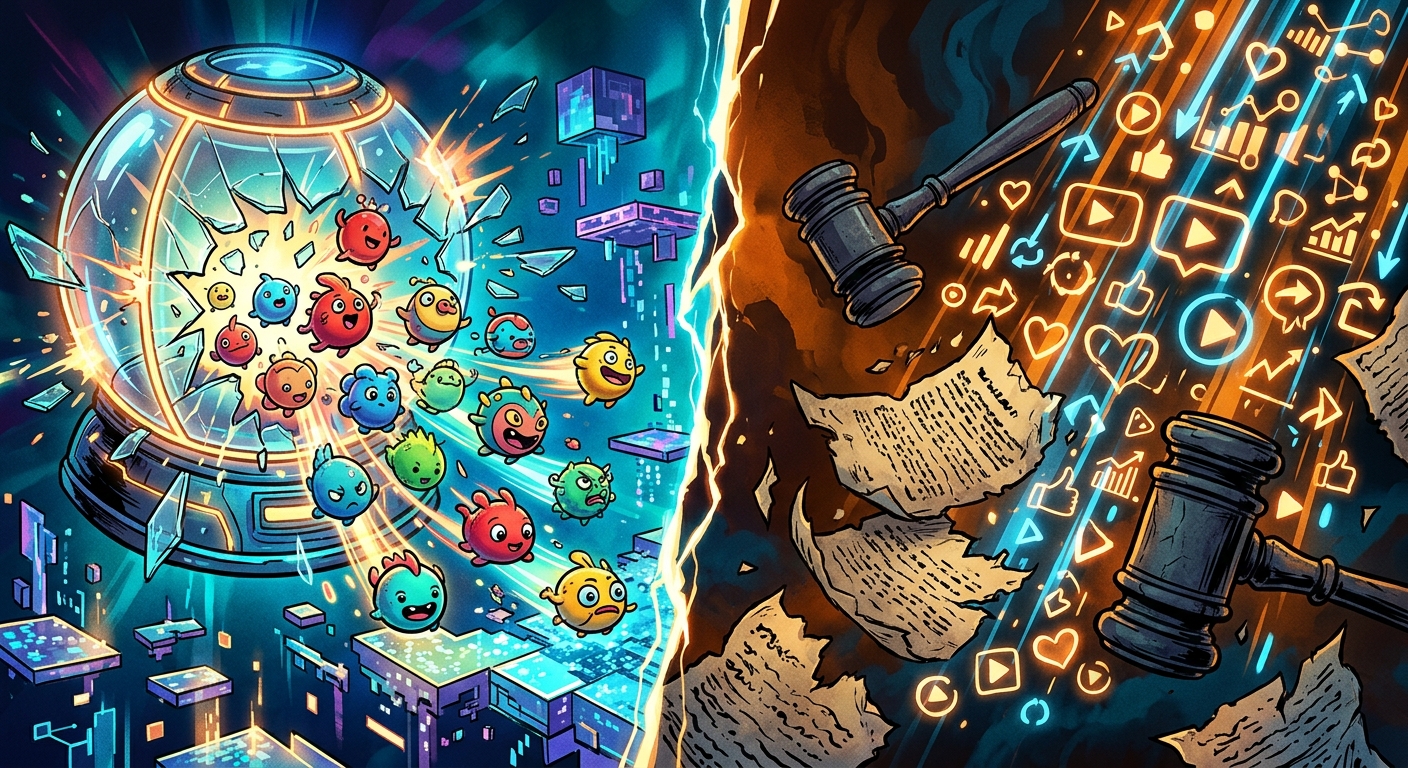
When Palworld launched in January 2024, it did not merely arrive; it erupted. Within days, millions of copies had sold, a velocity driven almost entirely by short-form video algorithms that amplified its provocative visual identity. To many eyes, the creatures of Palworld looked uncannily familiar, triggering a cultural flashpoint that quickly overshadowed its survival-crafting mechanics. This game, developed by Pocketpair, actively courted the discourse, turning every screenshot of a vaguely spherical monster being hurled into a containment device into free marketing. Platform recommendation engines, ever hungry for engagement, treated the controversy as fuel, pushing the game further into feeds already primed for outrage clicks.
This dynamic illustrates a new frontier for intellectual property disputes. The accused product benefits commercially from the very attention the allegations generate. It creates a perverse incentive structure that older legal frameworks never anticipated, a market validation that precedes legal judgment. By the time Nintendo and The Pokémon Company filed their Japanese patent suit in September 2024, Palworld had already banked its windfall. The lawsuit arrived not as a market correction, but as an afterthought to a viral event that had largely run its course.
The Patent Gambit: Why Nintendo Chose Mechanism Over Art
Legal observers immediately noted that Nintendo conspicuously avoided copyright claims, the avenue most of the public assumed would be the obvious weapon. Instead, the company pursued patents covering specific gameplay mechanics, a strategic choice that revealed both the strength and the brittleness of its position. Copyright protection for game characters requires demonstrating that an allegedly infringing design is substantially similar to a specific protected expression. This is a high bar when the accused creatures are distinct enough in color, silhouette, and name to survive cursory comparison.
Patents on mechanics, however, sidestep that difficulty by targeting the how rather than the what. Yet, patent claims in the interactive software space are notoriously hard to enforce. A defendant can often demonstrate prior art or design around specific claim language. Reporting from Techdirt in July 2026 indicated that Pocketpair had done exactly that. The developer quietly updated game systems in ways that undermined the narrowest readings of Nintendo's asserted claims. The choice of a Japanese court also introduced procedural timelines and damage caps, making the suit less financially threatening than a comparable U.S. action would have been. Pocketpair's legal team almost certainly factored this jurisdictional reality into its response strategy from the outset.
The Near-Nothing Verdict: What $30,000 Buys in Precedent
Video Games Chronicle reported in June 2026 that Nintendo and The Pokémon Company were poised to recover as little as $30,000 even in a best-case outcome. This figure, modest relative to the suit's duration and publicity, functioned more as a symbolic statement than a meaningful financial remedy. That number exposes the central miscalculation in Nintendo's litigation calculus. The company appeared to expect that the filing alone would deter Pocketpair and signal to the broader industry that creature-collection mechanics were protected territory. However, the market had already validated Palworld so thoroughly that any deterrent effect arrived years too late.
Legal scholars covering the case noted that a minimal damages award, rather than establishing a chilling precedent, might actually embolden other developers to accept the risk of near-identical suits. They could reason that even a loss costs less than forgoing a potentially viral product launch. For Nintendo, a company whose litigation history is widely studied by competitors and academics alike, the muted conclusion represents an unusual public outcome. This outcome will be cited in future negotiations and cease-and-desist responses as evidence that the company's enforcement reach has identifiable limits.
Inspiration vs. Infringement: The Impossible Line in Iterative Game Design
Every generation of game design is built on the grammar of the generation before it. The joystick arc of a thrown object, the tactile satisfaction of a capture animation, the loop of collect-train-battle are conventions assembled over decades from dozens of sources. No single company invented them whole. The difficulty Palworld's critics face is that 'inspired by' and 'infringing upon' occupy the same creative space in the public imagination, but very different spaces in law. The former is the engine of all artistic progress; the latter requires a specific, demonstrable taking of protected expression or a patented implementation.
Arcade history offers useful perspective here. The mechanics underlying classics like Dot Chomper or Segment Storm were themselves iterations on earlier spatial navigation and avoidance concepts. Yet, the industry treated rapid stylistic and mechanical evolution as normal and healthy, rather than actionable. What has changed is scale and speed. Algorithmic distribution means that a Palworld-style product can reach tens of millions of players before any legal process can respond, fundamentally altering the risk-reward math for both creators who push boundaries and rights holders who must decide whether to act.
After the Dust: Industry Lessons and the Next Viral Flashpoint
The Palworld episode will be taught in game design and entertainment law programs for years. This is not because of what the court decided, but because of what the market decided first. Consumers voted with their wallets before any judge ruled, and that sequence matters enormously for how the industry prices litigation risk going forward. Developers watching the case are likely drawing a clear lesson: ship fast, capture the algorithmic moment. If a legal challenge comes, ensure your mechanics have enough distance from the claim language to survive a design-around. The reputational cost of being called derivative is, paradoxically, often offset by the publicity it generates.

Nintendo's long-term brand depends on the perception that its creative universe is inviolable, and a $30,000 settlement does real damage to that perception. Future negotiating partners will arrive at the table knowing that even a well-resourced, aggressive plaintiff can walk away with almost nothing. The next flashpoint is already forming somewhere in an early-access library or a game jam submission, being refined by a small team that has studied Palworld's ascent as carefully as any business school case study. The question is not whether the pattern will repeat, but which IP holder will be standing across the courtroom when it does.
Sources

Julian Thorne is a seasoned house writer for GoAndGame, known for his deep dives into obscure game mechanics and industry trends. He often explores the sociological impact of gaming, blending critical analysis with historical context.


