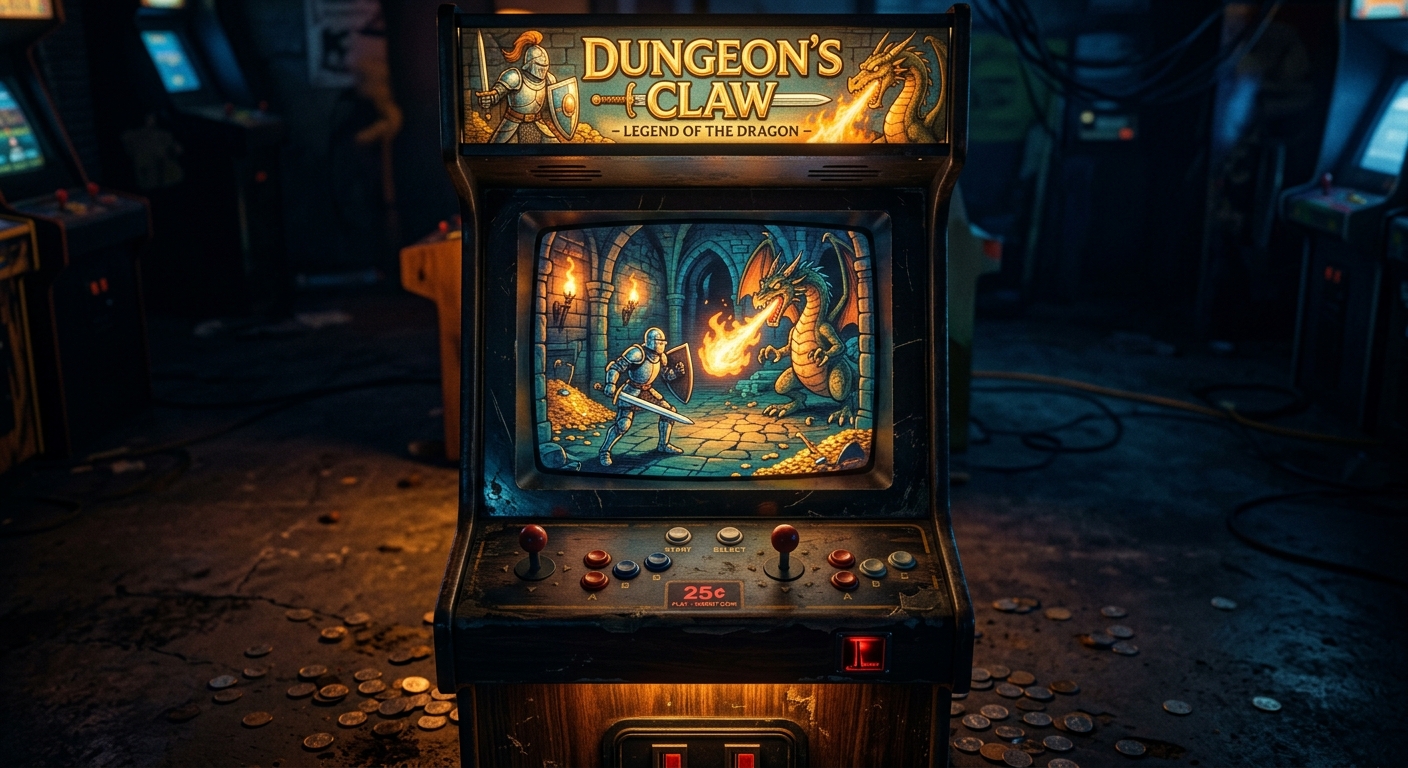
How a laserdisc novelty from 1983 quietly rewired what players expected from an arcade cabinet, and why its brutal, beautiful design still sparks debate among game historians.
A Quarter-Eating Machine Built on Animated Illusion
Dragon's Lair arrived in June 1983 as a genuine spectacle. Don Bluth's lush hand-drawn animation played back from a laserdisc, making the cabinet look less like a video game and more like a Saturday-morning cartoon you could theoretically control. This visual promise was the first and most calculated design choice. Operators reported lines stretching out of arcades because curious passersby could not reconcile the fluid animation with the chunky pixel art they associated with video games, and that curiosity translated directly into coins.
The illusion was carefully managed. Players were not watching a film they could influence freely. They were participating in a tightly scripted sequence of binary moments, each one demanding exactly one correct input at exactly the right frame, with failure punished by a comedic death animation that sent the coin meter clicking upward again. Cinematronics, the publisher, had never shipped anything quite like it. The machine became the arcade's most visible object almost immediately after release.
The Binary Grammar of Life and Death
Where contemporaries such as Pac-Man or Asteroids asked players to navigate a continuous field of spatial decisions, Dragon's Lair reduced agency to a single question repeated hundreds of times: correct direction or wrong direction, sword swing or no sword swing, right now or never. This binary grammar was not a limitation the developers apologized for. It was the architectural spine of the entire experience.
Because the laserdisc could not branch in real time with any sophistication, the design team at Cinematronics and Advanced Microcomputer Systems engineered each scene so that the correct input felt discoverable through a combination of visual cues embedded in the animation and pure memorization across repeat plays. Bluth's animation carried an enormous amount of design weight here: a flicker of light, a character's eye-line, the direction a creature lunged. These were not decorative choices. They were the game's instruction set, hidden inside what looked like cinema.
The result was a tension loop that kept players perpetually one attempt away from the successful sequence they could already half-picture in their mind. Each death felt instructive rather than arbitrary, at least until the room order changed on the next credit.
Level Sequencing as Controlled Chaos
Wikipedia's documentation of the game notes that level sequencing in Dragon's Lair was randomized across plays, meaning the order of rooms Dirk the Daring encountered changed each time the game was booted or a credit was inserted. This randomization served a precise psychological purpose: it prevented any single player from becoming a floor expert whose visible mastery would reduce the mystique of the cabinet and discourage others from trying.
If one teenager could be seen breezing through the game in a fixed sequence, the line behind him might dissolve. By shuffling the rooms, every player's knowledge stayed perpetually partial. The design also extended the effective lifespan of the game's content dramatically. Dragon's Lair's animated assets cost an exceptional amount to produce for 1983. The designers needed those assets to feel fresh across hundreds of plays per machine per week, and controlled chaos was the most economical solution available to them given the hardware's constraints.
This approach also created a social phenomenon on the arcade floor. Players compared notes, argued about room order, and pooled partial knowledge. The cabinet became a conversation, not just a coin sink, and that social energy kept the crowd self-replenishing.
The Spectacle Economy and Its Legacy
Dragon's Lair was reported by contemporaneous arcade observers to have charged a premium per play at a time when most cabinets asked for a standard coin, and operators accepted this because the machine generated revenue at an outsized rate simply through the crowd it attracted. The broader arcade industry had not yet articulated what Dragon's Lair demonstrated clearly: players would pay more for an experience that felt qualitatively different from existing entertainment, not merely incrementally better.
The game's long tail confirms that the core design choices around spectacle, punishing simplicity, and memorization-as-mastery created something genuinely durable. Home ports arrived on DOS in 1989, on the Nintendo Entertainment System in 1990, and on Game Boy Color in 2001. An animated television series followed the arcade release. The Steam version, published by Digital Leisure, carries reviews as recently as the current decade. Each platform stripped away the laserdisc and replaced it with whatever the host hardware could manage, yet the underlying vocabulary, the timed binary prompt, the death animation, the promise of a correct answer waiting to be discovered, survived every translation intact.
That survival is the real argument for Dragon's Lair's place in design history. The laserdisc format became obsolete. The specific cabinet became a collector's item. But the quick-time event, the interactive cinema format, and the idea that players will accept extremely narrow agency if the audiovisual reward is rich enough, all of those remained active tools in game design long after Dirk the Daring stopped drawing crowds at the local mall arcade.
Sources
- Dragon's Lair (1983 video game) - Wikipedia
- Dragon's Lair | ClassicReload.com
- Dragon's Lair (1990 video game) - Wikipedia
- Dragon's Lair (GBC video game) - Wikipedia
- Dragon's Lair on Steam
- Dragon's Lair 30th Anniversary App - App Store
- Dragon's Lair - Videogame by Cinematronics | Museum of the Game
- 'Dragon's Lair' Review

Eliot Reed writes about the intricacies of virtual worlds, blending analysis with storytelling. As a house writer for GoAndGame, he delves deep into game mechanics and narratives, offering thought-provoking insights for players and developers alike.


