
Branching RPGs present a unique philosophical challenge. They promise unlimited player choice, yet operate within carefully constructed narrative constraints. This tension between apparent freedom and underlying authorial control shapes the player experience, often pushing players toward an existential engagement with their virtual selves. Every dialogue option, every quest fork, and every faction alignment appears to offer a genuine path to self-definition, forcing a reckoning with the consequences of one's digital deeds.
The illusion is profound. Players step into a world of ostensible abundance. Dialogue wheels glow with options, maps shimmer with divergent quest markers. All these elements conspire to suggest an open moral universe, a space where individual will dictates destiny. Yet, designers frequently funnel these perceived infinities through what narrative theorists call 'the diamond structure.' Paths fan outwards, only to collapse back into a common story spine, ensuring that production budgets can survive the inevitable onslaught of player curiosity.
The game's authored determinism becomes visible. Players treat the branch not as a moral crossroads but as a costume rack, identity as aesthetic rather than burden.
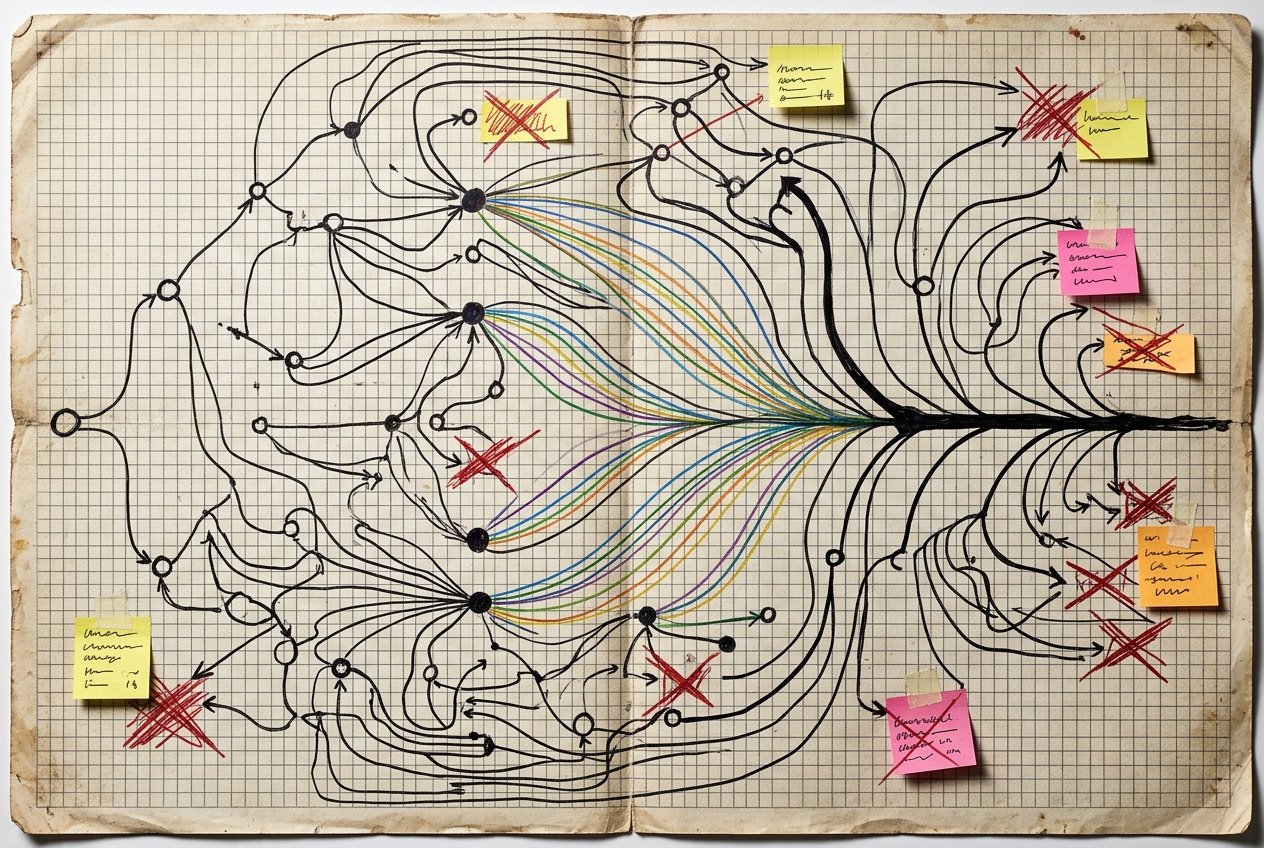
This structural necessity creates an inherent conflict. The player, confronted with what feels like genuine agency, quickly learns the limits of their power. When identical cutscenes follow diametrically opposed dialogue choices, the curtain drops. The game's authored determinism reveals itself. The branch then transforms from a moral crossroads into a costume rack. Identity becomes an aesthetic choice, rather than a genuine burden. This shift is not a design failure. It is an honest confession: all authored narrative, even interactive forms, is a controlled experiment. The author has already run the trials, presenting a curated version of possibility.
The Illusion of the Fork: How Branching Structures Manufacture Meaning
Sartre argued that existence precedes essence. We are condemned to choose, therefore condemned to be responsible for what we become. Branching RPGs literalize this anxiety. They attach stat consequences, companion reactions, and world-state flags to every selection. The weight of selfhood feels mechanical and trackable, unlike real life. This scaffolding makes choice consequential. It also reveals its limitations. The apparent agency collapses into the appearance of agency.
Sartre, Kierkegaard, and the Save-Scummer: Philosophies of Commitment in Interactive Fiction
Kierkegaard's stages of existence map surprisingly well onto branching RPG players. The aesthetic player chases spectacle. They reload saves to collect every cutscene variant and romance option. Choice becomes entertainment, not obligation. The ethical player commits to a single run. They accept consequences as binding, even with easy escape hatches.
Save-scumming is the dominant mode of aesthetic play. It is philosophically subversive. Practitioners rarely articulate this. By refusing to let decisions stick, the save-scummer denies the game's central premise: that choice has weight. They treat the branching structure as a vending machine, not a tribunal. Game narrative designers are aware of this tendency. They develop countermeasures. Some systems use timed dialogue prompts. These expire before deliberation, forcing impulsive commitment. Others remove manual saves, making every choice permanent by architectural fiat.
These mechanics raise a deeper question. Does forced commitment produce the phenomenological experience of responsibility? Or is it merely a simulation? A player who cannot reload is not necessarily more ethically engaged. They may simply be more frustrated. Their relationship to the narrative becomes resentment, not investment. Genuine moral weight, Kant insisted, requires the real possibility of having chosen otherwise.
Subverting the Author: Speedrunning, Sequence-Breaking, and the Player as Antagonist
The branching RPG is a playable philosophical argument. The speedrunner acts as its most committed heckler. Speedrunning transforms the designed choice-space into an obstacle course. The goal is not rich narrative, but the fastest path through or around authored intentions. Glitches become tools. Dialogue skips become virtues. The moral architecture of the branching structure is exposed as surmountable code.
This practice is more than vandalism. It draws from a critical tradition: Situationist détournement. This treats subversion of a system's intended use as commentary. A speedrunner might skip a pivotal moral choice by clipping through geometry. They are making an argument. The choice was always optional. Its weight was performed. Its consequence was a designer's preference, imposed under the guise of freedom.
Sequence-breaking produces a disorienting philosophical effect. Players reach late-game areas through unintended paths. The narrative context for these areas is missing. A climactic boss or revelation appears without emotional scaffolding. The scene's impact does not land. This reveals how much a story's meaning is procedural. It depends on specific information order, not inherent content. Designers have begun to incorporate this adversarial relationship. They build games that acknowledge the player's power to break the fiction. This acknowledgment becomes narrative material. The fourth wall becomes a load-bearing structure in the narrative. For examples of games that bend expectations, consider the tight, impactful design of classics reimagined, like Star-Dive.
The Ethics of the Unfinished Path: Guilt, Completionism, and the Moral Texture of Unexplored Branches
Completionist culture drives players to exhaust every branch and unlock every achievement. It introduces an ethical dimension rarely anticipated by designers. Players treat the branching RPG as a checklist. In doing so, they inadvertently expose the game's truth. Its branches were always content, never consequences.
Yet, the unexplored branch haunts in unique ways. Players who make a specific moral choice and never return to see the other path report something similar to regret. It is not remorse for a real-world action. It is a nagging curiosity about a self they did not become, a world-state they did not author. This is a remarkable psychological achievement. It stems from a medium built on polygons and flag variables.
Philosophers of narrative, like Paul Ricœur, argue that identity forms through story. We become who we are by the tales we tell about ourselves. This includes the choices we claim. In branching RPGs, this process externalizes. It becomes legible. The save file is a narrative self. The branch taken is a biography. The branch abandoned is a road not traveled. It continues to exert a gravitational pull. The most sophisticated RPGs exploit this guilt directly. They design content that exists only in paths players are least likely to take. The most philosophically rich material hides in uncomfortable, costly, or narratively risky choices. Ethical courage offers a more honest game, not merely a better ending.
Designing for Resistance: How Studios Can Build Systems That Respect Player Intelligence
The practical question for narrative designers is how to make choices genuinely generative, beyond cosmetic variation. Contemporary game narrative design literature emphasizes systemic coherence. This includes frameworks emerging from communities like Generalist Programmer. It ensures world-state variables propagate through enough downstream systems. Players can then detect the ripple of decisions in unexpected places, long after the choice moment.
'Silent consequence' is one effective technique. These are changes to the game world resulting from player choices, never explicitly flagged. An NPC might vanish from a market because a player's earlier decision destabilized the region's economy. No notification or achievement pop accompanies this. It creates a different phenomenology than a banner proclaiming "Your Choice Mattered." The former demands player attention. The latter dictates what they should feel.
Resistance to player manipulation need not be punitive. Effective design pushes back meaningfully against save-scumming, completionist exhaustion, and narrative tourism. Games that make the cost of reversal visible engage players in a metacognitive relationship with their own decision-making. This relationship is philosophically interesting in itself. Imagine the strategic depth of Segment Storm or the nuanced progression of Dot Chomper, where every choice, even seemingly minor ones, carries a weight that subtly alters the unfolding experience.
Ultimately, the most ambitious goal for branching RPG design is to create an irreducible structure. A game whose meaning cannot be fully extracted by any single playthrough. No guide, no YouTube compilation of endings, can capture it. Meaning lives in the specific texture of the journey taken. It resides with a specific player, their tendencies, and their failures of nerve. This is not merely a technical problem. It is an artistic one.
Sources
- Game Narrative Design: Complete Storytelling Guide 2025
- Narrative Games: Story-Driven RPGs Where Your Choices Matter
- https://dl.digra.org/index.php/dl/article/download/2275/2272/2290
- https://dl.digra.org/index.php/dl/article/download/2629/2622/2658
- 2025 Papers and Abstracts – Video Game Cultures
- https://arxiv.org/pdf/2603.18398
- Client Challenge
- Exploring Existentialism in Video Games: Finding Absurdity in NieR: Automata

Julian Thorne is a seasoned house writer for GoAndGame, known for his deep dives into obscure game mechanics and industry trends. He often explores the sociological impact of gaming, blending critical analysis with historical context.


