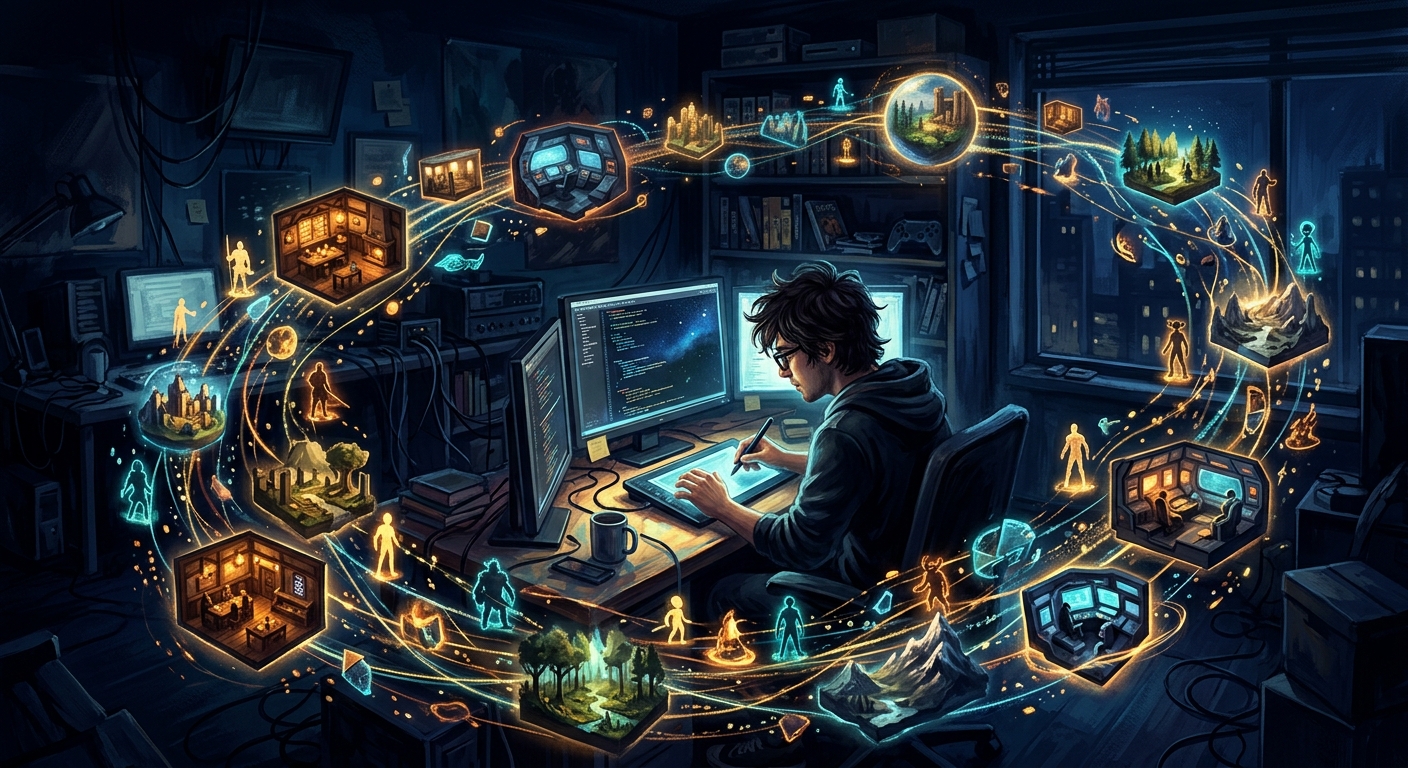
From game-jam experiments to critically celebrated releases, independent developers are rewriting the rules of narrative design, one hand-crafted world at a time.
A New Grammar for Interactive Stories
Indie developers have spent much of the last decade dismantling the assumption that compelling storytelling requires blockbuster budgets. The year 2025 made that argument more convincingly than any year before it. While major studio narrative games still tend to rely on motion-captured cutscenes and scripted dialogue trees, smaller teams are experimenting with environmental cues, procedural text, and player-driven consequence systems that feel genuinely alive. Critics and players have reached for the phrase "immersive storytelling" as shorthand for this approach: a mode of play where the world communicates its history and stakes through every texture, sound cue, and NPC behavioral loop instead of through exposition dumps. Into Indie Games' Indie Games of the Year 2025 feature, published in December 2025, captures that energy directly, with staff writers describing titles that "made us look inwards" and "reminded us why indie games are the most exciting and innovative space in the art form."
What connects the standout titles cited in that feature is a shared refusal to treat story as a layer placed on top of gameplay. Instead, the narrative and the systems are the same thing. A room that resets daily but retains the player's knowledge, as in Blue Prince, is not a puzzle mechanic with a story attached. The mechanic is the story. That distinction matters, and it is the clearest signal that something structural is shifting in how independent developers think about their work.
Game Jams as Proving Grounds
Nowhere is the energy around immersive indie storytelling more visible than in the game-jam circuit. Time-boxed constraints force developers to strip projects to their most essential communicative gestures. The Immersive Storytelling Spring 2025 jam, hosted on itch.io by organizer MayaGeorgieva, attracted nineteen submissions spanning browser-playable experiments, Windows builds, macOS ports, and a Linux entry. That platform diversity reflects how accessible modern development tooling has become, and it reflects something else: immersive storytelling is not the property of any single engine or operating system. It is a design ambition that travels.
The submissions themselves ranged widely in subject matter. Entries included a first-person experience following a young woman navigating a commute safely, an ecological simulation casting the player as an elephant in a destabilized savanna, and an interactive fiction piece built around the conventions of institutional listening. What united them was a commitment to making the player feel consequence rather than simply observe it. Participants used the jam's tight April-to-June window to prototype ideas that would be commercially risky at scale, including interfaces that degrade as a character's mental state deteriorates and environments that record and reflect player behavior back without comment.
What "Immersive" Actually Means in Practice
The term risks becoming a marketing buzzword, so it is worth being specific about what these developers are actually building. At its core, immersive design means every system in the game carries narrative weight. Movement speed, economy, audio fidelity, UI layout: all of it can and does mean something. The story is not something that happens between gameplay sections. It emerges from the gameplay itself. A shopkeeper adjusting prices based on rumors the player has spread is one example. A soundtrack that loses fidelity as a protagonist deteriorates is another. These details distinguish immersive design from games that simply attach a story to a genre chassis.
Developers working at small scale often describe their team size as an advantage in this regard. Fewer collaborators means fewer opportunities for tonal inconsistencies. A two-person team building a game about grief can ensure that the font choice, the save-file naming convention, and the ambient sound design all speak the same emotional language. At larger studios, those decisions pass through enough hands that coherence becomes a managed risk rather than a default condition. The jam format compresses that advantage further: nineteen teams, each solving the same brief, produced nineteen distinct answers to the question of what it means to make a player feel something through systems rather than through cutscenes.

The Critical and Commercial Reckoning
Into Indie Games' year-end feature underscored a broader critical shift: the titles generating the most passionate reader responses in 2025 were those that made players feel like active participants rather than consumers of a pre-written plot. The feature's editorial team described Blue Prince, one of its picks, as "a masterclass in visual storytelling" with "immersive gameplay that bleeds into the real world." That phrase, gameplay that bleeds into the real world, is a useful marker for what the most ambitious immersive indie games are attempting. They do not end when the player closes the application. They leave residue.
Commercially, the picture is more complicated. Deeply narrative indie games often find their audiences through word-of-mouth rather than launch-day sales spikes, making traditional success metrics a poor fit. A game that rewards a second or third session more than the first does not benefit from the same promotional infrastructure as a game designed to impress in a two-minute trailer. Some developers have adapted by leaning into the jam-to-release pipeline, using public jam builds to build communities before committing to a full release. Others rely on festival showcases and critical coverage to carry the weight that marketing budgets cannot.
Heading into 2026, the tools, the community infrastructure around jams and showcases, and the critical vocabulary for discussing this work have all matured at the same time. Development environments that once required specialized knowledge are now accessible to developers with limited formal training. Critics have developed more precise language for evaluating systemic narrative, moving past binary assessments of whether a game "has a good story" toward questions about coherence, intentionality, and the relationship between mechanics and meaning. That convergence creates conditions for immersive indie storytelling to move closer to recognition as a self-sustaining genre, one defined not by a single aesthetic or subject matter but by a shared conviction that the best way to tell a story through a game is to make the game itself the story.

Eliot Reed writes about the intricacies of virtual worlds, blending analysis with storytelling. As a house writer for GoAndGame, he delves deep into game mechanics and narratives, offering thought-provoking insights for players and developers alike.


