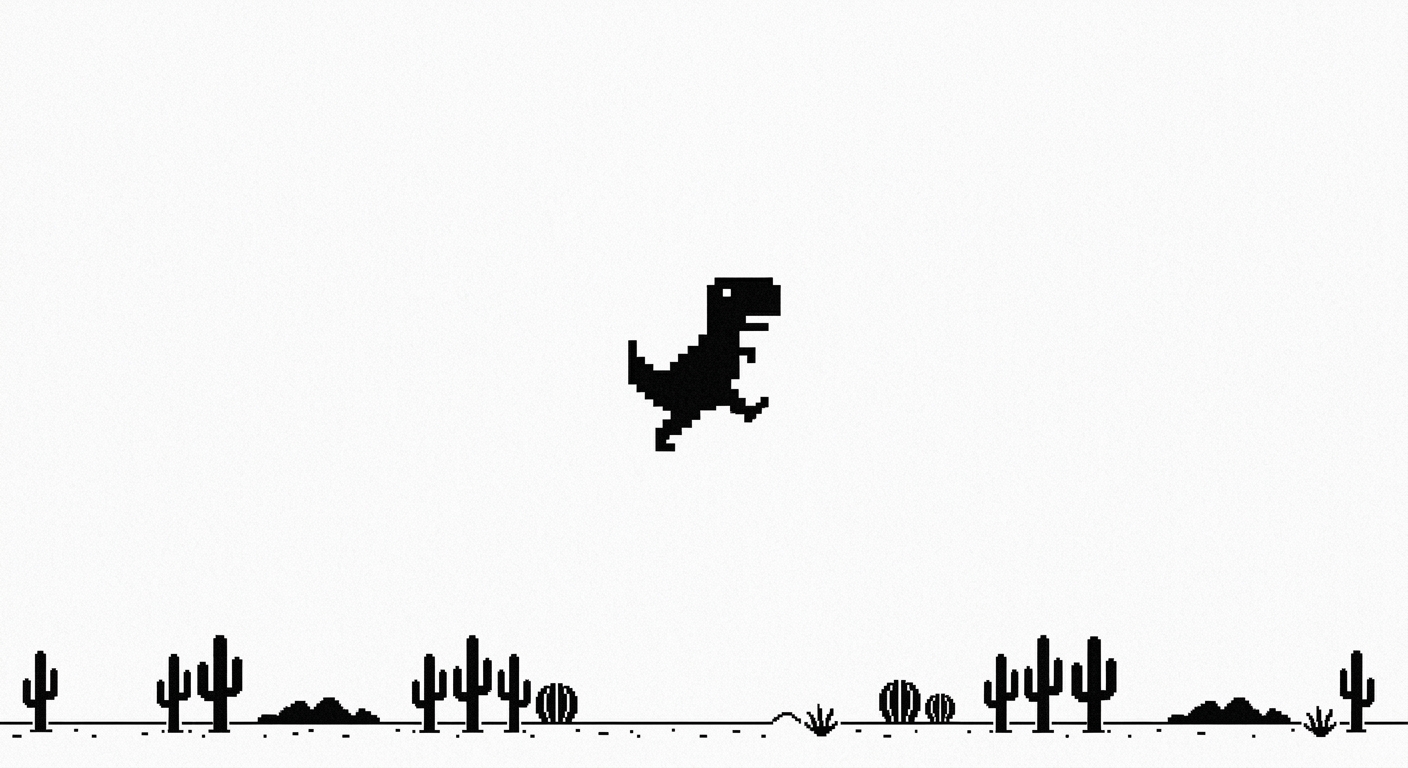
The connection drops, the page stops loading, and Chrome offers a small dinosaur standing in a wide stretch of white. Press the spacebar and it runs. The tab that failed to deliver what you wanted now asks for your attention on different terms. Chrome’s Dino game makes a curious bargain: it cannot restore the internet, but it can give your hands something to do while you wait.
A glitch becomes a feature
The game arrived with Chrome 38 in September 2014. Its creators, Alan Bettes, Edward Jung, and Sebastian Gabriel, put it where a user would ordinarily find an error message. According to a history of the game, early designs carried the nickname Project Bolan, after Marc Bolan of T. Rex. That private joke suits the finished dinosaur: small, recognizable, and a little more charming than an explanation of a failed connection needs to be.
The placement is the important design decision. An offline page catches people in the middle of another task. They may be trying to send a message, check a route, or finish work. Chrome cannot assume they came looking for entertainment, so the game asks for almost nothing. There is no menu to navigate and no story to catch up on. One key turns an interruption into a run.
Built for the connection that failed
That tiny invitation did not reach everyone at first. The original game would not run on older Android devices. The team rewrote it, with an updated version ready by December 2014. For a feature meant to make a frustrating moment easier, that limitation mattered. A consolation prize is less useful if it disappears on hardware that already has fewer comforts.
The rewrite also reveals how much work can hide inside something that looks disposable. Dino’s plain shapes and sparse page are part of its character, but simplicity on screen does not make compatibility automatic. The game had to respond quickly on devices with different capabilities, inside a browser that people opened for reasons other than play. Its smallness was a design constraint, not a lack of ambition.
One key, then another cactus
The controls are easy to grasp while the page is still settling. Space starts the run and makes the dinosaur jump; the up arrow jumps too. The down arrow ducks. Cacti supply the first lesson. Later, flying obstacles make ducking useful, changing the player’s decision without adding another button. A web replica of the game presents the same compact set of inputs, now available without the original excuse of a lost connection.
As the run speeds up, the generous first impression gives way to concentration. You begin to measure the distance to a cactus by feel. A jump made too early leaves the dinosaur landing in trouble; a late one never clears the obstacle. There is no need for a tutorial because each collision explains the rule. The next attempt begins almost immediately, which makes failure feel less like a verdict than a request to try again.
That rhythm has an arcade lineage. Games such as Dot Chomper also make familiar movements demanding through timing and repetition. Dino carries that idea into a peculiar venue: an error page. The score matters for as long as the run lasts, but the run was never the reason you opened the tab.
An arcade that travels with the browser
Once people knew the dinosaur was there, waiting for a genuine outage became optional. Chrome’s developer tools could simulate an offline connection, and fan-made versions brought the run to ordinary websites. The browser’s little apology had become something people sought out. That shift is part of Dino’s appeal: a game designed for a moment of absence proved enjoyable even when nothing was missing.
Its cultural footprint comes from that unusual doorway. There was no download to weigh up and no separate game to remember to launch. Dino appeared inside a routine inconvenience shared by people who might never call themselves players. For a few seconds, a stalled page offered a clear goal, a quick mistake, and another chance. When the connection returned, you could go back to the task you had meant to do. The dinosaur would be there for the next interruption.

Alexandra Rivet explores the intricate interplay of games and culture for GoAndGame. A passionate storyteller, she delves into narratives with depth and curiosity. Her pieces often highlight the stories behind the pixels.


