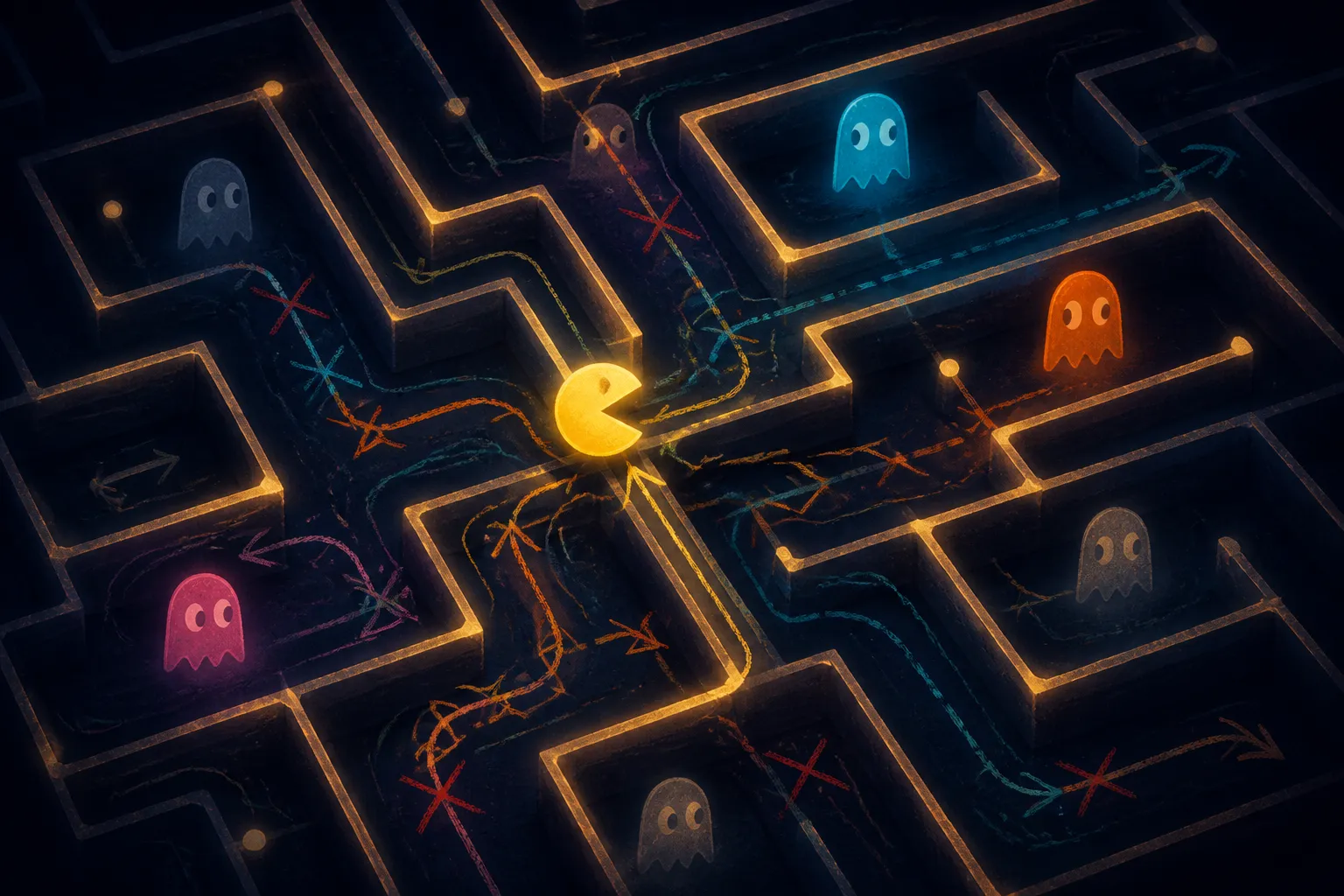
Everyone wants a route. A fixed line through the maze, memorized, repeated, and rewarded. After reading through the guides and references on Dot-Chomper, I came away with a more useful idea: treat every route as a guess you can test. Here is what the numbers support, and where they run out.
Why Memorized Patterns Only Go So Far
Original Pac-Man ghosts are deterministic. Give them the same inputs and they make the same moves. That is why players built fixed move sequences, called patterns, and replayed them. The Pac-Man Dossier is the standard reference for why this works (The Pac-Man Dossier).
Billy Mitchell's perfect 3,333,360 in 1999 is the famous example, and the detail is worth noting. According to the Dossier, he got there without memorized patterns, relying on his knowledge of how each ghost moves. Understanding beat recitation.
Now the catch. None of the sources tell us whether Dot-Chomper's ghosts use the original AI. One GoAndGame guide even warns the game may not follow original rules (Planning Pellet Paths). So any transfer from Pac-Man to Dot-Chomper is an open question, not a given.
Ghost Phases and Pellet Timing
Ghosts alternate between scatter, where they head for their corners, and chase, where they come after you. The same corridor can be safe in one phase and a trap in the next. That is the whole reason a route has to be checked against the clock, not just the map.
Timing matters for pellets too. A GoAndGame guide says eating one during scatter spreads the ghosts out, which makes a multi-ghost chain harder. Eating one when two or more ghosts converge on your corridor overlaps the frightened timer with more targets (Stop Panic-Eating the Power Pellet).
The same guide argues that a power pellet is a scheduled resource, not an emergency button, and that this separates competitive routing from survival play. Its concrete advice: hold at least one pellet until the dot count drops below thirty. Dot-Chomper's pellets sit at four fixed corners, which makes scheduling plausible.
What we do not get is numbers. Scatter, chase and frightened durations are not given. If you want them, you will need a stopwatch and some patience.
Chain Scoring and the Multiplier Math
Frightened ghosts are worth 200, 400, 800 and 1,600 points in a chain. Add that up and four ghosts pay 3,000, about 8 times one ghost at 200 and not 4 times. The last ghost alone is worth as much as the first three combined plus a bit more. That is why chain setup matters more than any single catch.
Dot-Chomper layers its own system on top. Scoring depends on chain streaks and multipliers, and the multiplier scales with consecutive dots collected without a gap in movement. Stages contain two to four multiplier windows (Why Your Dot-Chomper Score Is Stuck).
The guide also describes a closed-loop clear through a color cluster. It eats every dot in a region and triggers a burst bonus. Removing one color at a time tightens the remaining dots into formations that are easier to loop.

Be careful with precision here. Scoring resolves at stage end with a polynomial over dot count and chain length, but the formula and individual dot and bonus values are not reproduced. Any exact score estimate would be a guess.
Routing as a Graph Problem and Testing Hypotheses
Chalkdust frames optimal Pac-Man routing as a graph problem and ties it to Euler's 1735 proof that the Konigsberg bridge walk is impossible (Optimal Pac-Man). It is a good lens. Intersections are nodes, corridors are edges. Unfortunately the retrieved text cuts off before the routing conclusions, so I can only point to the framing.
The practical advice from the GoAndGame guides is humbler. Build each route as a hypothesis and test it. Time the phases yourself. Favor loop recognition and chain continuity over raw speed.
At each intersection, ask four things:
- How does this ghost pick its next tile?
- Is it in scatter or chase when I plan to eat the pellet?
- Will two or more ghosts converge on this corridor when the timer runs?
- Does this route keep my chain intact, or force a hesitation?
The Dossier's chapters on maze logic and ghost behavior cover tile detection, target tiles and intersections, and they are worth reading before you trust any ghost assumption.
Source Weaknesses and What Remains Unknown
Some of this material is thinner than it looks. One GoAndGame guide admits it cannot supply routing rules or target coordinates. Another describes an optimal bait tactic that its own author calls only a hypothesis. Several claims, like pellet cooldowns "measured in stages" and routing guides "consistently" ranking chain sequencing, have no named source.
The Game Developer feature page was no help either. Its visible text is mostly site navigation (Feature: The Pac-Man Dossier).
Still unknown: exact ghost target tile rules, scatter and frightened timer lengths, stage dot counts, and how the board changes from stage to stage. Those are the things to log in your own runs. Write down the phase, the pellet, the result. That notebook will tell you more than any recipe.
Sources
- Planning Pellet Paths: A Test Loop for Baiting Ghosts in Dot-Chomper | GoAndGame
- Stop Panic-Eating the Power Pellet | GoAndGame
- Why Your Dot-Chomper Score Is Stuck (and How to Fix It) | GoAndGame
- https://vertexaisearch.cloud.google.com/grounding-api-redirect/AUZIYQFeuoRrrjN2rKhsEZVg-F0WYEWwSFtxMe9T_W3akYtAA5kAYCVWbeKfc3-p0yiYBaZ_Qa_UJI6bQxWXyvD-uMDwEdJJL7nre_eNnSFAc1jsCJSLNjKyStQ=
- PacBot - Columbia University Robotics Club
- Optimal Pac-Man - Chalkdust
- The Pac-Man Dossier
- Feature: The Pac-Man Dossier

Mara Solis is a staff writer at GoAndGame covering board games, tabletop strategy, and the culture around competitive play. She has spent years logging hours at game tables from local hobby shops to international conventions. Her writing blends practical insight with a genuine enthusiasm for the communities games create.


