Romeo Stargazer dies, returns with his grandfather’s consciousness projected onto a patch on his jacket, and goes looking for Juliet across space and time. That is only the beginning of Romeo is a Dead Man. Grasshopper Manufacture’s adventure keeps changing its visual language, its activities, and sometimes the reality its characters occupy. The question raised by the reviews is not how to make every strange detail fit. It is whether Romeo gives the player enough to hold onto while the game keeps moving.
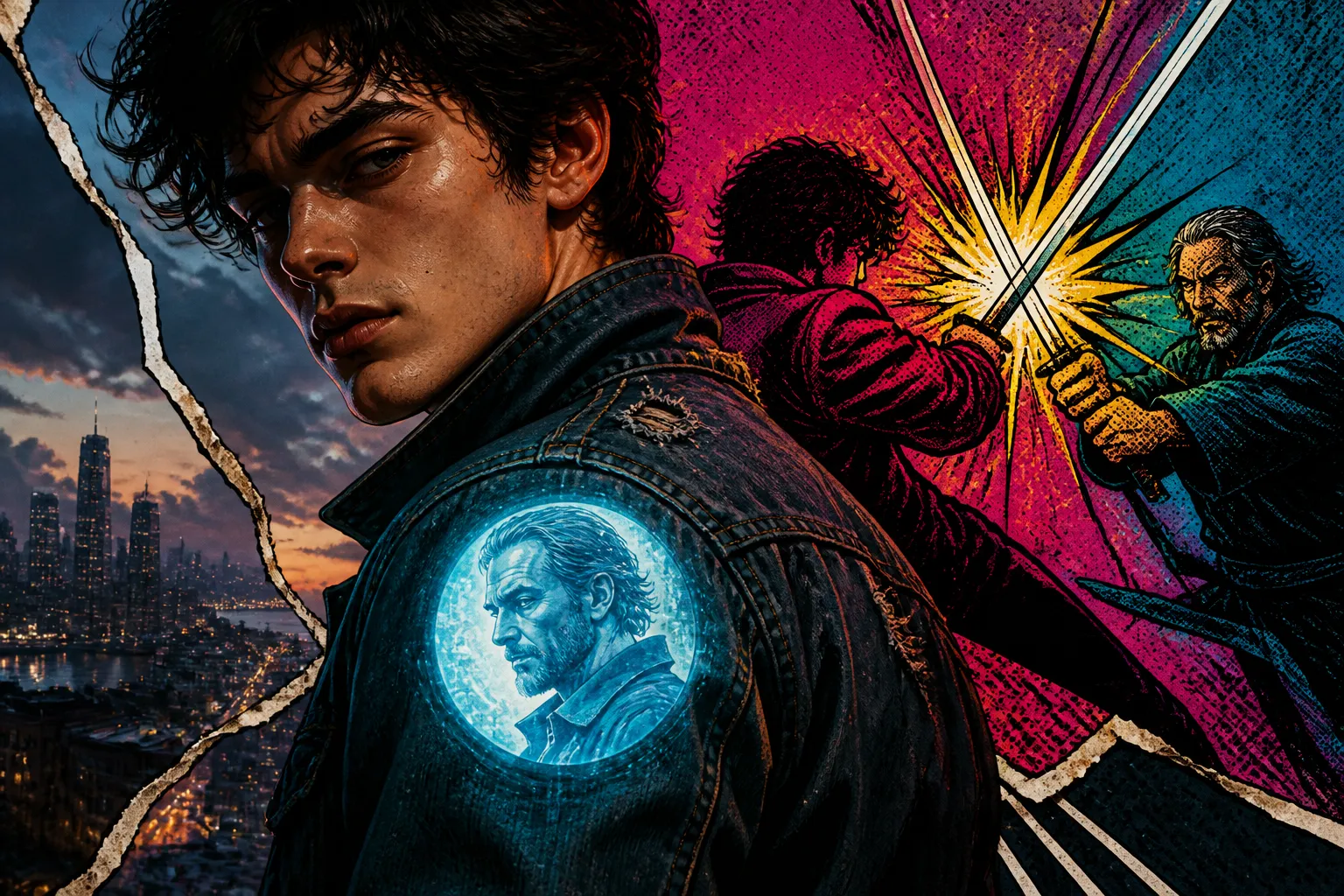
That visual force has a counterpart. Sam Chandler’s Shacknews review describes pop art set against realistic environments, a combination that can make one scene feel as though it has broken into another. The contrast suits a story about unstable realities. It also sets an expectation: a change in presentation should reveal something about the world Romeo is crossing.

The game makes that expectation difficult to test. Its episodes offer new images and activities, but Chandler finds that their shape becomes familiar. The style remains arresting even when the journey begins to repeat itself.
A dead man with a destination
Romeo starts as a small-town cop. After saving Juliet, he begins dating her, then dies. His grandfather, a scientist, brings him back through the jacket patch, and Romeo becomes Deadman. Juliet proves to be a space-time drifter, with multiple Juliets causing havoc across realities. Romeo joins the FBI Wanted Space-Time Criminal Special Investigative Task Force to track them down. The premise gives him both a personal reason to search and an institution capable of sending him almost anywhere.
Two reviews published on February 10, 2026, approach that promise from different angles. Chandler, writing for Shacknews, questions how well the ideas come together. Rhys Wood’s TechRadar review calls the game a hyper-violent sci-fi trip full of bizarre pop culture references and places it within Grasshopper’s offbeat catalog. Both accounts describe an experience with a particular appetite for excess. Neither presents that appetite as a universal selling point.
Each episode starts over
The chapter structure makes room for sharp changes in subject and tone. Each episode opens with a voiceover introducing a philosophical idea and closes with a credit roll. Those bookends give the adventure the rhythm of a series: arrive somewhere, encounter its problem, and leave. Between destinations, Romeo’s crew travels on a ship called the Last Night. They target a reality through a Pong-like game, then ride a motorcycle with a sidecar over a bridge of light and into a wormhole.
These transitions make travel an event rather than a menu choice. Elsewhere, Romeo fights through sword-based hack-and-slash combat, collects key fragments, and stirs a vat of unpleasant liquid. The sheer difference between those tasks speaks to Grasshopper’s taste for interruption. A quiet errand can follow a violent encounter; a small game can decide where a crew goes next. Chandler’s concern is that the systems compete for attention without forming a particularly cohesive or polished whole. An episode can surprise moment to moment while still leading the player through a pattern they have already learned.
When confusion stops being productive
A story about space-time drifters can make disorientation feel purposeful. Blurred realities invite the player to ask which events matter, which version of a person they have met, and what might change when they cross into another timeline. Chandler’s account suggests a more practical problem: as episodes begin to feel alike, the timelines and realities blur too. If the chapter endings provide a clean reset but the events within them lose distinction, the credit rolls may mark progress more clearly than the story does.
Romeo’s role adds to that uncertainty. Finding Juliet is his stated goal, but Chandler describes him as a largely inactive protagonist who does little to pursue her. This matters because the game is constantly proposing new places to go and things to do. A lead who makes few visible choices can become a passenger in his own search. The grandfather on his jacket, the FBI task force, and the many Juliets all promise relationships worth following. The available criticism leaves open how much Romeo himself changes those relationships.
Who has reason to make the trip?
Players drawn to Grasshopper Manufacture’s unruly shifts in tone may find plenty to examine here. The premise allows for violent action, odd comedy, and sudden visual contrasts in the space of one episode. Wood describes the game as niche, in keeping with the studio’s offbeat work. Chandler is less persuaded by its accumulated ideas, suggesting it is unlikely to raise a player’s pulse unless they are already a Suda51 diehard. Those views point to a useful distinction: enjoying an unexpected scene is not the same as wanting to repeat the trip between scenes.
The supplied review excerpts cannot settle a purchase decision on their own. They provide no price, platform list, playtime, difficulty assessment, or account of the ending. Neither excerpt supplies a numeric score or complete final verdict, and the TechRadar excerpt ends before its verdict is complete. Anyone deciding when or where to play should check current details from the publisher and read the full reviews. What these accounts do establish is the central tension: Romeo is a Dead Man has no shortage of ways to get Romeo into another reality, but his reasons for moving through it seem much harder to feel.
Sources

Alexandra Rivet explores the intricate interplay of games and culture for GoAndGame. A passionate storyteller, she delves into narratives with depth and curiosity. Her pieces often highlight the stories behind the pixels.