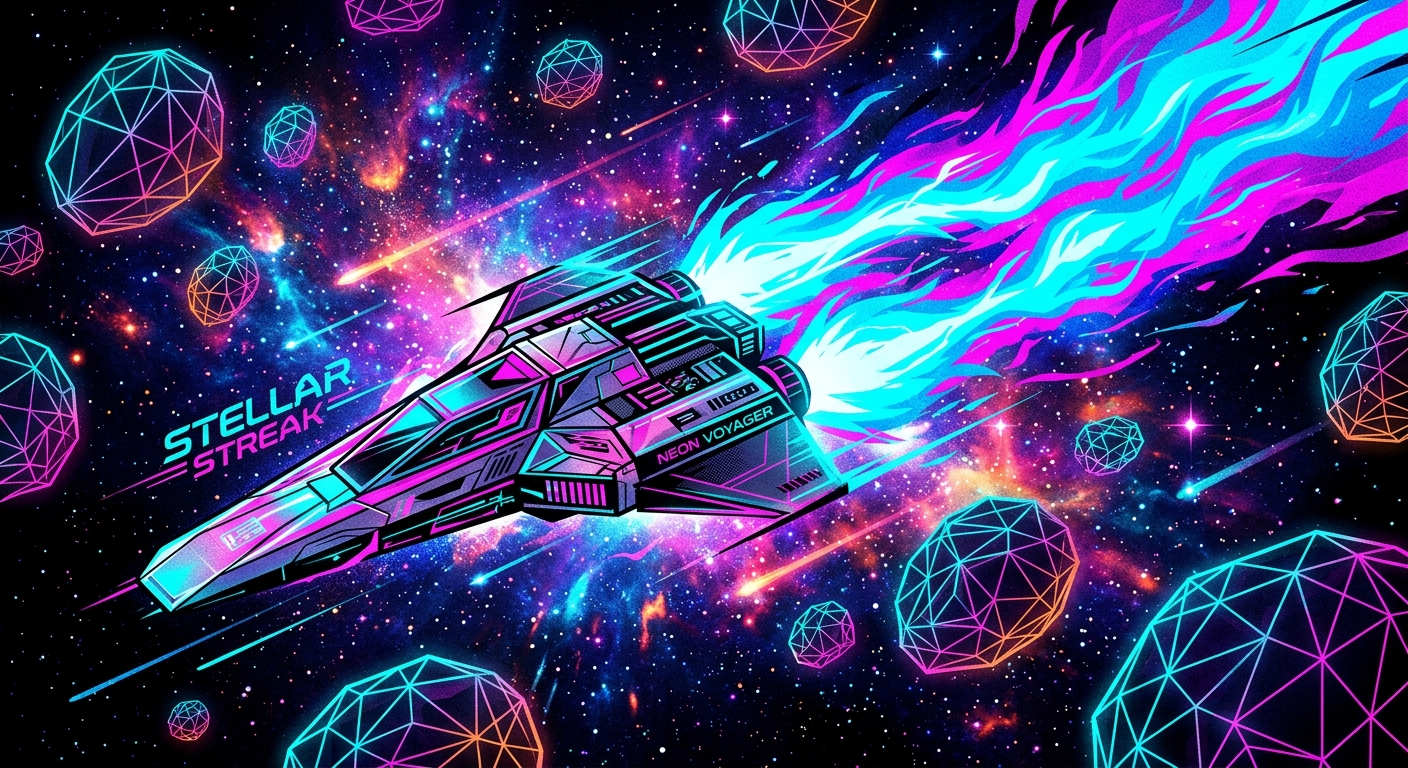
Stellar Drifter: Galactic Crucible arrives trailing neon exhaust and retro-vector ambitions, but does this space opera earn its place among the stars or collapse under the gravity of its own nostalgia? This game positions itself as a modern callback, yet it strives for more than mere homage. It asks whether the skeletal beauty of arcades past can support a complex narrative and evolving mechanics, a challenging proposition for any title.
A Universe Built from Familiar Stardust
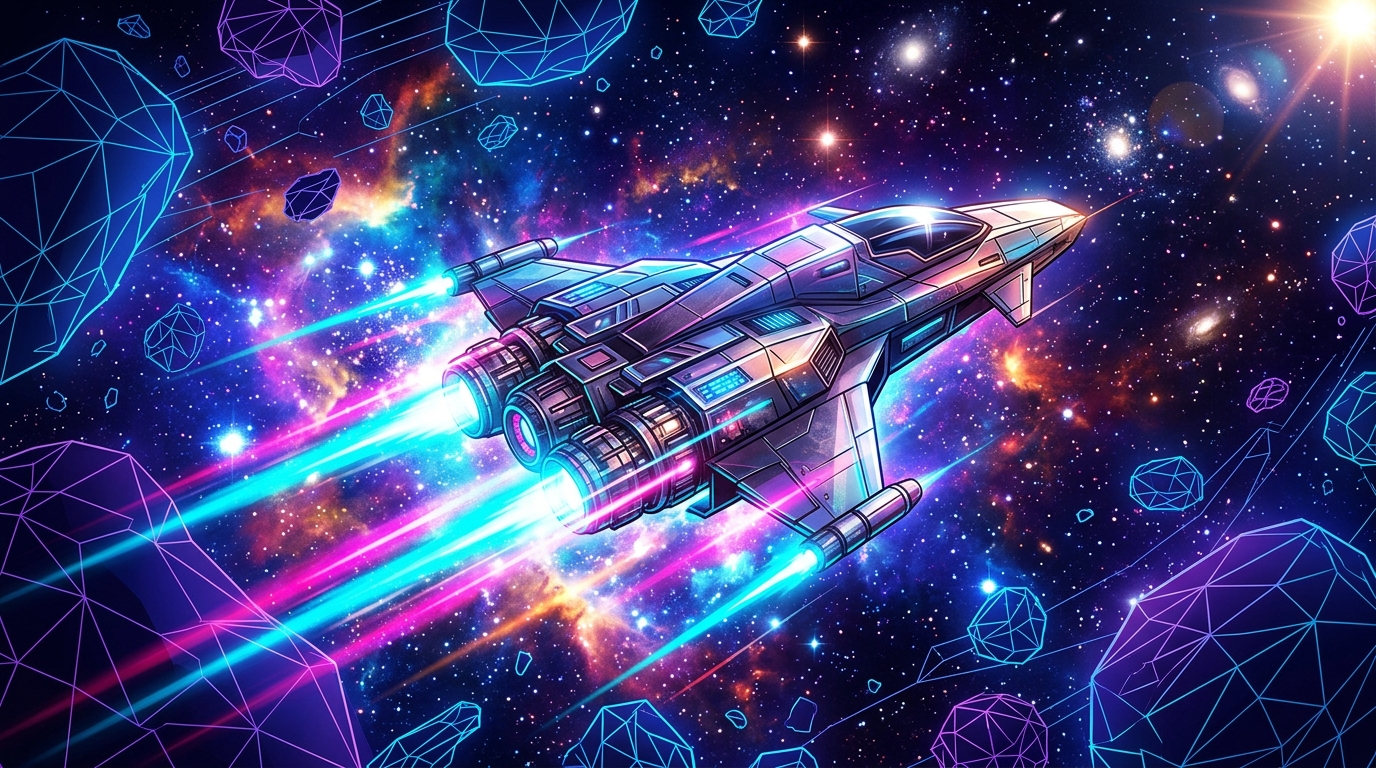
Stellar Drifter: Galactic Crucible draws its visual DNA from the golden age of vector-graphics arcade shooters. It wraps wire-frame asteroids and glowing ship silhouettes in a modern high-resolution coat. This creates a look simultaneously ancient and freshly minted. The aesthetic echoes early titles like Asteroids Remake, yet it pushes beyond simple recreation.
The game's art direction leans hard into a retro-futurist aesthetic, much like synthesizer album covers come to life. Think of the sweeping cosmic romanticism explored by artists such as Out Runner on records like "Stellar Drifter," where immense joy and melancholy share the same interstellar canvas. That tonal ambition translates directly into level design. Nebula corridors shimmer with gradients reminiscent of 1980s planetarium show slides. Enemy craft pulse with saturated neon, a direct nod to Sega arcade cabinets from 1986. This visual language is both a comfort and a challenge, asking players to look past surface familiarity.
Mechanics at the Crucible's Core
At its mechanical heart, Galactic Crucible is a twin-stick shooter fused with light roguelite progression. Players pilot customizable vessels through procedurally generated star systems. These systems grow measurably more hostile with every sector cleared. This core loop is familiar, seen in titles like Segment Storm, but Stellar Drifter introduces a distinct twist.
The 'crucible' system, the game's central hook, forces tactical choices. At the end of each wave, players must choose between upgrading offensive payload, defensive shielding, or engine thrust. This creates a meaningful resource triangle. It prevents any single dominant strategy from calcifying across a full run, demanding adaptive play. Combat itself is tight and readable. However, early hours can feel underdeveloped. Later sectors feature enemy formations that exploit the geometry of the wraparound play field in genuinely clever ways. This design rewards spatial awareness over reflexive button mashing, evolving from simple reflexes to strategic positioning.
The Space Opera Wrapper: Story and Atmosphere
Galactic Crucible commits to its space opera framing with a seriousness most arcade-adjacent titles abandon. Between runs, voiced log entries from a rotating cast of galactic factions build a surprisingly textured lore. This narrative focuses on a dying star cluster and the civilizations scrambling to harvest its last energies. It presents a historical context for the frenetic action, offering a deeper 'why' than many contemporaries.
The musical score earns special attention. Sweeping synthesizer compositions shift dynamically based on threat level. They move from ambient cosmic drift during exploration phases to propulsive arpeggiated sequences during boss encounters. The marriage of sound and action rarely feels accidental. Where the narrative stumbling is in pacing. Exposition often arrives in front-loaded chunks. These can feel disconnected from the shooting taking place on screen. Players who skip the log entries entirely will find the story's emotional beats land without proper foundation, highlighting a tension between arcade impulse and narrative ambition.
Crowded Cosmos: Where It Stands in the Genre
The indie arcade space is genuinely saturated right now, a cosmic sea of contenders. Galactic Crucible must elbow past dozens of competitors for attention, a challenge it meets unevenly. Its production values and tonal commitment distinguish it immediately. However, its moment-to-moment loop lacks the crystalline simplicity that makes the best arcade titles endlessly replayable. Games like Star Dive often prioritize immediate, intuitive gratification, a different design philosophy.
Veterans of classic vector shooters will feel echoes of foundational arcade DNA throughout. The game functions as an interesting companion piece to modern reimaginings of that era's design philosophy. Yet, it opts for layered complexity over pure mechanical purity. This makes it a distinct experience. Ultimately, Stellar Drifter: Galactic Crucible is a game that respects both its genre elders and its own creative ambitions. It forges something that feels neither slavishly derivative nor recklessly experimental. This is a difficult orbit to maintain, and one it mostly sustains across a full campaign, challenging players to engage with its particular blend of past and future.
Stellar Drifter: Galactic Crucible proves that retro-futurism can be more than just aesthetic. It can be a philosophical stance. The game asks its players to consider the weight of history and the potential for new narratives within familiar frameworks. It may not redefine the genre, but it certainly complicates it in interesting ways, offering a rich, if sometimes uneven, experience.

Julian Thorne is a seasoned house writer for GoAndGame, known for his deep dives into obscure game mechanics and industry trends. He often explores the sociological impact of gaming, blending critical analysis with historical context.


