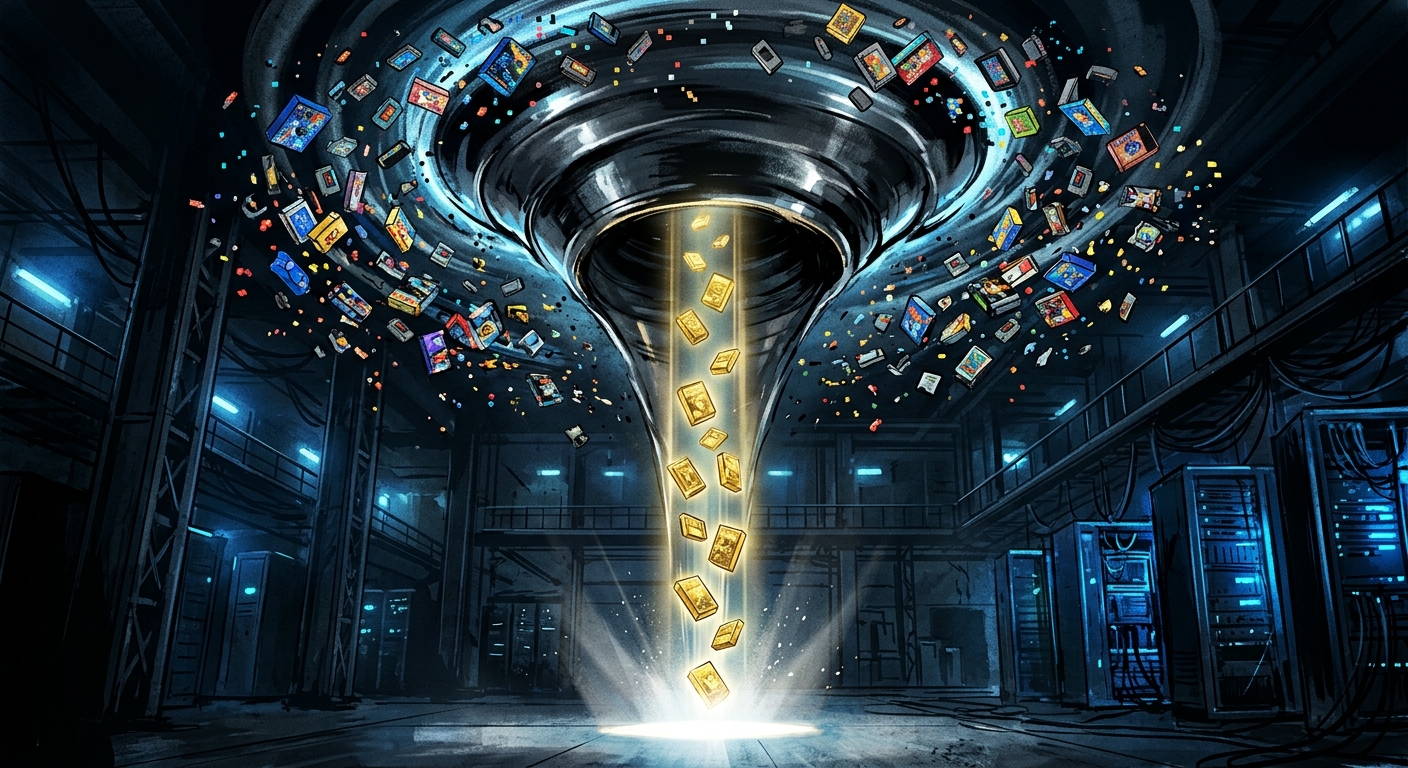
Steam released more than 20,000 games in 2025 alone. Most of them disappeared. That number is not an accident and it is not purely a quality problem. It is, in large part, a structural outcome produced by a recommendation engine that nobody at Valve has fully documented and that the development community has mostly agreed, through self-interested silence, not to criticize in public.
The Invisible Funnel Nobody Talks About
Steam's storefront has evolved quietly into something that functions less like a discovery tool and more like a popularity amplifier. Games that already have momentum get more surface area. Games that do not have it yet rarely find the ramp they need to build it. The platform processes thousands of new releases every month, and the logic governing which ones surface in the discovery queue is almost entirely opaque to the people whose livelihoods depend on it.
Developers in the midrange bracket, studios spending somewhere between $300,000 and $2 million on a title, report that key visibility metrics feed into recommendation placement in ways that create a compounding disadvantage. Steam Next Fest wishlist totals, review velocity in the first 48 hours, and concurrent player peaks during launch week all appear to influence where a game lands in the queue. Arrive without a pre-built audience and every one of those numbers starts in the red.
The cruelest part is that the algorithm does not announce itself. There is no dashboard that tells a developer their game has been deprioritized. Discovery simply goes quiet. Refund rates tick up because players who do stumble onto the game feel like they found something unfinished, and the studio is left reverse-engineering signals from sales data that Valve declines to fully explain. The silence is the punishment, and you only recognize it after the launch window has already closed.
Why Midrange Studios Are the Specific Casualty
Very small indie games can survive on goodwill, word of mouth inside niche Discord servers, and price points low enough that impulse buying barely registers as a decision. Very large releases from established publishers carry their own gravitational pull and can purchase the front-page real estate the algorithm would otherwise deny them. The midrange studio has neither lever. It is too expensive to be a reflex buy and too unknown to be a considered one.
A game built by a ten-to-thirty-person team over two or three years carries overhead that demands sustained sales, not just a launch spike. When review-velocity weighting punishes a slower rollout, say 200 reviews in the first week rather than 2,000, the recommendation engine treats that signal as indifference rather than as a moderate but genuine audience. Placement in the discovery queue degrades rapidly. Industry veterans speaking on background describe this as hitting the dead band: algorithmically invisible to exactly the players who would, if they ever saw the game, actually want to buy it.
The arcade and action-adjacent space is particularly exposed here. Games in that genre family often build audiences slowly as players return repeatedly and recommend to friends over weeks. High-score culture, replayability loops, the kind of thing you see in titles like Segment Storm or Star Dive, those games earn their communities gradually. The current signal weighting reads that tempo as failure rather than as the healthy retention it actually represents. A game like Dot Chomper thrives on repeated short sessions, not a single explosive launch weekend, and that rhythm is structurally punished.

What the Data Signals Actually Reward
Valve's public statements emphasize personalization and user behavior, but developers and analysts who study the platform's outputs have identified several proxy signals that appear to dominate placement: total wishlist count at launch, the speed at which early reviews accumulate, peak concurrent users within the first 72 hours, and the ratio of positive reviews to total reviews weighted heavily toward recency. Each of those signals is easier to manufacture or inflate at scale than it is to earn organically.
Large publishers can coordinate review campaigns, run pre-launch beta access for content creators with large audiences, and spend on external advertising that drives wishlist numbers before a game is ever released. A midrange studio doing none of those things, because it cannot afford to, enters launch week already behind on every metric the algorithm appears to care about. The race begins before the starting gun, and the entry fee is a marketing budget most teams do not have.
This dynamic mirrors what observers have noted in other algorithmic marketplaces. The system optimizes for engagement metrics it can measure easily. Those metrics correlate with existing popularity rather than with quality or fit. The long tail of genuinely good products that would find audiences given time instead gets pruned before that time is ever granted. Steam's discovery queue was built to surface the unexpected, and it has gradually become a machine for confirming what was already expected.
The Industry's Collective Silence
Nobody with a game currently on Steam, or planning to release one, wants to say publicly that the platform's recommendation logic is broken. Valve controls the primary distribution channel for PC gaming, and studios are rationally reluctant to antagonize the gatekeeper even when the gate is quietly closing on them. The result is an industry-wide code of omission. The problem is discussed extensively in private Slack channels and at GDC hallway conversations and almost never in press releases or developer blogs.
The developers who speak most freely tend to be those who have already left the industry or whose studios have already closed, which means the testimony arrives too late to be actionable.
That silence has a secondary effect: it prevents collective pressure from forming. Because no prominent studio will attach its name to a criticism of Steam's recommendation systems, Valve has little public incentive to rethink the weighting. The criticism that does surface in places like Steam's own community forums tends to come from players asking basic questions about whether the algorithm even exists, not from developers with the technical context to explain what it is actually doing. And reporting like Outlook Respawn's breakdown of the indie discovery crisis puts the scale in plain numbers: over 20,000 launches in 2025, most of them invisible, with discoverability cited as the primary failure mode.
What a Corrective Might Actually Look Like
Proposed reforms circulating in developer communities cluster around a few practical ideas. Longer evaluation windows, measuring a game's review trajectory over 30 or 90 days rather than just the first week, would give slower-building titles a chance to register as real audiences rather than as dead launches. Explicit carve-outs in recommendation placement for games below certain revenue thresholds would let smaller studios compete for visibility without a marketing budget. More transparent disclosure from Valve about which signals actually drive placement would at least allow developers to make informed decisions about launch strategy rather than guessing at rules nobody published.
Some developers argue the most meaningful change would be structural. A discovery queue that actively surfaces games a user has not encountered, rather than reinforcing games they have already seen, combined with a genre-specific trending metric that normalizes for the size of a game's target audience, would mean a niche title with a devoted following could score comparably to a mainstream hit with a diluted one. That kind of normalization is not technically difficult. It is politically difficult, because it requires Valve to choose a different definition of success.
Whether any of these changes happen depends almost entirely on whether Valve decides to pursue them. No regulatory framework currently compels platform transparency in recommendation systems. No competitor has yet emerged with enough market share to create business pressure for reform. The studios most harmed by the current setup are also the least positioned to demand change. Until that asymmetry shifts, the dead band stays where it is, and the games that would have found their audiences, given a few more weeks and a fairer queue, keep disappearing into the noise of 20,000 annual releases that the platform was never quite designed to handle.
Sources

Priya Nambiar covers competitive gaming and emerging esports ecosystems for GoAndGame, with a particular focus on Southeast Asian scenes and grassroots tournament culture. She came up through community forums before moving into sports journalism, and that background shapes everything she writes.


