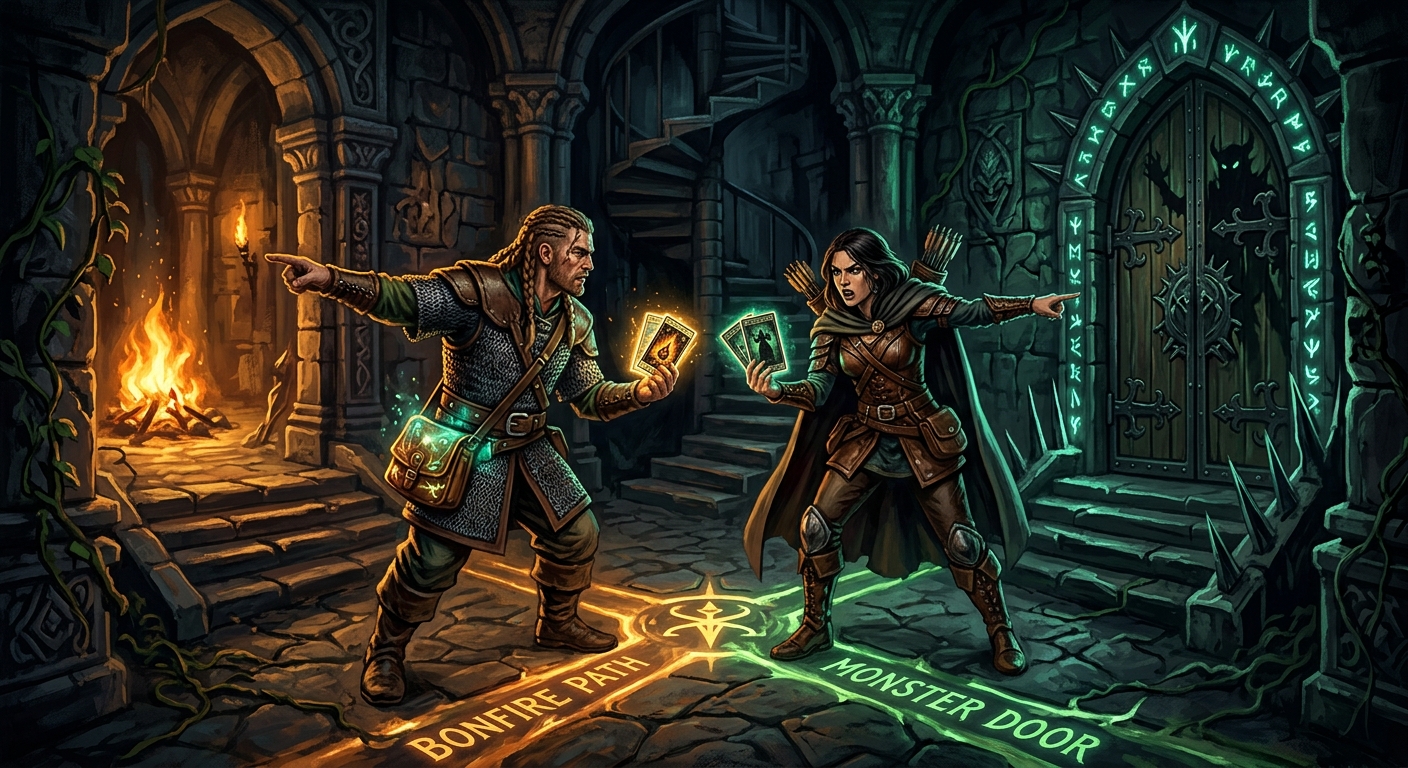
In the first Slay the Spire, a bad map choice belonged to you. You took the elite fight, arrived at the next campfire with too little health, and knew exactly whose optimism had caused the trouble. Slay the Spire 2 lets two players make that climb together. Each brings a character and a deck, but the route belongs to both. A fork in the map can become a conversation neither player expected to have.
Two players, one route
The original game made solitude part of its appeal. A run gave you time to stare at three card rewards, imagine the deck you might build, and make a choice without explaining it. Co-op keeps that slow accumulation of decisions, then adds another person whose plans may be perfectly sensible and entirely incompatible with yours. According to the official multiplayer documentation, all players visit every map location together and vote on which node to advance to. Disagreement does not produce a deadlock; instead, the next location is chosen at random, weighted by how many players backed each option. Three votes for a campfire and one vote for an elite fight give the elite fight a twenty-five percent chance to win anyway. That wrinkle matters. A minority view can still carry the run, which means every vote is also a small gamble.
Consider the texture of that choice. One player has assembled enough damage to want the elite fight and its reward. The other is carrying a fragile deck that needs another rest before it can survive a hard battle. Because both players move along the same map, neither can quietly take a safer branch. They must decide how much risk the stronger deck can absorb on behalf of the weaker one, and how much the weaker deck might contribute later if it gets more time to grow. The conversation happens in the vote, and the vote can be overruled by chance.
Mega Crit has kept the solo climb alongside multiplayer. That matters because co-op changes the character of a run without having to become its definitive form. Playing alone still offers the clean satisfaction of owning every mistake. Playing together makes room for a different story, one where the decisive move may be agreeing to skip a fight.

Combat has two plans to keep alive
Inside a battle, each player draws and plays from their own deck against a shared set of enemies. That arrangement sounds simple until a turn starts to go wrong. The multiplayer rules confirm that enemies attack all players at once, but each player blocks individually. A burst of damage that finishes an enemy before it acts saves more health than either player could protect with a block card alone, so the useful question is no longer only what a card does for its owner. It is what playing it allows the pair to do next.
Enemy scaling adds another layer. According to the wiki, enemy maximum HP increases progressively with each additional player in the lobby, and certain buff stacks such as Artifact and Slippery also grow per player. More cards and more coordination do not simply make the Spire easier. Tougher fights ask each deck to justify the space it occupies alongside its partner. A card that looks modest in isolation may become valuable if it buys the other player one more turn to assemble a powerful hand.
This is also where co-op faces a pacing test. Slay the Spire makes thinking feel urgent even when nobody is watching a clock. Add a second player, and a long pause has an audience. The best shared turns give both people something to consider, rather than reducing one to a spectator while the other solves a hand. Whether the game threads that needle consistently is something early-access runs will answer before the full release.
A deck now has a relationship with another deck
Deckbuilding games reward coherence. You notice a useful interaction, take one card that supports it, then spend the next several floors making the idea dependable. In co-op, that private project has a neighbor. One player might build toward damage while the other prioritizes survival or status effects. Both might discover that their decks need time to become dangerous, leaving them exposed to the same early threat with no one positioned to cover it.
Neither arrangement can be judged from a card reward screen alone. The conversation between fights becomes part of deckbuilding: which deck needs an upgrade most, which one can afford a weaker pick now, and what the pair will do if the hoped-for cards never appear. The Necrobinder, one of the sequel's new characters, makes that dynamic especially sharp. She carries a large skeleton companion called Osty that can attack and shield her, which introduces timing and support questions a partner deck cannot ignore. A player building around Osty's shields may need their partner to apply pressure while Osty charges; a partner focused on poison may need Osty's blocks to survive a counterattack. The interesting part is watching players negotiate those answers during a run, not assuming one perfect synergy before it starts.
Even a rest stop can reveal the difference. Healing may seem like the responsible choice for a wounded character, but an upgrade might give that character the tool both players need for the next boss. In solo play, the trade-off is tactical. In co-op, someone else must trust your reading of it, and they cannot take a different campfire if they disagree.
What changes at the genre's smallest unit
Since the first game's early-access arrival in November 2017, Slay the Spire has been a reference point for deckbuilding roguelikes. Its influence rests partly on how sharply it connects a single card choice to the fate of an entire run. The sequel's co-op mode tests what happens when that connection runs through another person. The unit of strategy becomes the partnership as well as the deck, and losses carry a different charge when someone else helped steer the run toward them.
Other games have explored cooperative deckbuilding. What makes this attempt worth watching is the precision players already expect from the Slay the Spire formula. A shared run still needs difficult fights, surprising drafts, and losses that teach you something. It also needs space for disagreement without letting every vote drain the energy from every floor. The weighted-random resolution on split votes is a small mechanical answer to that problem, and it is a more interesting answer than a simple coin flip, because it preserves the value of persuasion without requiring unanimity.
Slay the Spire 2 entered early access on March 5, 2026. The co-op mode ships with it, which means the negotiation starts now. Perhaps the most revealing moment will be a small one: a card left unpicked because a partner needed the shop's gold, or a dangerous path taken because their deck was finally ready for it. Those decisions do not replace the pleasure of building a great deck. They give that deck someone to answer to.
Sources

Alexandra Rivet explores the intricate interplay of games and culture for GoAndGame. A passionate storyteller, she delves into narratives with depth and curiosity. Her pieces often highlight the stories behind the pixels.


