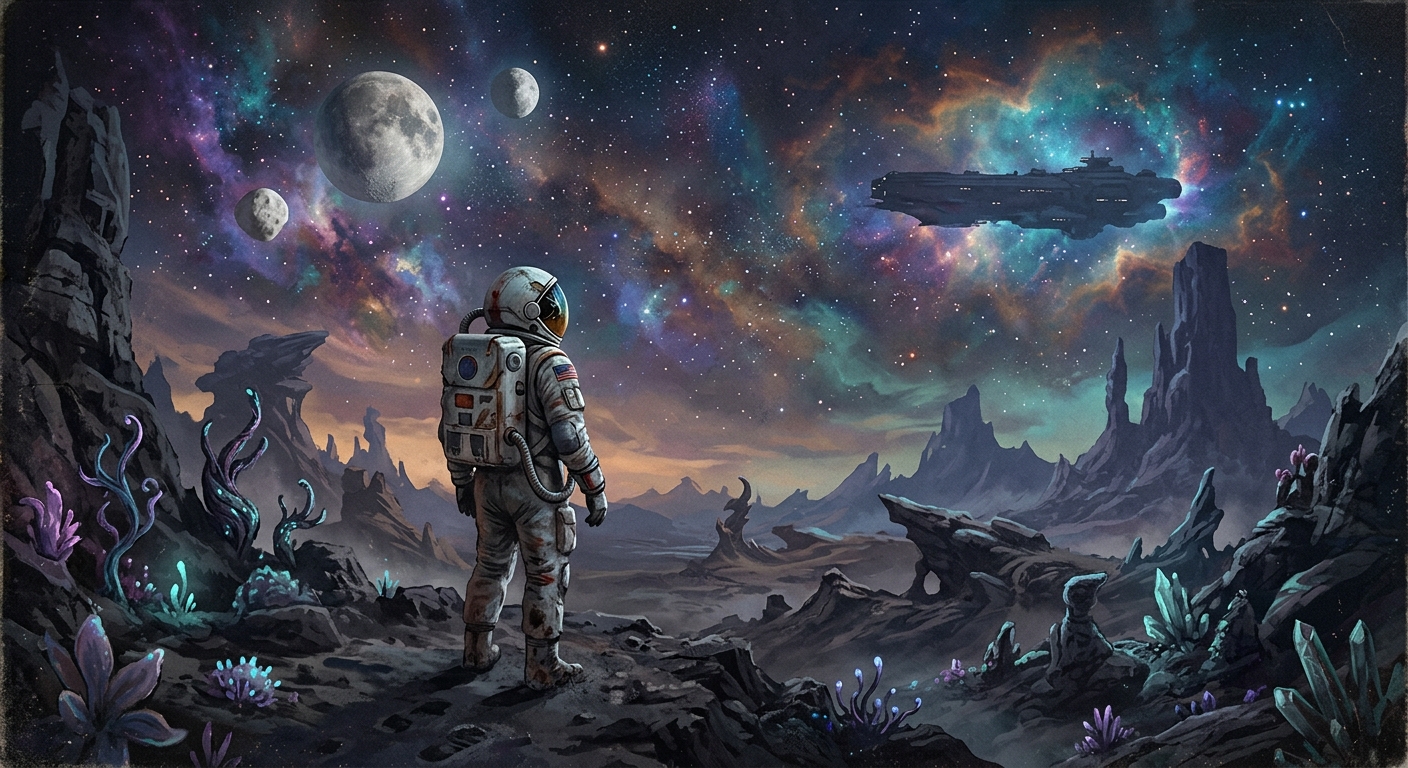
No Man's Sky continues its relentless expansion. The Voyagers update arrived in late August 2025, bringing with it capital-class starships and new expeditions. Sean Murray's social media announcement was characteristically understated, signaling another substantial, free content drop. This pattern of generosity has become expected. Yet, underneath the excitement for multi-crew vessels and enhanced customization, a persistent question nags: can infinite procedural generation ever truly deliver a compelling universe, or does it merely dilute meaning across an endless, undifferentiated expanse? The game has grappled with this tension since its origins, and each update offers another attempt at a solution.
The Latest Iteration of Infinity's Problem
The Voyagers update, without fanfare beyond a brief social media post, introduced large, customizable, multi-crew starships. These vessels represent a significant expansion of the game's shipbuilding and social systems. Players can now staff, outfit, and fly these ships cooperatively, an ambition unmatched since the game's difficult launch in 2016. This addition of communal exploration layers new mechanics onto the existing procedural substrate. Patch 6.02 followed swiftly in September, addressing bugs and stability issues. This rapid fix suggests Hello Games is running a tighter feedback loop, utilizing Zendesk reports and console crash logs. It also implies the update shipped with immediate problems, a persistent echo of past releases. The continuous focus remains on adding layers of activity to a universe that struggles to feel distinct, a vastness that often lacks definition.
The Peculiar Economics of Generosity
Hello Games' strategy of continuous, free updates defies standard industry practice. This approach has become the studio's primary method for repairing its reputation after the initial launch controversy. Sean Murray's update announcements are now a recognized phenomenon, breezy and optimistic. As the blogger at The Ancient Gaming Noob noted, the sheer generosity can feel disorienting, even unsustainable. This economic model, ostensibly funded by the original purchase price, creates a unique psychological contract with its audience. It often compels players who left years ago to revisit a game that constantly promises improvement, implying a kind of historical debt. The studio continually offers more, but the underlying motivation is often a tacit acknowledgment of past shortcomings. This endless cycle of updates, while celebrated, raises questions about what constitutes a finished product.
A Social Patch for a Philosophical Void
The core tension within No Man's Sky persists, largely untouched by the myriad updates. The game boasts eighteen quintillion planets. This number, intended to inspire wonder and scope, often leads instead to a peculiar sense of numbness. Most planets are merely minor variations on a few biome templates, lacking truly unique characteristics. Voyagers attempts to address this fundamental problem with social and cooperative mechanics. Multi-crew ships suggest companionship. Expeditions imply worthwhile destinations that demand collective effort. However, the fundamental question remains: how can any star system truly matter when billions of near-identical ones exist just a warp jump away? The procedural generation ensures infinite quantity but often at the expense of qualitative distinction.
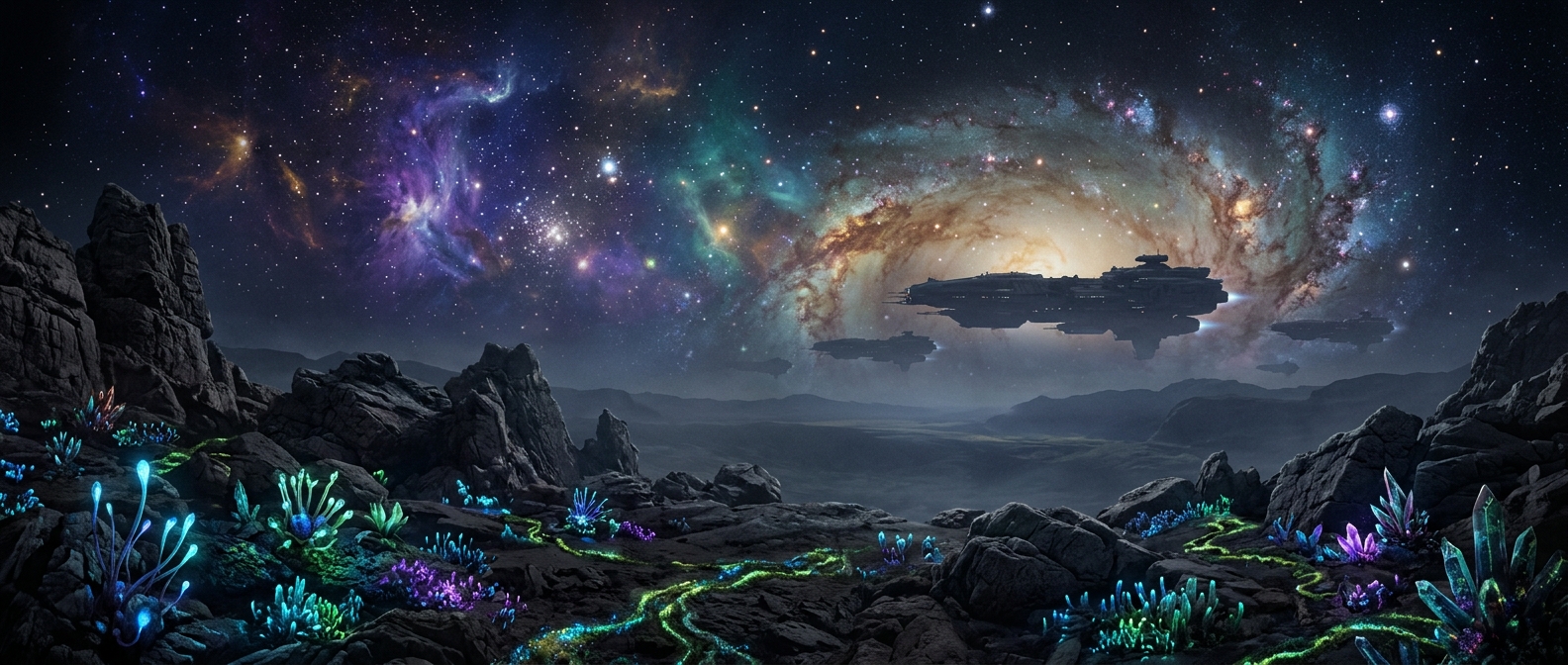
Games built on spatial exploration and scoring, from early arcade titles onward, found different solutions. They made the void hostile yet legible. The screen explicitly quantified a player's worth in that space, offering immediate, unambiguous feedback. Consider a title like Star-Dive, where every asteroid destroyed adds a concrete value, where progress is clear and finite. Open-universe sandboxes, by contrast, deliberately forsake this clarity. They trade defined stakes for endless possibility, often at the cost of genuine significance. The new capital-class starships are the most direct effort yet to populate No Man's Sky's emptiness. When another player is physically aboard your vessel, sharing tasks, the procedural void outside becomes mere scenery. It recedes into the background, momentarily secondary to the human interaction within. This is a design instinct borrowed from survival games, seeking to make social features an antidote to content fatigue. But the moment your crew logs off, the system's algorithmically generated name provides cold comfort.
The Horizon Beyond the Voyage
No Man's Sky has received active post-launch development for almost a decade. This means the game has spent more time in expansion than many titles spend existing, a testament to its unusual development trajectory. Voyagers marks another waypoint, not a final destination, in what appears to be an indefinite improvement project. The rapid release of patch 6.02 indicates a refined feedback loop within Hello Games. The studio now uses platform crash-reporting infrastructure and Zendesk tickets as continuous signals, a significant improvement from earlier, more reactive phases. Yet, the core philosophical problem endures, one that no mere patch can likely resolve. Infinite space is, by definition, space where nothing is uniquely precious, where every discovery is ultimately repeatable in some form. This is the existential question No Man's Sky has been deferring, one free update at a time. The game continually expands without quite resolving its central paradox, merely pushing the boundaries of its own definition.
Sources

Julian Thorne is a seasoned house writer for GoAndGame, known for his deep dives into obscure game mechanics and industry trends. He often explores the sociological impact of gaming, blending critical analysis with historical context.


