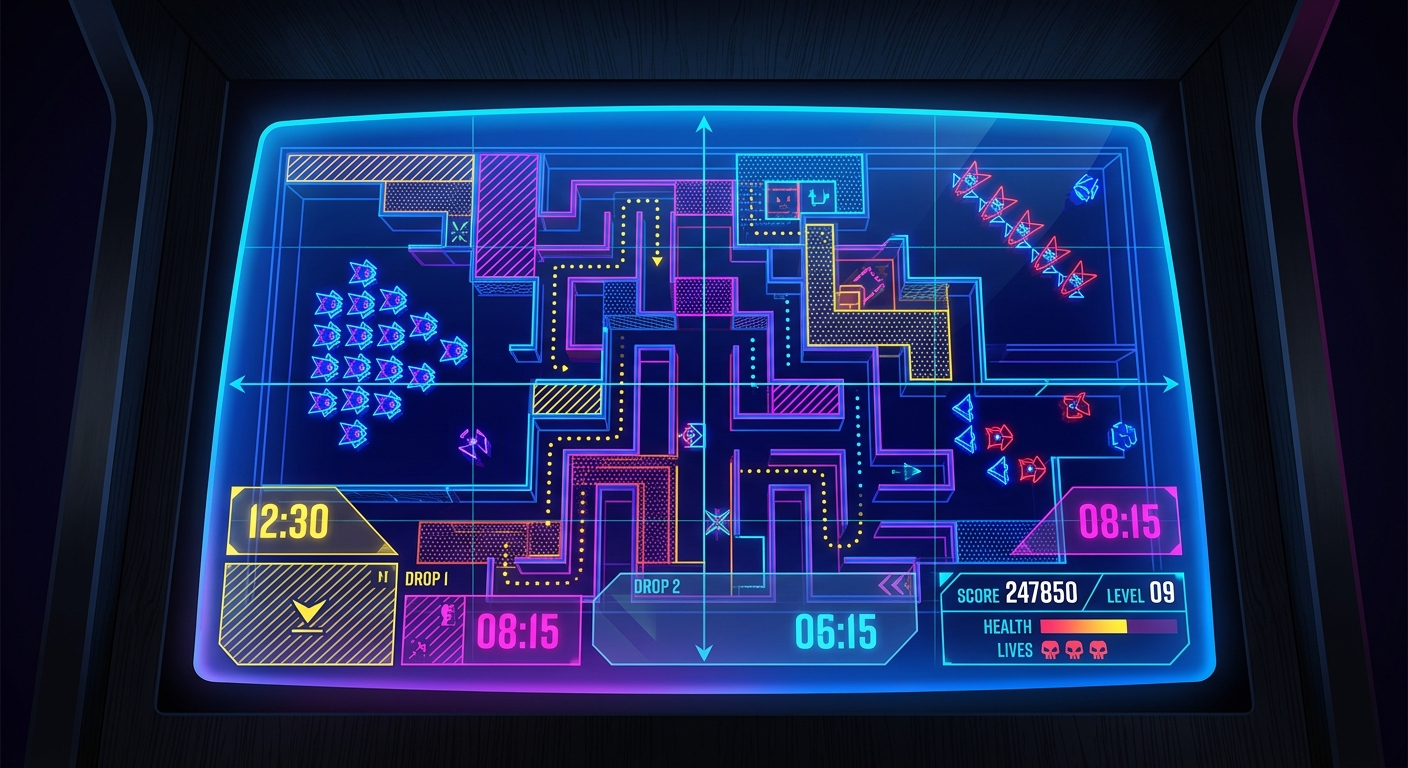
Every arcade game hides a second game underneath the surface one. Master the surface layer and you clear a few waves. Master the logic underneath and you start building real scores. Structured guides are the fastest route to that second layer, not because they do the thinking for you, but because they compress hours of trial-and-error into a single readable session.
Why Pattern Recognition Beats Pure Reflexes
Arcade games look like twitch contests from the outside. Spend twenty minutes with any of them and you notice something different: the enemy spawns follow a schedule, the safe corridors repeat, and the resource drops cluster in predictable zones. Guides exist to name those patterns before you discover them the hard way, mid-run, with no lives left.
Take Dot Chomper as a clean example. New players chase pellets reactively and get cornered. A guide teaches the four-quadrant clearing sequence, which keeps at least one open lane at every stage of the board. The reflex demand does not disappear, but the decision load shrinks to a manageable size. That reduction is what lets players improve quickly instead of plateauing after a week.
The same principle applies to Go and Zap, where enemy firing arcs overlap in ways that feel random until you map the timing. Once you know which arc clears first, positioning becomes deliberate rather than desperate.
Reading the Field Before You Fire
Situational awareness in an arcade game means scanning the full playfield before committing to any move. Most players stare at their own position. Strong players read the whole screen, tracking spawn timers at the edges while handling the threat in front of them. Guides teach this habit explicitly because it does not develop naturally under pressure.
Threat prioritization is the first lesson in any worthwhile guide. Not every enemy on screen deserves equal attention. Fast movers close to your position outrank slow movers at distance, even if the slow movers carry more point value. Guides that spell this out, with annotated diagrams or step-by-step scenario breakdowns, cut the learning curve sharply.
Escape geometry is the second lesson. Every playfield has corridors that remain open longer than others during a given spawn cycle. Knowing which corridor to use, and when it closes, turns a reactive scramble into a controlled retreat. Star Dive builds its difficulty almost entirely around this mechanic: players who memorize the safe lanes progress; those who improvise stall out on the same wave repeatedly.

Resource and Movement Economy
Ammunition and special weapons function as in-game currencies. Spending them at the wrong moment is the arcade equivalent of blowing your budget on the first vendor you see. Guides that treat resource management seriously walk through the cost-benefit of each spending decision: when a bomb clears enough enemies to justify its loss, and when it only delays an inevitable reset.
Movement economy is harder to teach but equally important. Every unnecessary pixel of travel is time spent off-target and exposed. In Dirt Pump, the scoring multiplier resets whenever a player crosses a hazard zone without a clear reason. A guide that maps the shortest safe routes between pump targets keeps that multiplier alive and turns an average run into a personal best.
Decision trees work well here. A good guide does not just say "save your bombs"; it shows a branching chart that asks how many enemies are grouped, whether the spawn timer is under three seconds, and whether an escape lane is available. That structure gives players a repeatable framework rather than a vague principle.
Applying Guide Knowledge Under Pressure
Reading a guide and executing its advice at full speed are two different skills. The gap between them is where most players stall. The best guides account for this by staging their instruction: first a slow-motion breakdown of a scenario, then a practice drill at reduced difficulty, then a note on what the same situation looks like when the game accelerates.
Rehearsal protocol matters. If a guide tells you to hold the left lane during a boss phase, it should also tell you what the visual cue looks like a half-second before the boss commits to that pattern. Concrete cues outperform abstract advice every time. "Move left when the center column flashes" is more useful than "position yourself advantageously."
Confidence is the quiet output of good guide use. Players who have rehearsed a scenario recognize it when it appears live. That recognition creates a brief pause, maybe a quarter second, where a decision happens instead of a reaction. In arcade games, a quarter second of clarity is often the difference between extending a run and starting over.
The catalog games listed here, from Asteroids Remake to Segment Storm, each reward that kind of deliberate preparation. Guides do not replace the hours at the controls. They make those hours count faster.
Sources

Eliot Reed writes about the intricacies of virtual worlds, blending analysis with storytelling. As a house writer for GoAndGame, he delves deep into game mechanics and narratives, offering thought-provoking insights for players and developers alike.


