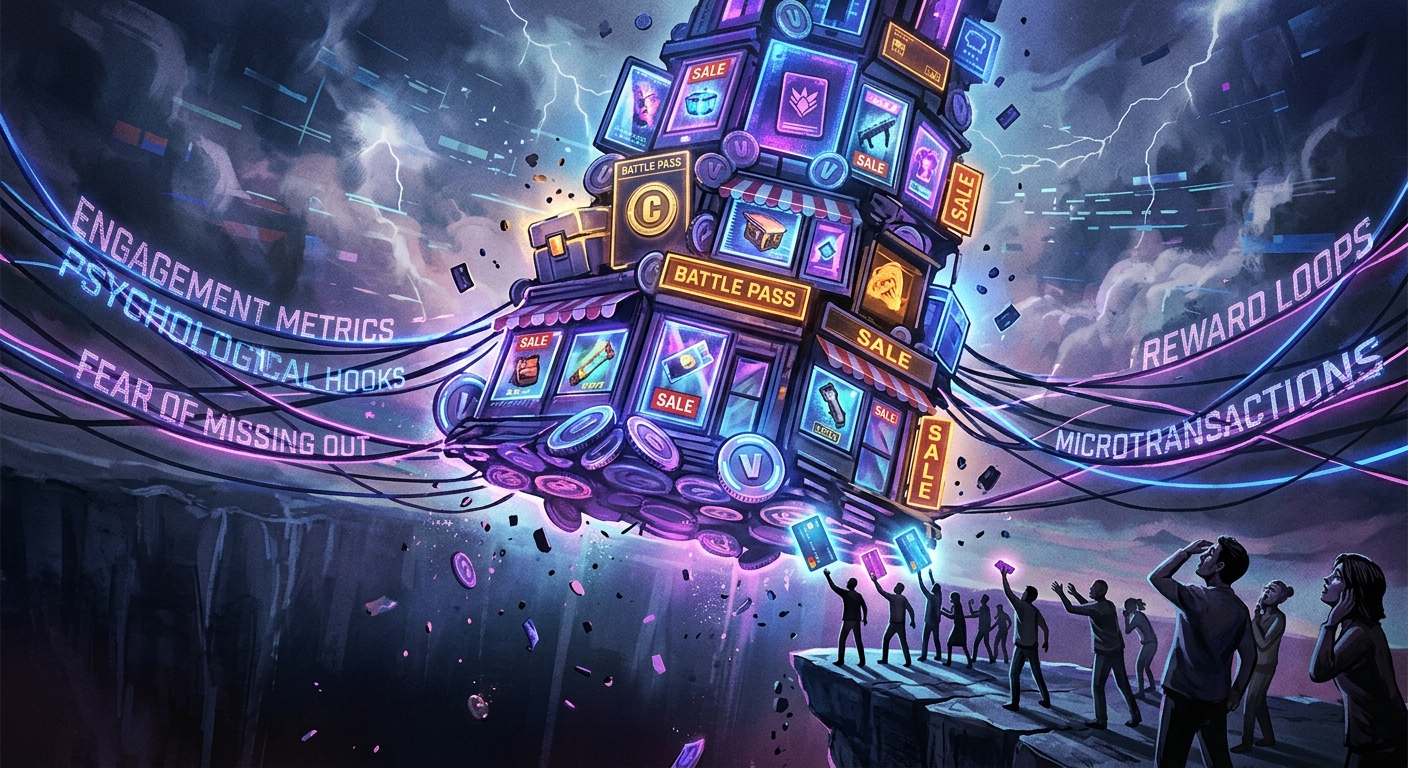
The contemporary video game marketplace is increasingly defined not by discrete products but by ongoing services. Studios now construct complex systems designed to generate continuous revenue long after a title's initial release. This model, known as live service, layers seasonal passes, rotating storefronts, and ephemeral currencies atop the core experience. The transformation is more than a business decision. It represents a fundamental re-engineering of how players interact with games and how value is perceived within them.
The practical consequence of this shift is that the internal economy of a game, how virtual currency is earned, exchanged, and spent, becomes as meticulously designed as any gameplay mechanic. Studios employ specialized live operations directors and monetization analysts, constantly tuning the flow of digital goods and the psychological levers that encourage spending. Sergei Vasiuk, Live Ops Director at Wargaming, described this evolution as moving from mere "game updates" to "game ecosystems," acknowledging the inseparable bond between a title's financial architecture and its very identity. He wrote in February 2025, ahead of Gamesforum Cyprus, that LiveOps teams of the future will oversee "player-driven economies, community-created content, and digital social hubs," not just patch schedules.
For players, the straightforward arcade impulse of dropping a coin to continue playing has been supplanted by a far more intricate array of choices. Decisions now revolve around bundled offers, tiered subscriptions, and the speculative social cachet of a cosmetic item bought today for a season that ends in three months. It is a system that subtly, yet profoundly, alters the player's relationship with the game itself, often converting play into a form of value extraction.
The Retention Problem and the 90-Percent Drop
The inherent fragility of the live service model stands in stark contrast to its ubiquitous ambition. A report aggregated by OpenCritic, published January 21, 2026, revealed that over half of the live service games launched in 2025 had already shed more than 90 percent of their player base within months. The analysis covered 19 titles, including Supervive, FragPunk, Mecha Break, and Splitgate 2, all of which saw catastrophic player-count declines on Steam. This is not merely anecdotal. It speaks to a profound structural challenge at the heart of the model.
Economically, this player exodus is catastrophic because live service revenue relies almost entirely on a comparatively small cohort of highly engaged, high-spending individuals. When the general player population dwindles, the incentive for even these committed players diminishes. Why invest in a battle pass or a limited cosmetic for a game that feels empty, devoid of the very community the purchase was meant to be part of? The perceived social value, a key driver for many purchases, evaporates when the servers go quiet.
Studios frequently react to this pressure by accelerating content cadence, pushing out new seasonal events and limited-time offers with relentless speed. This tactic carries significant risks. Players report feelings of fatigue or coercion rather than excitement. The constant pressure to keep up or not miss out can generate negative sentiment, ironically accelerating the very player exit studios aim to prevent. The line between sustained engagement and burnout is perilously thin, and most titles in 2025 appear to have crossed it quickly.
The distinction between live service games that maintain healthy economies and those that devolve into digital ghost towns is increasingly tied not only to content quality but to whether the underlying economic design genuinely respects player time. This dimension remains remarkably difficult to quantify during the intense pressures of post-launch monetization planning, and most studios do not appear to prioritize it until the numbers are already falling.

Currency Systems, Battle Passes, and the Psychology of Spending
Most live service economies are built upon at least one proprietary currency. This digital abstraction serves a crucial function: it obscures the direct real-money cost of purchases, a technique with clear roots in the casino and theme park industries. The distance between spending actual cash and acquiring an in-game item is deliberately stretched, softening the perceived financial transaction at the moment of purchase.
Battle passes have emerged as the predominant monetization layer, converting a single upfront payment into a sustained behavioral loop. Players feel compelled to log in daily, completing tasks and earning experience, to extract the maximum value from what they have already paid. That daily engagement, in turn, continuously exposes them to further spending opportunities within the game, reinforcing the cycle of investment and potential purchase. The design is elegant from a revenue perspective and exhausting from a player perspective.
Beyond battle passes, rotating storefronts employ powerful scarcity pressure. Specific cosmetics or bundles appear for only 24 to 72 hours. This time-limited availability creates a psychological effect distinct from merely offering items for sale. The fear of missing out functions as an extraordinarily effective conversion mechanism. Even financially cautious players can succumb to the urgency, making purchases they might otherwise deliberate on for days.
Critics contend that the long-term consequence of these systems is a reorientation of player motivation. Games become less about intrinsic enjoyment and more about progression optimization or cosmetic acquisition. Vasiuk himself acknowledged that the era of mass-market battle passes will likely decline in favor of dynamically personalized events tailored to individual playstyles, suggesting even industry insiders recognize the current model has a ceiling. The short-term revenue figures may look healthy, but the community relationship underneath them can be quietly degrading.
Regulatory Pressure and the Search for Sustainable Models
The ethical implications of live service monetization have not escaped global authorities. Governments across Europe and Asia, and increasingly in North America, have moved to classify certain mechanics, notably randomized loot boxes, as gambling-adjacent products, leading to age restrictions, disclosure requirements, and in some jurisdictions, outright prohibition. The legal landscape is evolving, and studios that built their revenue assumptions around opaque randomized rewards are facing real structural pressure to redesign those systems, not merely relabel them.
In response, a growing segment of the industry is exploring what might be called honest economy designs. These models prioritize direct-purchase cosmetics at transparent prices, seasonal passes with clearly communicated expiration terms, and the elimination of proprietary currencies engineered primarily to obscure real-money costs. The aim is to rebuild trust and provide a clearer, more predictable value proposition for players who have grown wary of the standard approach.
The challenge for studios adopting this path is significant. Transparent pricing, by its nature, tends to depress impulse purchases. While player trust may be higher, the overall revenue ceiling for a title could be lower than what opaque systems previously generated. This trade-off presents a structural difficulty for publicly traded companies beholden to quarterly earnings targets and investor expectations for continuous growth.
The live service market was estimated at 12.3 billion U.S. dollars in 2025, with projections suggesting growth to 18.7 billion by 2030, according to industry analysts cited by InAppStory. That growth projection, however, assumes the current wave of launches will succeed at rates the 2025 data plainly contradicts. Whether the model matures into something more sustainable, or continues its cycle of explosive launches followed by rapid collapse, may depend less on player preference and more on the hardening of regulatory frameworks. How quickly studios adapt their underlying business assumptions to align with emerging laws will determine the long-term viability of this dominant and precarious economic paradigm.
What Survives and What Does Not
The live service titles that have sustained large populations over multiple years share a few characteristics that have nothing to do with currency obfuscation or rotating storefronts. They built core gameplay loops that were genuinely enjoyable independent of monetization pressure. Warframe, for instance, offers a deep player-driven economy and large content drops without hiding the cost of anything behind a second currency layer. Fortnite has layered relentless monetization atop a game that remains free and mechanically engaging, keeping the baseline population high enough that spending feels social rather than desperate.
The titles that collapsed in 2025 tended to launch with monetization infrastructure in place before the gameplay itself felt finished. Players arrived, recognized the extractive architecture immediately, and left within weeks. No battle pass cadence or limited-time storefront rotation can compensate for a thin core game. The economic design, however sophisticated, is parasitic on the game beneath it. When the host is weak, the parasite fails too.
For players navigating this landscape, the practical advice is simple: wait. The 90-percent drop the OpenCritic report documents is also a price-signal. Games that survive six months with their populations intact are demonstrating something real about their underlying value. Games that crater in weeks are telling you something equally real. The market, left to itself, produces this information quickly. The question is whether studios will read it before the next round of investment pitches promises another ecosystem platform destined to become a ghost town by summer.
Sources

Julian Thorne is a seasoned house writer for GoAndGame, known for his deep dives into obscure game mechanics and industry trends. He often explores the sociological impact of gaming, blending critical analysis with historical context.


