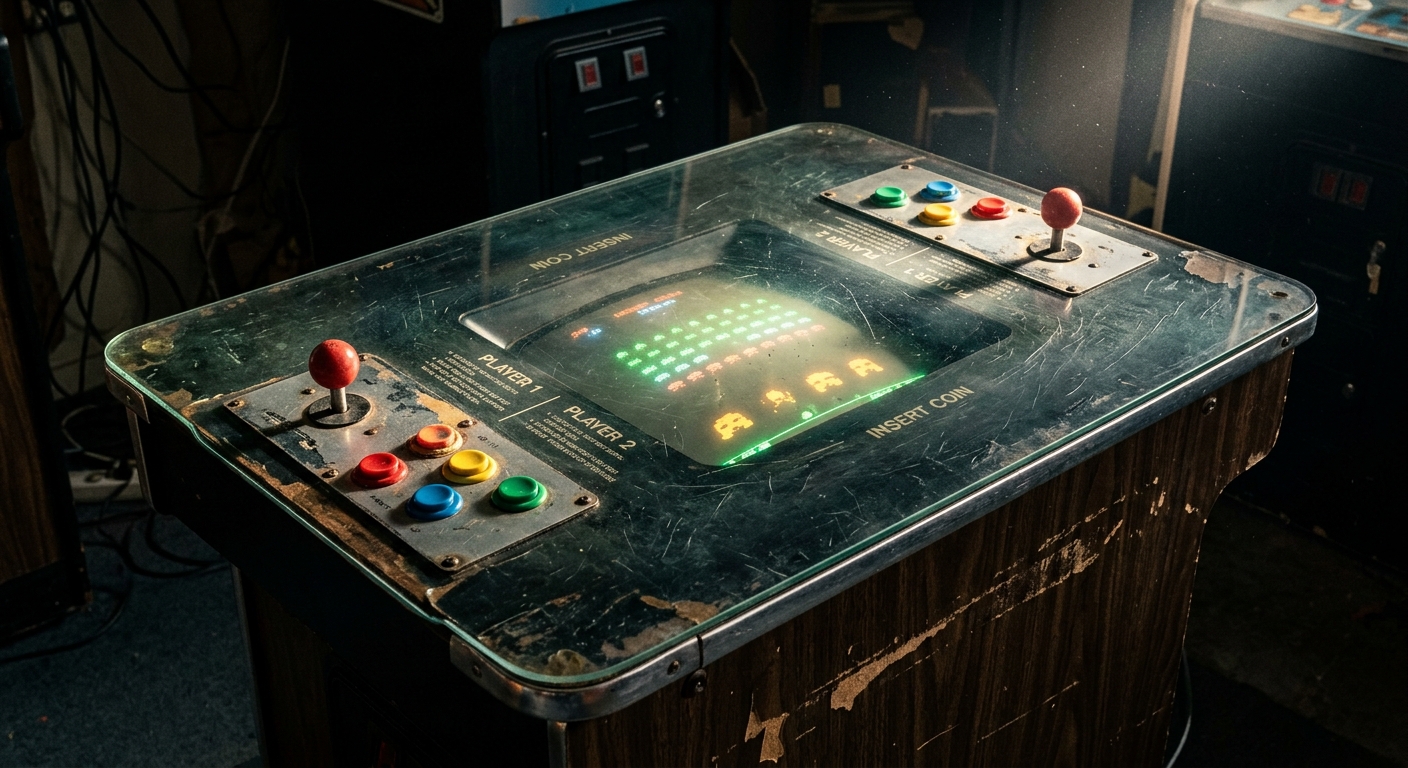
Somewhere in a storage unit outside Dayton, or a shuttered pub in Lancashire, or a garage in Fresno, there is a cocktail-cabinet arcade machine running a game that exists in no emulator database, on no cartridge, and in no one's living room. The PCB still boots. The ROM chips still hold their data. And the person selling it for two hundred dollars thinks it is a table.
Why Cocktail Cabinets Occupy Their Own Archaeological Layer
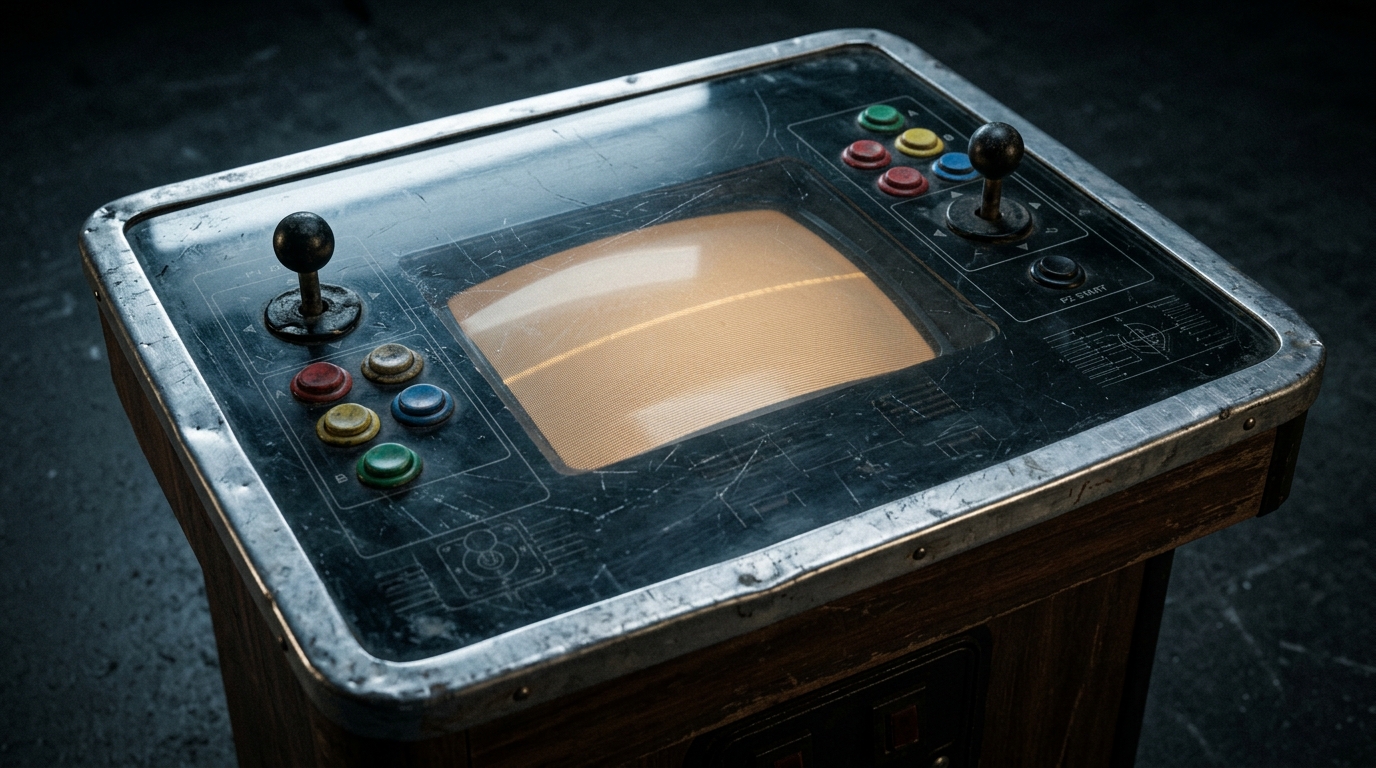
The cocktail cabinet was designed for a room that was not an arcade. It went into pizza parlors, bowling alleys, and bar corners, squat and table-height, with controls facing each other across a glass top. That form factor shaped everything about its cultural fate. Because the machine read as furniture rather than as a game cabinet, it was disposed of through restaurant liquidators and estate sales, not collector auctions. Upright cabinets commanded walls and became landmarks. Cocktail cabinets collected drinks.
That social DNA also meant that titles built specifically for the cocktail format were almost never ported to Atari, ColecoVision, or any other home system. The face-to-face two-player geometry, the low sightline, the ambient bar noise the designers were designing against: none of that translated. Publishers did not bother. So when the machines disappeared, the games disappeared with them, uncopied and undiscussed, into a category of loss that is different from a forgotten upright title. There is often no home version to fall back on. There is only the original hardware, or nothing.
Preservation communities have stepped into that gap. The Vintage Computer Federation Forums and the Museum of the Game forums function as distributed archaeology projects, accumulating PCB scans, ROM dumps, and photographic evidence for titles that no institution has formally catalogued. The researchers are hobbyists. The methodology is crowd-sourced visual comparison and community memory. And it works, repeatedly, in ways that centralized databases have not managed to replicate.
The first intellectual shift a serious hunter must make is treating the cocktail cabinet as a distinct artifact class, not a reskinned upright. The identifying marks are different. The failure modes are different. The documentation trails, when they exist at all, run through bar supply records and estate inventories rather than through arcade operator logs. Once you internalize that distinction, the search becomes legible.
Field Identification: Reading the Machine Before You Read the Manual
Coin doors are among the most reliable dating tools available to a field researcher. Threads on the Museum of the Game forums document collectors cross-referencing hinge styles, lock barrel diameters, and bezel stampings to narrow a cabinet's origin to a single manufacturer and a two-year production window. That level of precision from a single component is remarkable, and it is the reason experienced hunters photograph the coin door before they photograph anything else.
The underside of the monitor glass deserves equal attention. The exterior of a cocktail cabinet that spent a decade in a bar has usually lost most of its markings to cigarette burns and spilled drinks. But the glass underside and the two-player control clusters, which face inward and downward, often preserve silk-screening, part numbers, and distributor stickers in near-original condition. A macro lens and a small LED panel light, angled low, will pull detail from that surface that a phone camera will miss entirely.
PCB edge connectors on cocktail-exclusive hardware are the point of highest risk in any identification session. Non-standard pinouts are common, and misidentifying them before powering anything on has destroyed more irreplaceable boards than water damage. Photograph the connectors first, share the images on the Museum of the Game identification threads before you connect anything, and wait for confirmation. The community response time for a well-documented submission is often measured in hours rather than days.
Sourcing and Legal Access: Where the Machines Actually Are
Estate sales in regions with high bar density during the 1978 to 1984 window still surface cocktail cabinets at rates that surprise newcomers. The American Midwest, coastal California, and the industrial northeast of England are the most productive territories, because the machines were integrated into commercial interiors and their disposal followed the same channels as secondhand restaurant equipment. A collector who monitors local estate sale listings with the same regularity they monitor auction sites will find machines that never appear online.
Regional collector clubs affiliated with VCF events, including VCF Midwest and VCF East, maintain informal registries of members willing to grant access to non-running machines for documentation and ROM preservation purposes. That access is often the only legal path to a dump when a cabinet cannot be purchased outright. The community operates on the understanding that documentation has value independent of ownership, and most collectors who have been doing this for more than a few years have benefited from someone else's generosity in exactly this way.
ROM preservation under fair use and abandonware frameworks remains legally gray in most jurisdictions, and the practical guidance from preservation communities is consistent across forums: document physical provenance thoroughly, work with established repositories rather than ad hoc distribution sites, and avoid distributing dumps of titles with demonstrable current rights holders. Online estate auction platforms have expanded sourcing geography significantly, but they have also made in-person verification or a trusted regional proxy essentially non-negotiable, because a seller who cannot power a machine on cannot tell you whether the PCB boots.
Getting Forgotten Games Running: Emulation, Original Hardware, and the Middle Path
MAME's cocktail-mode emulation handles rotated-display logic and dual-control-set mapping automatically for any title in its database. The problem, which is the entire point of this archaeology, is that titles which were never dumped are not in the database. That situation requires either a working original PCB or a custom FPGA implementation built from reverse-engineered schematics, neither of which is a casual weekend project.
Games like Asteroids Remake and Segment Storm show how vector-display and early raster architectures informed the design decisions of cocktail-exclusive hardware, and understanding those parent architectures matters when you are trying to extend an existing MAME driver to accommodate a new ROM set. For titles built on modified Galaxian or Space Invaders boards, community-written drivers that handle the parent hardware have been successfully extended to new ROM sets multiple times, with VCF and Museum of the Game threads documenting the process in public.
The intermediate approach favored by experienced restorers is to use a working cocktail cabinet shell as display and control infrastructure while substituting a modern single-board computer running MAME for the original PCB. The physical and social experience of the face-to-face configuration is preserved even when the original board is too degraded to revive. Sitting across a low table from an opponent, in a room that approximates the original context, is not nostalgia performance. It is the only epistemically honest way to evaluate design decisions made specifically for that spatial arrangement. No emulation window on a desktop monitor replicates the sightline geometry the designers assumed. Games like Dot Chomper and Star Dive make more sense when you understand the social geometry they were built around.
Building a Personal Reference Archive Before the Machines Disappear
Machines are still being scrapped at a rate that outpaces preservation efforts. The most urgent task facing any cocktail-cabinet archaeologist is documentation before acquisition, because a comprehensive photograph and measurement record of a cabinet that cannot be saved is infinitely more valuable than no record at all. A blurry photograph of an unidentified coin door that prompts three responses from collectors who recognize it immediately has saved more machines than any number of perfectly composed images of already-catalogued hardware.
A standard documentation kit fits in a carry-on bag: a mirrorless camera, a macro lens, a small LED panel light, a millimeter ruler, and copper-braid solder wick for cleaning edge connectors before photographing. That kit can produce submission-quality records for the Museum of the Game or MAME's source repository in a single two-hour session with a cooperative seller. The ruler matters more than most beginners expect. Dimensional data on PCB mounting holes and control panel cutouts has resolved identification disputes that photographs alone could not settle.
Cross-referencing personal field records against catalog entries for games with similar visual signatures helps situate an unidentified board within a manufacturer's production lineage before full identification is confirmed. Early raster shooters and vector-display titles, including platform relatives of GoAndZap, carry enough visual and architectural family resemblance that a knowledgeable hunter can often narrow the search to two or three candidate manufacturers within the first hour of examination.
The community consensus, borne out across hundreds of identification threads, is that sharing partial and uncertain documentation is far more productive than waiting for certainty. Post the blurry photograph. Include the measurements you are not sure about. Mark your uncertainties explicitly, and let the crowd work. That posture, more than any single piece of equipment or technical skill, is what makes this hobby function.
Sources

Mara Solis is a staff writer at GoAndGame covering board games, tabletop strategy, and the culture around competitive play. She has spent years logging hours at game tables from local hobby shops to international conventions. Her writing blends practical insight with a genuine enthusiasm for the communities games create.


