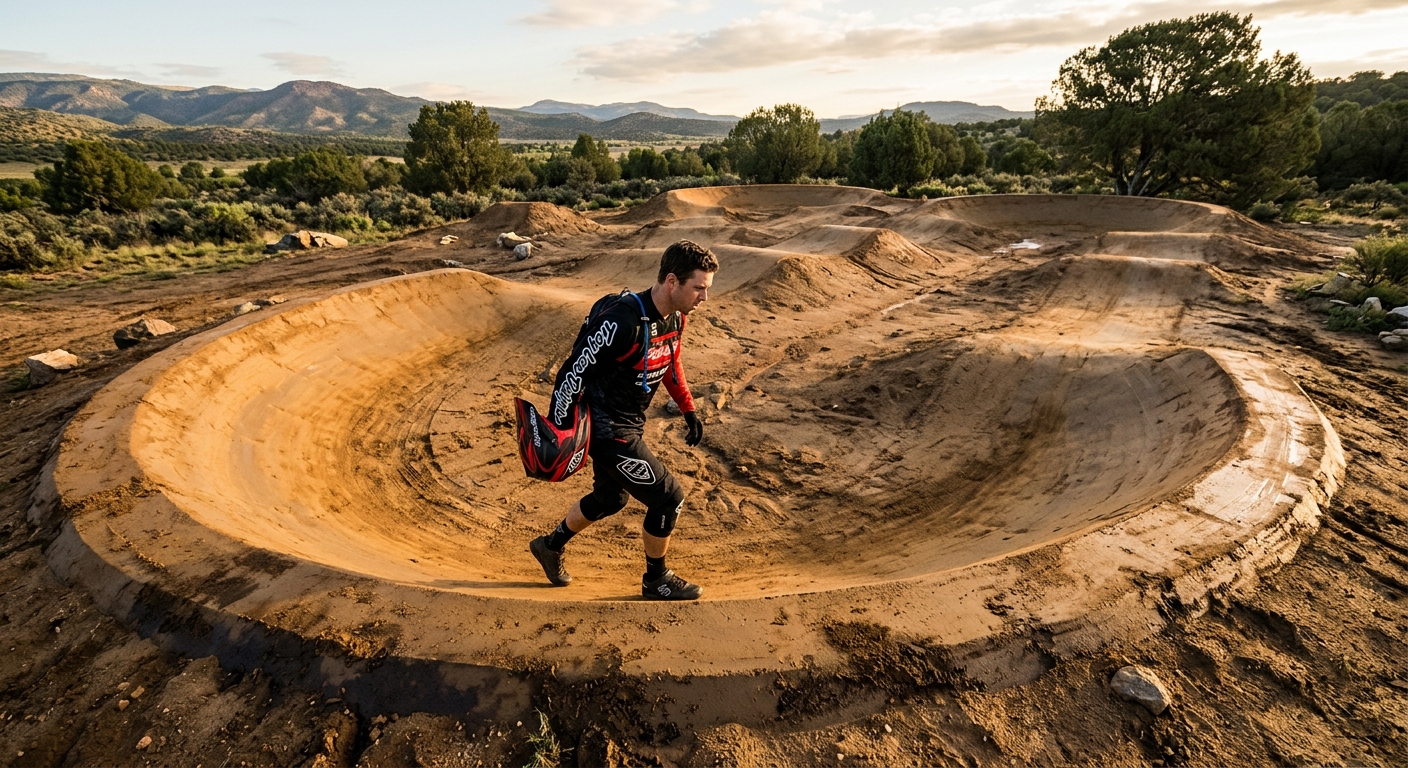
The fastest lap on a pump track is decided before you ever clip in. Riders who win timed runs consistently report the same habit: they walk the entire circuit on foot, at race pace on zero watts, reading the dirt the way a poker player reads a table. That walk is not warmup. It is information collection, and what you do with it shapes every decision you make once the clock starts.
Reading the Terrain Before You Drop In
Start at the entry and walk the full layout without skipping sections. You are looking for the compacted crown of each roller, that slightly glossy strip across the top where rubber and impact have sealed the soil into a surface that transfers force cleanly back into the frame. The shoulders of the same roller will look duller and softer. Drift two inches onto those shoulders under load and you lose generated speed with nothing to show for it.
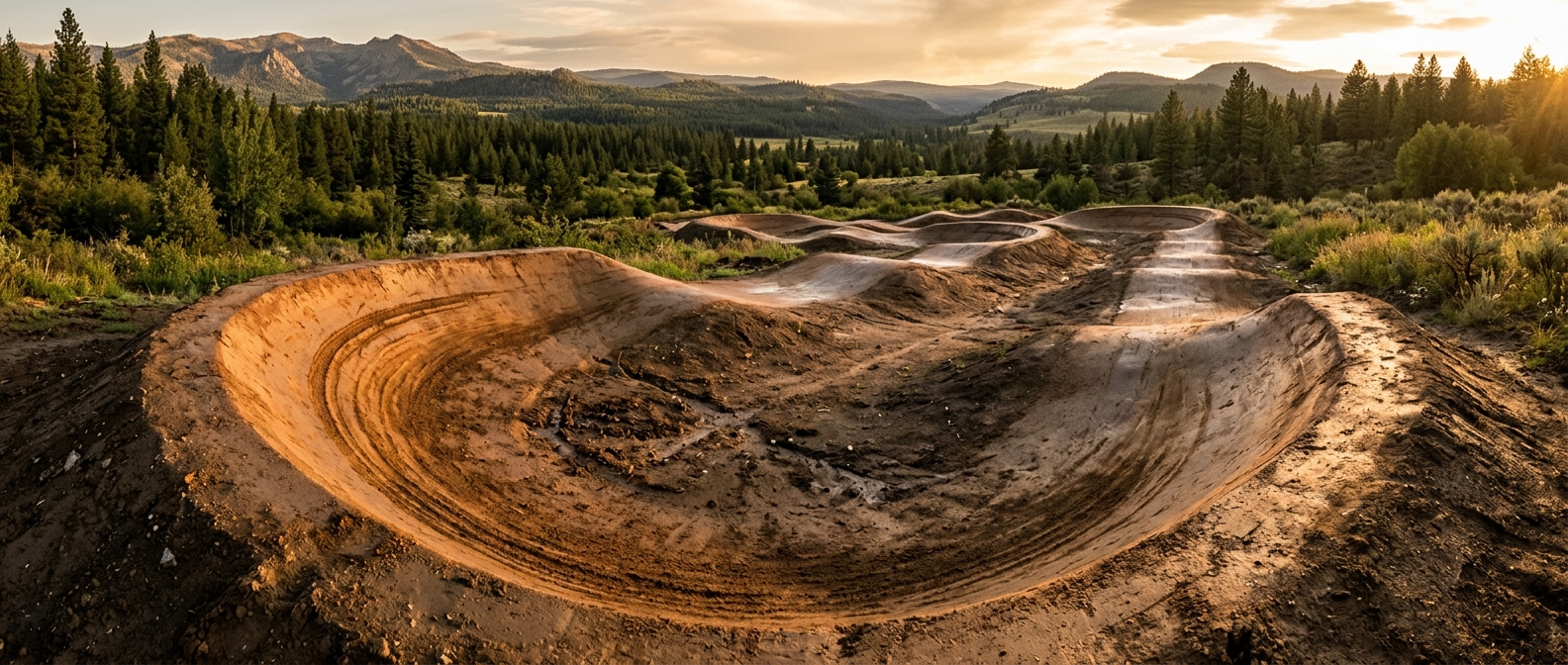
Pay attention to moisture staining at the base of berms. A dark crescent where water pools marks soil that has lost its structural stiffness. On a dry morning that patch may feel firm enough, but two hours of riders compressing it will turn it greasy by the time a race heat runs. Flag those spots mentally and plan your line to cross them at the flattest possible angle, minimizing lateral load on a surface that cannot support it reliably.
Elevation change across the full circuit matters more than any single feature height. A track that drops even half a meter over its total length gives you kinetic energy to borrow early in the lap. Your opening line should favor features that let you absorb that natural fall rather than fighting it. Riders who ignore overall gradient tend to over-pump the first section and arrive at mid-circuit already fatigued, having spent energy the terrain would have given them for free.
Understanding Pump Zones and Rhythm Sections
Rhythm sections are the engine rooms of any lap. The entry line into a sequence of rollers determines whether you exit with surplus speed or bleed velocity trying to correct a mis-timed weight shift mid-section. The difference between those two outcomes is almost always readable in the dirt: look for a subtle change in surface angle at the compression point of the first roller. That is where the fastest arc begins, and previous riders have already traced it for you as a faint groove worn into the soil.
Treat the entire rhythm section as one fluid unit, not a series of individual obstacles. Your body position over roller one is already setting up the compression timing you will need over roller three. The optimal line threads not just through the crest of each feature but along an imaginary sine wave that keeps your center of mass traveling in the smoothest arc across the whole sequence. Riders who break the section into discrete jumps, resetting their weight after each crest, consistently exit slower than riders who let the wave carry them through.
When a rhythm section curves partway through, the fastest line cuts slightly to the inside of the curve early. This shortens total distance traveled and positions the bike on the uphill face of the next roller at exactly the moment peak compression returns maximum propulsive force into the frame. The geometric center of the track is not your friend in a curving sequence. Find the groove that exits the curve already pointing at the next feature rather than needing a correction to reach it.
Berm Entry, Apex, and Exit Geometry
Berms are where lap times are either protected or destroyed. The most common mistake at intermediate level is entering too high on the berm wall. That trajectory forces an exit that bleeds speed into flat ground rather than launching the rider toward the next feature. The correct entry point is almost always lower than it looks from a standing position outside the turn, and it almost always feels uncomfortable the first time you commit to it.
Think of the apex not as a pivot but as a launch ramp. Arriving at the apex with the bike leaned into the wall and your hips driving down and forward converts circular momentum into linear acceleration. The exact location of that apex shifts depending on what follows the berm. A tight rhythm section demands an early apex that straightens the exit line before the first roller of the sequence. An open flat section can tolerate a later apex that maintains corner speed longer. Study what follows before you decide where to aim.
Exit trajectory must be pre-visualized during entry. Once you commit to an arc the dirt gives you very limited ability to correct course. The riders who consistently put down fast berm splits describe the same mental process: they are aiming through the exit from the moment they hit the lip of entry, treating the berm wall as a redirectional surface rather than a boundary. That distinction is not semantic. It changes where your eyes go, which changes where your weight goes, which changes everything that happens in the following meter and a half of dirt.
Adapting Your Line as Track Conditions Change
A pump track is not a static circuit. It evolves across a session as rubber deposits build on roller crests, dust layers over previously moist sections, and repeated rider weight compresses certain features while leaving adjacent ones relatively untouched. The fastest line at the start of a practice session may be measurably slower by the time a race heat begins, and riders who treat the course as fixed pay for that assumption in the results.
Riders who adapt fastest to changing conditions build a specific habit: one exploratory lap at reduced speed whenever conditions shift significantly, deliberately testing grip at each berm apex and at the compression point of the first and last roller in every rhythm section. That single-lap investment almost always returns more time than it costs. Think of it as buying current data at a discount before the race clock makes the price much higher.
Temperature and humidity play a larger role than most riders appreciate. A track that felt loose and powdery during morning practice can transform into a fast, predictable surface by midday as heat drives surface moisture upward and reactivates the natural binders in clay-rich dirt. That same track, if cloud cover drops temperatures before an afternoon final, can become slick and unpredictable within twenty minutes. The winning line at the start of the day may require a completely different approach by the last race, and riders who refuse to update their mental model are already behind before they drop in.
Competition Strategy: Committing to Your Line Under Pressure
In timed solo formats the biggest threat to line execution is not the track itself but hesitation. Research into cycling and motorsport decision-making consistently shows that partial commitment to a line produces worse outcomes than fully committing to a slightly suboptimal one. The mechanical and physiological cost of a mid-feature correction exceeds the cost of the original line's inefficiency. Knowing this in advance is useful. Internalizing it enough that you do not flinch in the moment takes repetition.
Head-to-head racing introduces a second variable that solo riders rarely train for. A competitor on an adjacent lane generates visual and auditory noise that the brain interprets as threat information, triggering a measurable shift in attention away from your own line and toward their position. Elite riders counteract this with anchor cues: specific visual reference points on the track surface or surrounding structure that they fix their gaze on at predetermined moments, regardless of what the competitor is doing. Pick your anchors during the pre-race walk, not during the run.
Post-run analysis should focus on three features where the largest time gaps between riders typically accumulate: the entry berm of the first major turn, the center roller of the longest rhythm section, and the final feature before the finish. Optimizing these three locations tends to improve overall lap times more efficiently than hunting for gains uniformly across every element of the circuit. If you are debriefing with a coach or reviewing video, start there. The rest of the track will often clean itself up once those three anchors are sorted.
If you want to map these principles against a course before committing them to muscle memory, Dirt Pump surfaces enough of the same line-selection pressure to be genuinely useful as a conceptual rehearsal space. It is not a substitute for dirt under your tires, but the decision-making loop it creates translates directly to the walk-then-commit workflow that separates fast laps from frustrating ones.

Priya Nambiar covers competitive gaming and emerging esports ecosystems for GoAndGame, with a particular focus on Southeast Asian scenes and grassroots tournament culture. She came up through community forums before moving into sports journalism, and that background shapes everything she writes.


