
Bubble Bobble and its puzzle-shooter cousins reward a specific kind of thinking: not the shot you are about to take, but the two or three that follow it. Most players learn the color-matching basics quickly. Fewer learn that the scoring system is built almost entirely around what happens after a cluster pops, not during it. Understanding that gap is what separates a solid casual score from a genuine leaderboard entry.
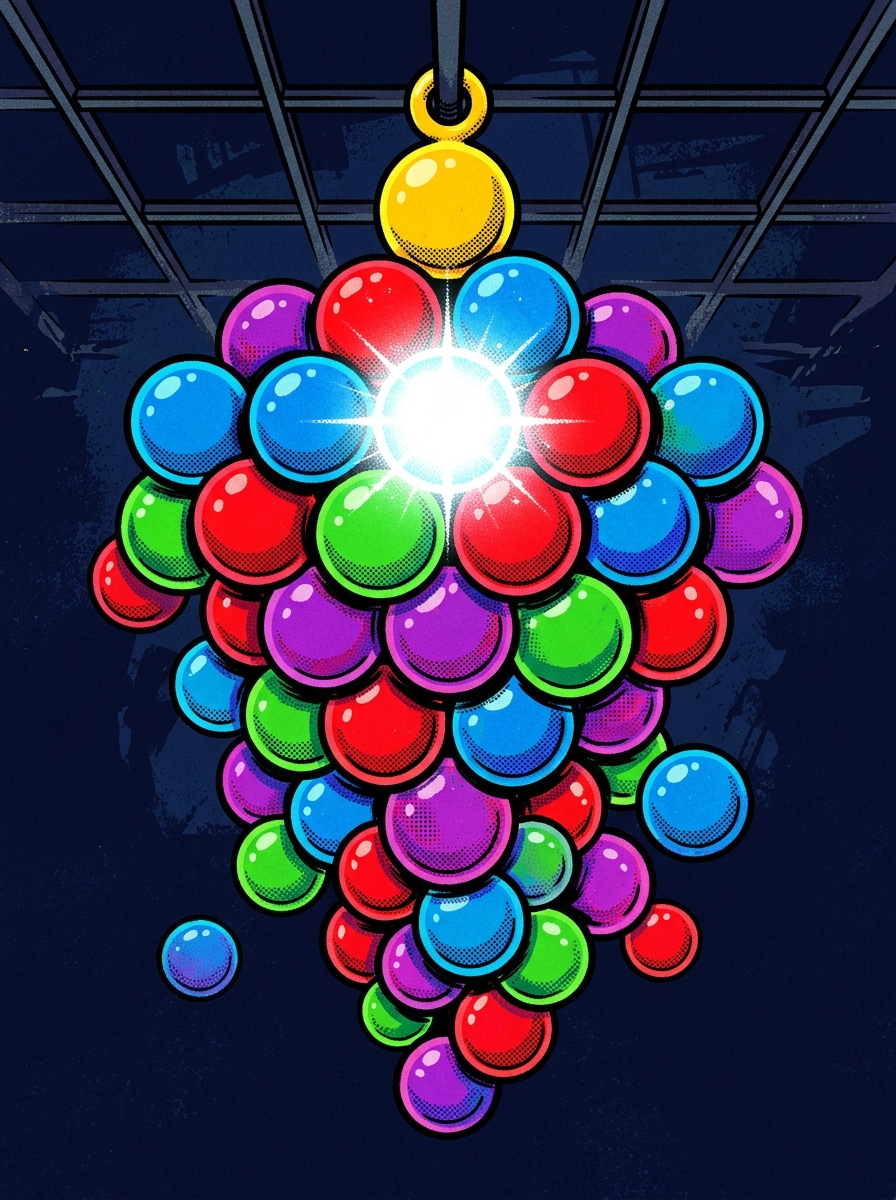
The core mechanic to internalize is the difference between a bubble you actively pop and a bubble that falls because it lost its anchor. Dropped bubbles, the ones that detach from the ceiling after a support cluster is removed, score significantly more than directly shot bubbles. In Puzzle Bobble and Bust-A-Move variants, a large ceiling drop typically outscores a sequence of careful direct pops covering the same bubbles. A player who clears a board with three well-placed drop-combo shots will often outscore one who clears the same board with twelve direct shots.
Chains compound this further. Consecutive combo rounds within a single stage stack the multiplier, so two drop-combo shots back to back produce more than the same two shots taken with non-scoring turns between them. This is why experienced players sometimes hold a useful bubble in the queue, waiting for the board configuration that allows a chain rather than spending it immediately on a safe direct pop.
Reading the Board for Anchor Clusters
An anchor cluster is any small group of bubbles whose removal will cause a significantly larger hanging mass to detach. Finding them before you shoot is the central skill. Look at the ceiling and trace which groups are load-bearing. A cluster of three bubbles holding up forty is worth far more attention than a cluster of twelve sitting flush against the top with nothing hanging below it.
The practical drill is simple: before each shot, ask whether your current bubble can connect with at least three same-color bubbles while simultaneously undercutting a hanging mass. Both conditions together are the target. Either one alone is useful. Neither means you are playing reactively, which is fine for casual play and slow death for competitive runs.
Scanning the bubble queue matters just as much. Knowing that your next two bubbles are red and then yellow lets you plan a sequence instead of solving one turn at a time. Queue awareness is consistently cited as the skill most underused by intermediate players. The queue is free information. Use it.
Bank Shots Are Not a Fallback
Wall bounces belong in every shot selection, not just when a direct line is blocked. Many of the highest-value anchor clusters sit in positions that have no clean direct approach because the board geometry protects them. A bank shot from the opposite wall is often the only way to reach them, and a well-placed bank into an anchor cluster can produce a drop combo that a straight shot would never achieve.
The practical way to build this skill is to practice angle estimation on open boards, before row-descent pressure or a ticking clock forces rushed decisions. Reflection angles in bubble shooters are consistent, and the side walls behave predictably once you have internalized a handful of reference angles. Treat them as a known tool the way you would treat color matching, not as a creative emergency measure.
Leaderboard Strategy: Consistency Over Spectacle
Community high-score competitions for Puzzle Bobble and Bust-A-Move judge on cumulative score across all stages. That structure has a specific implication: early-stage combo efficiency matters as much as late-stage survival. A spectacular combo on stage fourteen does not compensate for piecemeal play on stages one through eight. The players who consistently appear at the top of those boards are not the ones who land one perfect multi-drop per game. They are the ones who maintain a steady combo rate across every stage.
Consistency across rounds matters more than a single spectacular combo. Players who maintain a steady combo rate outpace those chasing one perfect shot per game.
There is also a technique worth knowing: deliberately leaving a small residual number of bubbles at the end of a stage in order to collect the stage-clear bonus on top of an already high combo score. The math on when this is worth it depends on how many bubbles remain and what the current multiplier looks like, but the existence of the technique illustrates how far competitive play has moved from the simple goal of clearing the board as fast as possible. Stage-clear bonuses are part of the scoring architecture, and ignoring them leaves points behind.
The Playhop scoring guide frames this well: players who win more usually spot the right shot earlier, before the board becomes a problem. That is the same logic applied to leaderboard runs. The goal is not to survive chaos. The goal is to never let chaos develop, because chaos means non-scoring turns, and non-scoring turns break the multiplier chain that the entire scoring system is built around.
Start with anchor-cluster identification on a single stage. Add queue scanning once that becomes automatic. Add bank shots as a primary tool after that. The multiplier will follow.
Sources

Priya Nambiar covers competitive gaming and emerging esports ecosystems for GoAndGame, with a particular focus on Southeast Asian scenes and grassroots tournament culture. She came up through community forums before moving into sports journalism, and that background shapes everything she writes.