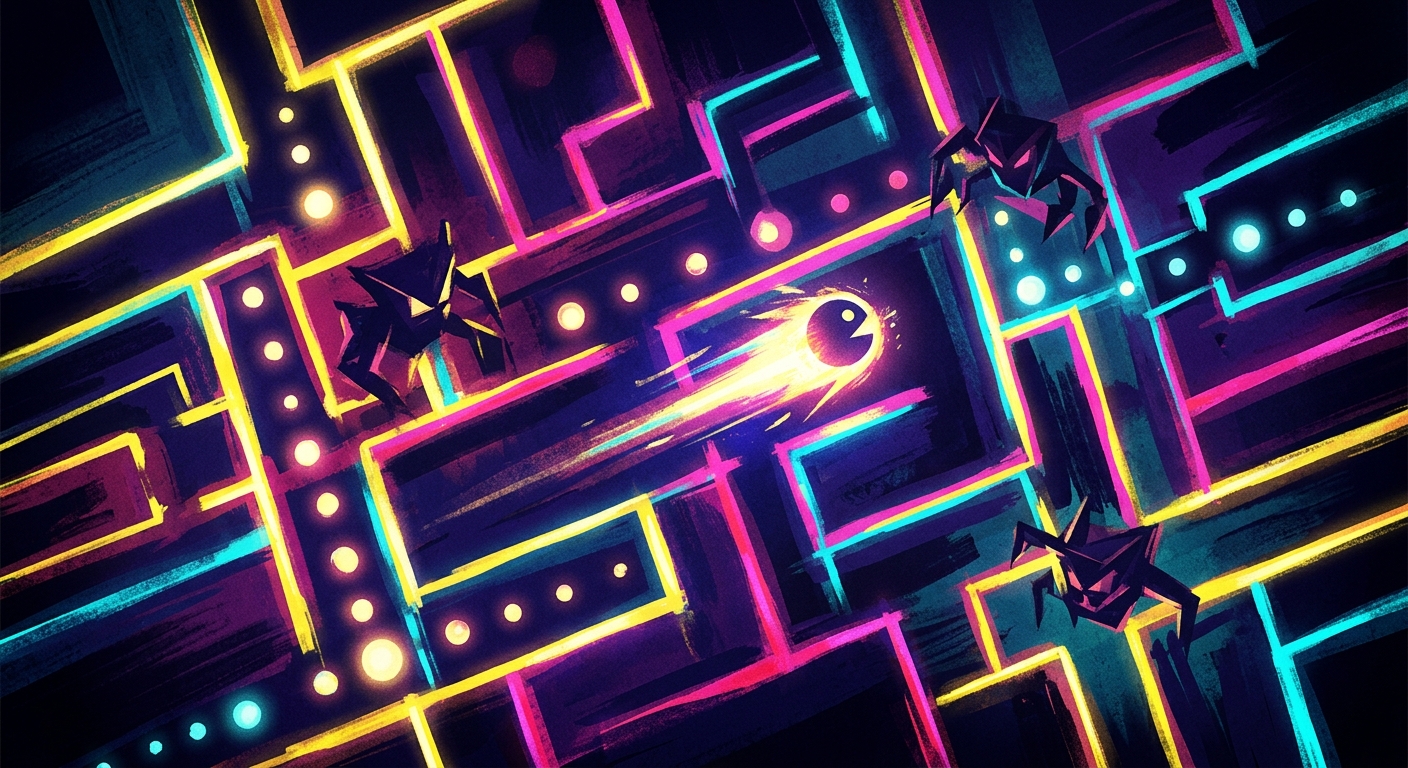
Proto-maze games were not simply forerunners to Pac-Man. They were laboratories for a new kind of interaction. Before the iconic yellow circle, a distinct family of corridor-and-junction titles began to sketch the fundamental grammar of pursuit. These games established a mobile agent, a hostile presence, and a field of collectibles that simultaneously served as progress markers and a ticking clock. The genius lay in the dot itself. This single pixel was a unit of progress, a signal of danger, and a metronome, compelling the player to constant motion. To stand still meant certain defeat.
The Grammar of the Gulp: What Proto-Maze Games Actually Invented
Scholars tracing the etymology of maze games observe that the genre's true characteristic is not the wall, but the junction. As Wikipedia's overview of maze games notes, writers like Mark J. Wolf described Pac-Man as combining maze navigation with collecting and escaping styles, and the genre classification itself only solidified around 1980 under economic pressure from the arcade industry. Proto-maze titles were relentlessly engineered to multiply decision moments. Dot Chomper stands as a stark distillation of this grammar. It stripped away narrative and visual complexity, leaving only the mechanical heartbeat: move, consume, evade, repeat. The game's escalating tempo replaced explicit storytelling, communicating urgency through pure kinetics. Every pellet consumed was both a reward and an announcement of position, pulling the player deeper into the corridor and further from a safe retreat.
Early maze games in the 1970s, such as Gotcha (1973) by Atari, began formalizing these ideas in commercial arcade hardware. By the late 1970s, titles like Head On (1979) and Heiankyo Alien (1979) had expanded basic navigation into something richer, layering collection and avoidance into a single continuous act. The junction, not the corridor, was the true unit of design. Every intersection forced a commitment, and the best proto-maze titles made each commitment feel consequential.
Threat Architecture: Designing Enemies That Teach Without Explaining
The ghost-type adversary in these early maze games was never intended to be fair. Its purpose was legibility. Through variations in color, speed, and path preference, enemies communicated their behavioral rules without needing a manual. Players internalized these patterns through repeated engagement. Dot Chomper's antagonists pushed toward a pure abstraction of threat. They used angular, often unpredictable trajectories and varying speeds, suggesting intelligence without needing complex pathfinding code. It proved a cheaper and, in some ways, more viscerally frightening design choice than true AI.
Designers learned that enemies in chase games function best as moving walls. They are dynamic constraints that reshape the navigable space in real time, rather than conventional opponents to be defeated in the traditional sense. Their presence redefines what is safe, where to go, and how fast to go there.

Pac-Man Plus (1982), released by Bally Midway, demonstrated how fragile that learned safety actually was. The game introduced invisible mazes and altered ghost behaviors, including power pellets that sometimes turned only three of the four ghosts blue, making full-round clears by pattern impossible. Remove a single layer of visual information, and the entire perceived threat architecture collapses into genuine dread. Players who had memorized every safe corridor suddenly found their knowledge useless, which revealed something important: the real skill being tested was adaptability, not memorization alone.
Power Pellet Politics: Temporary Inversion and the Pleasure of Role Reversal
No mechanic in the proto-maze canon proved more influential than the temporary power-up. This innovation inverted the roles of predator and prey. It introduced a timed economy of courage, forcing players to strategize when to spend their window of dominance. It was not merely a reaction; it was a choice. Dot Chomper's version of this mechanic demanded precise calculations. Players had to weigh distance, the number of remaining threats, and the density of pellet clusters simultaneously. This created a micro-strategy layer beneath the game's deceptively simple surface.
The inversion fantasy, where the hunted becomes the hunter, is a powerful psychological hook. The moment of empowerment is timed to expire before vulnerability returns, creating a cycle that pulls players back repeatedly. Pac-Man Plus sharpened this by making power pellet outcomes unpredictable: eating a bonus item could turn ghosts both vulnerable and invisible, doubling their point value while making them nearly impossible to track. That unpredictability reframed the power-up as a calculated gamble rather than a guaranteed reprieve. Games across the broader arcade catalog that feature sudden offensive windows or temporary invincibility inherit this structural logic directly, even when their visual presentation shares nothing with a dot-lined corridor.
Spatial Memory as the Real Skill Ceiling
On the surface, maze games appear to reward pure reflexes. A longer look at how players actually improve tells a different story. Elite performers are distinguished by spatial memory, the ability to maintain a mental model of threat positions across the entire maze while navigating a local corridor. Wikipedia's history of the maze game genre identifies a post-1980s shift where designers increasingly offloaded spatial complexity onto procedural generation, trading the deep memorization curve for greater accessibility. That trade-off remains debated among genre purists, and with good reason.
Dot Chomper amplified the spatial memory demand through irregular junction density. Safe corridors were not evenly distributed across its layouts. Players had to internalize which dead-end clusters represented acceptable risks at different threat-speed tiers, and that internalization took time. The chase loop achieves its full psychological weight only when the navigable space is learnable but not trivially so. It requires enough dedicated sessions for a genuine internal map to form before true mastery can begin. Strip that learning curve away with procedural layouts and the game becomes a series of first impressions rather than a skill that compounds.
Dot Chomper's Downstream Influence on Non-Maze Arcade Forms
The chase-and-collect loop, refined in proto-maze games, migrated far beyond corridor-and-junction titles. It infiltrated shooter-adjacent and score-attack genres where the physical maze was replaced by an abstract threat envelope. Players navigated that envelope through movement discipline rather than literal path selection. Titles built around field-clearing under intense enemy pressure, where the collectible field is also the danger field, owe a structural debt to the dot-economy logic that Dot Chomper exemplified. The pixel art may share nothing with a ghost chasing a yellow circle, but the underlying tension is identical: every item collected increases exposure, and exposure is what kills you.
Procedural and roguelite branches of arcade design absorbed these elements readily. The inversion mechanic and the demand for spatial memory were integrated even as the fixed maze was discarded, producing chase-loop experiences that are theoretically infinite yet mechanically coherent with their 1980s ancestors. The Wikipedia survey of maze games traces the genre's legacy through Pac-Man Championship Edition (2007) and notes that core gameplay persisted long after side-scrolling and 3D environments had displaced the maze as a dominant commercial form. That persistence is not nostalgia. It is evidence that the underlying design, a mobile agent consuming a field of collectibles while managing dynamic threats, solved something fundamental about how humans engage with pressure and reward. Dot Chomper's legacy is ultimately about that inseparable pairing: every moment of collection is also a moment of risk, and every reprieve is borrowed time.

Julian Thorne is a seasoned house writer for GoAndGame, known for his deep dives into obscure game mechanics and industry trends. He often explores the sociological impact of gaming, blending critical analysis with historical context.


