The term 'meta', short for 'most effective tactics available', exists as a widely understood, if often misapplied, shorthand within competitive gaming. It describes the current nexus of dominant strategies, character selections, loadouts, and playstyles that a given player base converges on. Yet, this definition, while practical, often obscures a crucial truth: the meta is never static. To treat it as a fixed target, rather than a constantly shifting force, is to fundamentally misunderstand competitive ecosystems.
Every balance patch, every subtle tweak to an ability's cooldown, or every newly discovered interaction sends ripples through the established order. A strategy that commands supremacy one week can become obsolete the next, as developers adjust their designs in response to community feedback, tournament results, and their own evolving design philosophies. Those who grasp the meta as a living, breathing system, one that demands continuous observation and critical analysis, consistently outmaneuver players who merely memorize optimal builds without comprehending the underlying logic that drives those choices. This historical churn is not a bug; it is a fundamental feature of competitive design, a perpetual negotiation between designer intent and player ingenuity.
What Is the Meta and Why Does It Keep Moving
The persistent motion of the meta is less an anomaly and more an inherent characteristic of complex systems. Unlike a solved game with a finite strategy space, live-service competitive titles are intentionally designed to resist stasis. Developers introduce new content, alter existing mechanics, and respond to emergent play patterns, all of which contribute to a cyclical disruption and reformation of what constitutes 'optimal' play. This constant evolution prevents the game from stagnating, ensuring a prolonged engagement from its player base. The philosophical implication is clear: competitive mastery lies not in achieving a final state of knowledge, but in adapting to perpetual flux.
Consider the core loop of competitive feedback. A dominant strategy emerges, players adopt it, its efficacy becomes undeniable, and then developers intervene. This intervention is often a calculated rebalancing, a deliberate attempt to open up new strategic avenues or reduce the dominance of an over-performing option. This cyclical process has historical parallels in military theory, where prevailing tactics are constantly countered and adapted. The digital battlefield, in this sense, is no different from its physical predecessors; an arms race of ideas, continuously escalating and evolving.
Reading the Signals: How Competitive Ecosystems Broadcast Their Own Shifts
Understanding the meta demands more than just reacting to developer updates; it requires an incisive ability to read the ecosystem's own internal signals. Competitive games, by their very nature, are transparent about their shifts, broadcasting impending changes long before they solidify into common knowledge. The challenge lies in discerning these signals from the noise, a critical skill that separates the reactive player from the predictive strategist.
To effectively anticipate a meta shift, one must synthesize data from diverse sources. This is not merely about aggregating statistics; it is about interpreting their implications within the game's broader context.
- High-level tournament play, for example, functions as an early warning system. Professional competitors invest extraordinary time to discover edge cases, synergies, and counter-strategies that casual players will not encounter for weeks, or even months. Their innovations frequently presage broader meta shifts.
- Empirical data, such as win-rate databases, pick-and-ban statistics, and streaming viewership metrics, offer quantitative proxies for directional momentum. Learning to interpret these numbers is akin to reading market indicators in a financial system. The expanding academic literature on online gaming economics explicitly draws this parallel.
- Community forums, patch anticipation threads, and the commentary from content creators provide a crucial qualitative layer. These sources capture theoretical debates, player sentiment, and speculative analysis that pure statistics cannot convey.
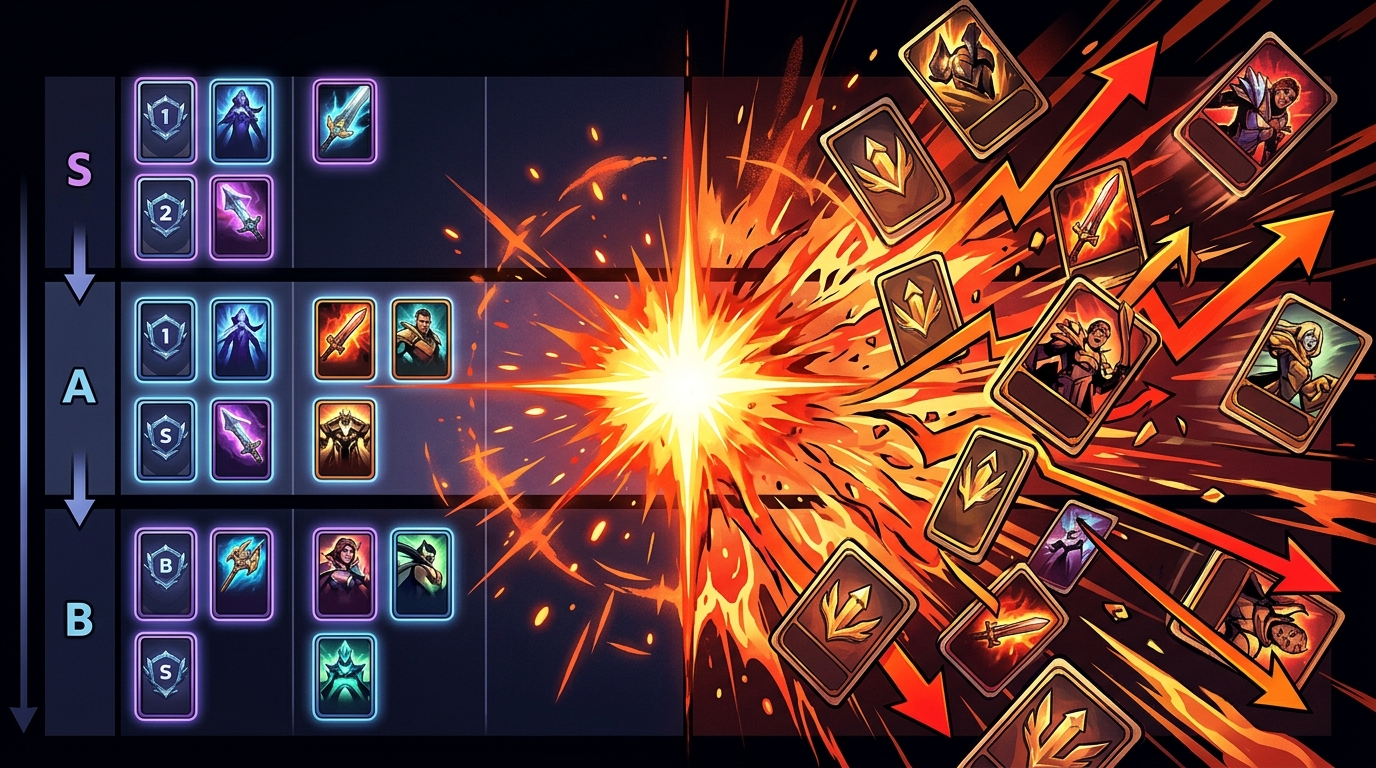
Interpreting these signals is not simply about observation; it is an active, critical process. The data points outlined above are not just facts; they are potential vectors of change, indicators of where competitive consensus is heading, sometimes long before it fully arrives.
- The strategies pioneered by professionals, while often niche at first, demonstrate theoretical ceilings and practical viability under pressure. These are often the seeds of future dominant strategies.
- Quantitative metrics offer cold, hard evidence of performance trends, highlighting what is working at scale and what is falling behind. A sudden spike in a character's win rate, even with low pick rates, can signify a breakthrough.
- Qualitative discussions, while subjective, reveal the collective consciousness of the player base. They show which ideas are gaining traction, which are being dismissed, and where the community's creative energy is focused.
Predicting the Next Dominant Strategy Before It Dominates
True competitive advantage stems from prediction, not merely reaction. To foresee the next meta, one must move beyond surface-level observations and cultivate an understanding of developer intent. This intent is encoded not just in explicit patch notes, but in broader design philosophy statements, developer livestreams, and the historical patterns of a studio's balancing decisions. A studio that has consistently punished dominant defensive strategies in the past, for instance, will almost certainly do so again, given the right circumstances.
Prediction also involves an incisive analysis of currently underplayed options. Many characters, items, or strategies possess strong theoretical ceilings but suffer from weak current adoption. These are the sleepers, often one small buff, one new item interaction, or one discovered synergy away from becoming overwhelmingly powerful. Identifying these latent strengths and developing practice around them before their break-out moment offers one of the clearest competitive advantages a dedicated player can achieve. The online gaming market's rapid expansion through 2033, as detailed in industry reports, means a larger influx of players with less foundational meta knowledge. This, paradoxically, creates more fertile ground for informed prediction to yield significant dividends.
Disrupting the Meta: The Art and Ethics of Counterpick Culture
Disruption is not synonymous with invention. More often, it involves identifying the implicit assumptions embedded within a dominant strategy and then deliberately violating one of those assumptions in a manner the meta has not yet learned to penalize. This critical approach, rooted in questioning established orthodoxies, defines the highest levels of competitive play. The art lies in understanding the core logic of the prevailing meta and then subverting it with precision.
Counterpick culture embodies this principle. It is the practice of selecting options specifically chosen to exploit the weaknesses of anticipated opponent strategies, rather than simply maximizing raw individual power. This strategic approach has historically produced some of the most memorable upsets in competitive gaming, demonstrating that superior strategic thinking can overcome perceived power imbalances. However, this pursuit of disruption also introduces an ethical dimension. An ongoing conversation within competitive communities debates the line between legitimate disruption and tactics perceived as deliberate griefing or 'cheese' exploitation. This social dialogue itself influences how quickly developers patch out destabilizing discoveries, making the sociological currents of the meta as vital to track as its mechanical ones. The meta, then, is a social construct as much as it is a mechanical one.
Applying Meta Thinking to Arcade-Style Competitive Play
Arcade-adjacent competitive games present a unique, often underestimated, meta challenge. Their apparent simplicity can lead players to believe the optimization layer is shallow, yet this assumption is fundamentally flawed. Twitch-reaction games, like those requiring precise movement or target prioritization, frequently develop surprisingly deep meta conversations. These often center around intricate routing strategies, optimal priority targeting in chaotic scenarios, or subtle resource denial techniques that rival the complexity found in more overtly strategic titles like Star Dive or Segment Storm.
Games built around classic score-attack or survival structures, such as Dot Chomper, also foster complex meta-games, but these are organized around risk-reward thresholds rather than opponent reads. Players and communities collectively discover, then codify, the exact points in a run where aggressive play yields maximum points versus where conservative play is necessary to preserve a high score or extend survival. These codified thresholds are not immutable; they shift whenever scoring systems are adjusted, enemy behaviors are tweaked, or new environmental factors are introduced. Understanding and applying meta thinking in these contexts is ultimately about learning to see any game system as a dynamic negotiation between designers, competitors, and the game's own emergent properties - a negotiation that never fully concludes, and one that rewards continuous, curious attention more than rote memorization of any single dominant approach.
Sources
- Online Gaming Market Competitive Landscape Report 2025-2033: Top Companies Analysis, Profiles, Strategic Developments, Sustainability Goals, Mergers, Product Launches, Innovations, Revenue Insights
- https://arxiv.org/pdf/2508.19152
- Agent Tools
- Mastering Meta-Strategies in Competitive Card Games
- Gaming Forecast 2025: Key Trends in Video Games

Julian Thorne is a seasoned house writer for GoAndGame, known for his deep dives into obscure game mechanics and industry trends. He often explores the sociological impact of gaming, blending critical analysis with historical context.


