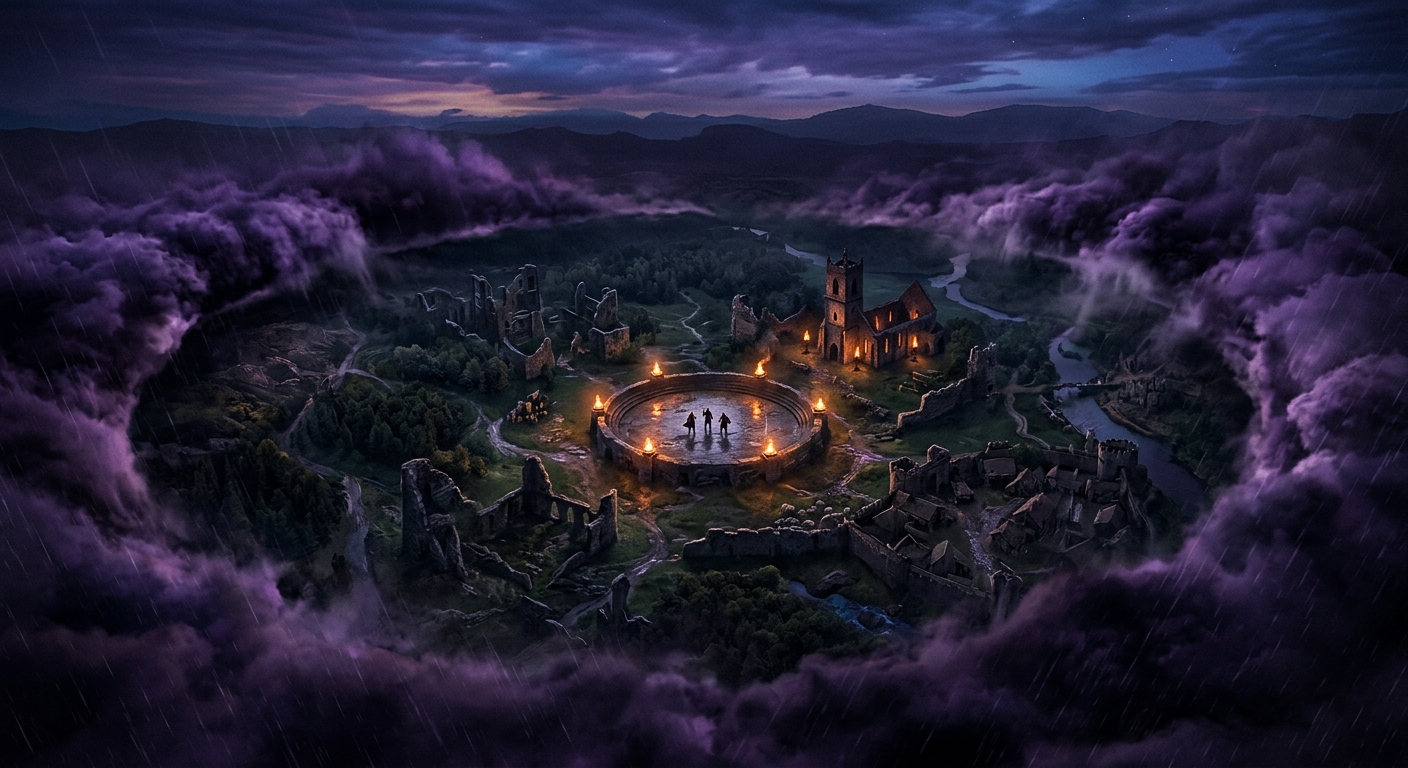
The last quiet minutes of a Nightreign expedition can make a half-finished build feel convincing. You have a weapon you like, a few levels, and a team that survived two nights together. Then the final encounter starts, and every choice made on the shrinking map gets tested at once. Preparation begins well before that threshold, while there is still time to choose one more fight, visit one more church, or turn runes into levels.
Spend the time the map gives you
A Nightreign expedition runs across two days of exploration, each ending in a night boss, before the final confrontation with the chosen Nightlord. The closing rain gives both days their shape. Early on, a distant objective may be worth the trip. As the safe area contracts, crossing the map for an uncertain reward becomes a gamble with the clock.
Plan backward from the second night. Decide which nearby sites can still improve the team, then stop treating every marker as an invitation. The Nightreign wiki's Game Progress Route recommends reaching level six to eight before the first night boss, and level eleven to fourteen before the second, with the second night boss often providing the rune push to hit the expedition cap. Work toward those targets first. A long detour toward enemies you are unlikely to finish before the rain arrives offers only the appearance of progress. The aim is to reach each nightly fight with resources you can actually use, not with three promising locations still visible on the map.
A manageable field boss may offer a useful reward. A church may expand how many flask charges you can carry into the final arena. These stops earn their place on the route. A third side trip that pushes you to the edge of the safe zone does not.
Build for the boss before the expedition begins
Relics belong to the preparation before a run. Equip them in a vessel at the Roundtable Hold, where you can compare effects without a storm closing around you. Once the expedition is underway, focus on the weapons, passive effects, consumables, and levels available in that run rather than counting on a late Relic swap. The Nightreign wiki's guides to Relic Effects and vessels are useful when deciding which bonuses suit a Nightfarer's usual role.
Give that role a practical test before the expedition locks in. If your plan depends on staying close enough to stagger a boss, look for damage and survivability that support repeated openings. If you expect to fight from range, ask how you will recover when the arena stops offering comfortable distance. A powerful effect that rarely activates in your intended fight is taking up space that a dependable one could use. The Night Aspect fight, for instance, punishes players who hold Holy damage tools in reserve too long: according to Method's Night Aspect guide, Heolstor's second phase opens immediately and aggressively, so anything you planned to spend there needs to be ready, not still sitting on a cooldown.
Turn the second day into a final checklist
On day two, spend runes at a Site of Grace whenever you can secure a useful level without wrecking your route. Unspent runes cannot protect anyone during the final fight. The harder judgment is how long to keep farming. One extra level is valuable. Dying outside the safe area while chasing it can cost more than that level provides.
Check your weapon as carefully as your level. Damage that feels adequate against scattered field enemies can make a long boss fight exhausting. If a sensible nearby objective offers an upgrade or a better weapon, prioritize it over clearing another pack for its own sake. Leave enough time to reach the night's boss together. A teammate arriving late, separated by the rain, turns a routine transition into an avoidable rescue. The second night boss often grants enough runes to push a player to the expedition's level cap, so arriving healthy and together matters more than one last skirmish at the edge of the map.
Flasks refill at Sites of Grace, so using a charge on day two does not permanently subtract from the final battle. Use healing as needed to survive the approach. Saving a flask charge is no achievement if the team loses a player before the night boss even begins.
Know which fight is waiting
The final opponent is selected with the expedition, so preparation can be specific. Read the chosen Nightlord's attacks before setting out, especially the moments that punish a revive, a long cast, or a greedy final hit. For an expedition facing the Night Aspect, Method's guide describes Phase 1 as a warmup with the Shape of Night, a figure using a broken straight sword that gains a greatsword and dagger around 75% health. The guide's explicit advice is to conserve flasks and Ultimate Arts for Phase 2, where Heolstor opens without hesitation. Do not assume those timings describe every other Nightlord.
Scouting also means noticing what your own group can do. A player who reliably draws attention may create safe windows for another to deal damage or revive a fallen ally. That is more useful than three players independently chasing the same opening. Decide who can take a risk, who covers a downed teammate, and when everyone should back away. These are brief conversations, but the final arena gives little room to have them for the first time. If two players rush a fallen ally during an attack, all three may end up on the ground. One player drawing the boss away while another attempts the rescue is a better split, and it is worth agreeing on before the encounter loads.
Carry capacity, not panic, into the last fight
Solo players need a different kind of discipline than a coordinated group. Learn which attacks allow a healing window and keep a defensive skill ready for any phase or pattern that already proved dangerous during day one or the second night boss. The final Nightlord is not designed to be easier than what came before it. What changes is that you now have two nights of information about how your build actually performs under pressure.
The final night rewards small decisions made early. Runes spent at the right grace, a clear answer to who handles a revive, and a weapon suited to the specific Nightlord waiting at the end can each change the shape of a long fight. When the arena opens, there is no need to wish for a perfect run. You need a workable one, built while the map was still yours to cross.
Sources

Eliot Reed writes about the intricacies of virtual worlds, blending analysis with storytelling. As a house writer for GoAndGame, he delves deep into game mechanics and narratives, offering thought-provoking insights for players and developers alike.


