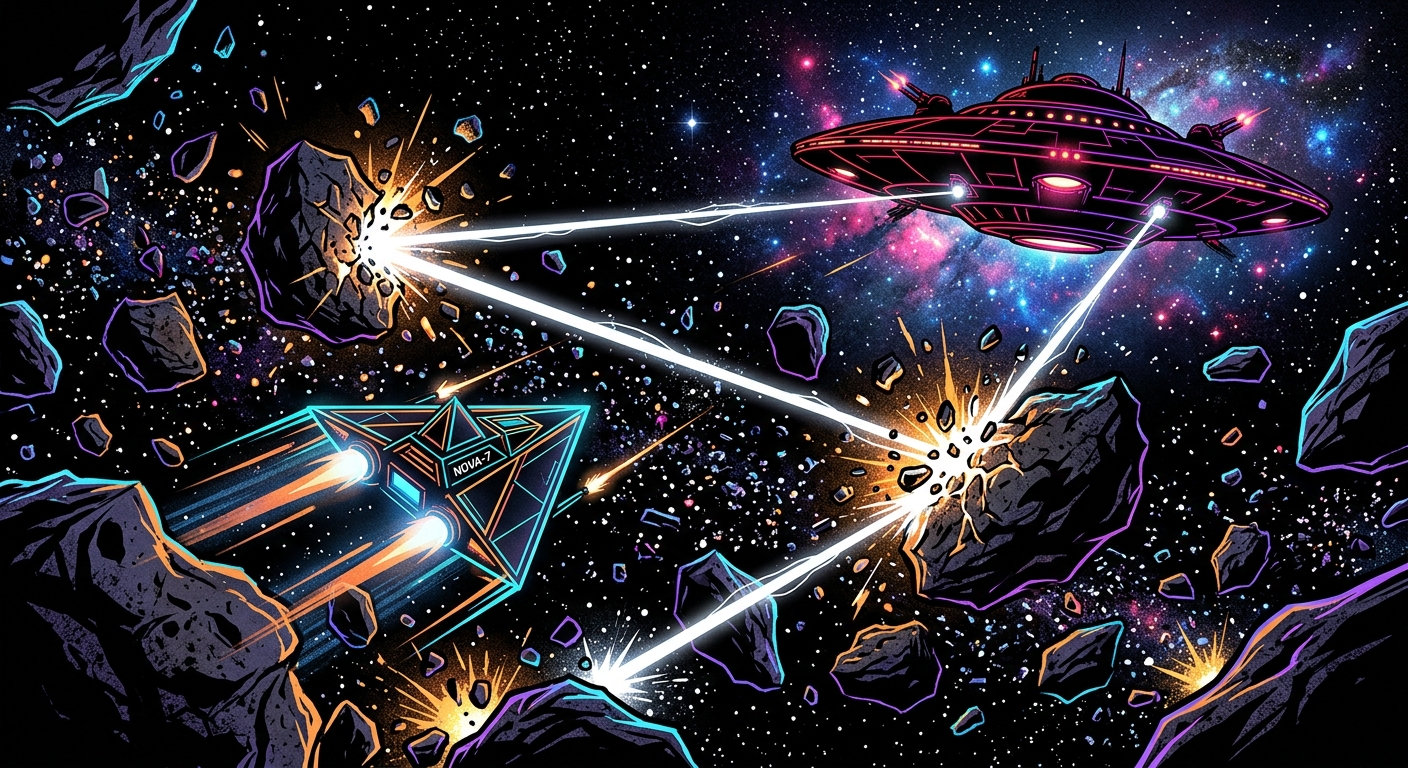
Atari's Asteroids arrived in arcades in 1979 with a deceptively simple premise: pilot a tiny ship through a field of tumbling rocks, break each one into smaller pieces, and survive long enough to post a score worth bragging about. Rotational thrust, wraparound edges, and the constant threat of a flying saucer made the loop addictive in a way that still feels immediate today. Nearly five decades later, indie developers keep returning to that same loop, not because they lack imagination, but because the blueprint is genuinely hard to improve on.
The Original Blueprint Still Holds Up
The genius of Asteroids is that every decision compounds. Shoot a large rock and you gain points but also spawn two mid-sized rocks moving faster in unpredictable directions. Shoot those and you get four small, darting fragments. The screen fills with chaos of your own making, which means every point earned carries a cost in risk. That feedback loop rewards players who think a second ahead without punishing newcomers who just want to shoot things.
Atari followed the original with Asteroids Deluxe, released in April 1981. Designer Dave Shepperd swapped the hyperspace escape button for a depletable shield and added the "Killer Satellite," a cluster of ships that breaks apart and actively chases the player after being hit. These changes were meant to close off the saucer-hunting exploit that let skilled players extend a single credit indefinitely. The result was a harder, less forgiving game. Some players loved the added pressure; many others found it punishing enough to walk away. The tension between accessibility and depth is one Asteroids has never entirely resolved, which may be part of why remakes keep trying to find a better balance.
Fan Remakes on the Indie Scene
Solokill Studio posted an Asteroids Remake announcement to the itch.io community forums in December 2025. The pitch was stripped down by design: no long story, no complicated tutorials, just tight ship controls and a high score waiting to be beaten. The thread drew 161 views in its first days, a modest number that nonetheless signals a real audience for no-frills arcade throwbacks. The game lives on itch.io rather than in any catalog arcade, which fits the project's spirit. It is a fan exercise in fidelity, not a commercial reimagining.
What stands out about Solokill's approach is the deliberate refusal to add features. Modern game development culture defaults toward more content, more systems, more onboarding. Choosing to ship something with a single-screen premise and a leaderboard as the only goal is itself a creative decision, one that takes confidence to stick with when every tutorial video says otherwise.
The Scratch-to-Executable Pipeline
RGS took a different path with the ASTEROIDS Mega 2025 Update, porting a Scratch-built remake into a standalone Windows executable. Scratch is a block-based programming environment aimed at students, so shipping a playable .zip from it is a real milestone for a hobbyist developer. The controls modernize the experience with WASD movement and mouse aiming, while keeping the rotational feel that defines the original. The game also includes a handful of cheat codes typed directly into play: "Slime" swaps the asteroid sprites for Minecraft Slimes, "Rainbow" makes the ship cycle through colors, and "Flash" doubles movement speed. These are small jokes, but they signal a developer who enjoys the medium and wants players to poke around.
The record score posted on the itch.io page sits at 5,347 points, set by a player identified as ABPG. That kind of public leaderboard entry is a small detail with real weight. It gives the next player something concrete to chase, which is the entire point of the original arcade design, and it shows that even a Scratch port can generate genuine competition.
What These Projects Reveal About Retro Revival Culture
Two Asteroids-inspired projects shipping within the same period of 2025 is not a coincidence. Nostalgia cycles tend to cluster around anniversaries and social media visibility, and a game from 1979 has had enough time to become foundational to multiple generations of developers who grew up with it, emulated it, and eventually built their own versions. The remakes that surface now are rarely attempts to compete with polished commercial releases. They are closer to cover songs: proof of affection, tests of craft, and contributions to a shared cultural record.
The accessibility angle matters here too. Both the Solokill and RGS projects are free. Neither demands a high-end machine or a subscription. They run in a browser or download in under 100 MB. That frictionless entry point is part of what keeps the Asteroids tradition alive, because the original game asked nothing of you beyond a quarter and a few minutes of attention. If you want to explore other arcade-style challenges in a similar vein, the catalog includes games like Segment Storm, Star Dive, and Go and Zap, each of which carries some DNA from the same era of fast, single-screen play.
The staying power of Asteroids comes down to one thing: the mechanics are honest. The rocks move according to simple physics. The ship handles the same way every run. There is no randomized loot, no unlockable power-up that changes the fundamental equation. What you get better at is the game itself, and that kind of mastery still feels worth earning.
Sources

Alexandra Rivet explores the intricate interplay of games and culture for GoAndGame. A passionate storyteller, she delves into narratives with depth and curiosity. Her pieces often highlight the stories behind the pixels.


