
Namco's Armadillo Racing spent almost thirty years as a coin-op exclusive that most players outside Japan had essentially no chance of ever touching. That changes now. Hamster Corporation is bringing the 1997 arcade oddity to home consoles through its Arcade Archives label, catalog entry ACA-420, marking the first time the game has ever been available outside a physical cabinet. For a certain stripe of arcade historian, that is genuinely big news.
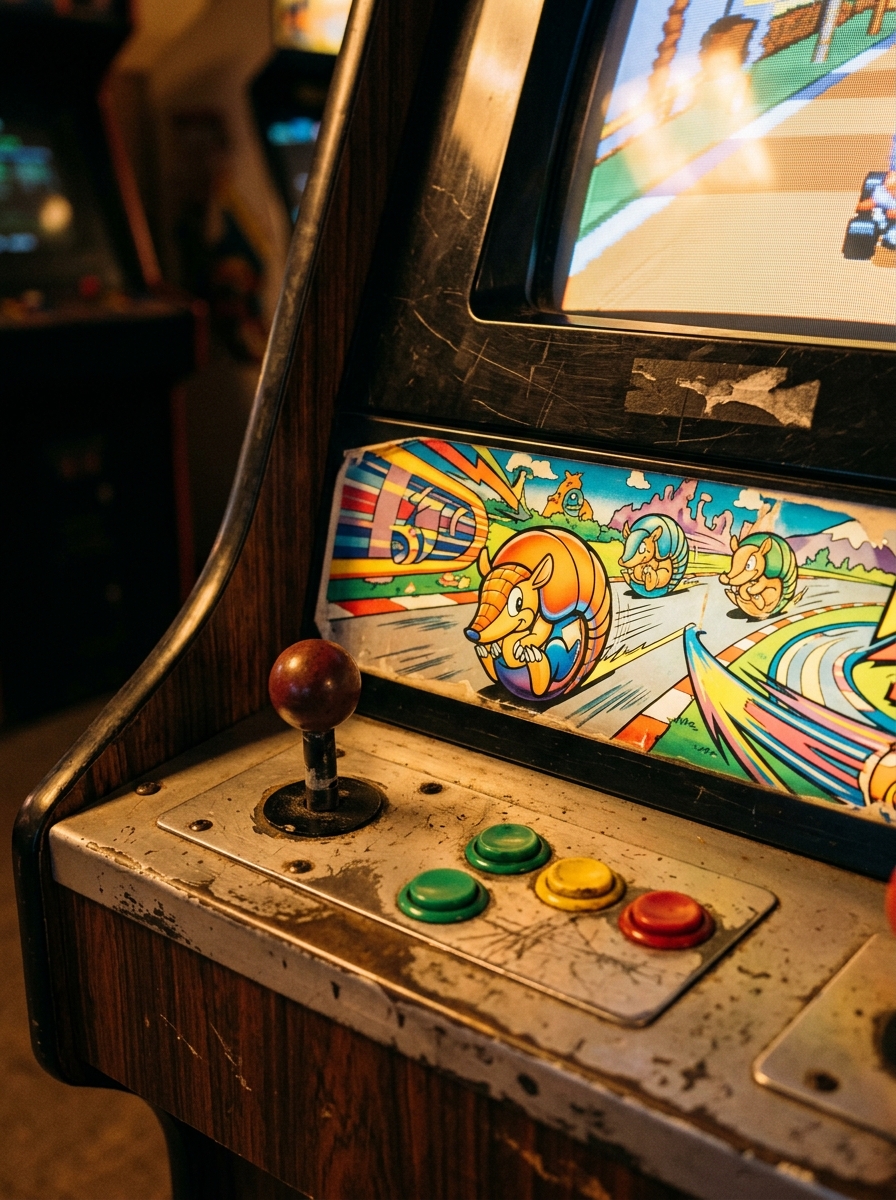
The game never enjoyed the home conversions that its Namco stablemates took for granted. Ridge Racer hit PlayStation in the console's launch window. Tekken became a franchise. Armadillo Racing, meanwhile, stayed quietly in the coin-op tier, profitable enough in its own modest way but never popular enough to justify the development costs of a home port. Decades passed. Cabinets aged out of service rotations. The game became the kind of footnote that arcade historians trade notes about in dedicated Discord servers and forum threads, something more rumor than reality for most players.
Time Extension called the release "deeply meaningful," and that phrasing lands correctly. There is a specific feeling attached to games that have existed only inside hardware that is slowly disappearing from the world. Getting one of them onto a platform millions of people own is not a small thing.
What the Game Actually Does
The central mechanic separates Armadillo Racing from the steering-and-braking rhythm of conventional arcade racers. Your animal curls into a ball and gains momentum as it rolls, so the skill you are developing is not really about cornering lines or brake points. It is about reading how a spherical creature with genuine rolling physics wants to move through a course, and working with that rather than against it. Speed management becomes something closer to understanding a body in motion than operating a vehicle.
Namco built two distinct track types into the experience. Obstacle courses fill the path with events and hazards designed to disrupt any clean strategy you think you have established. Sprint courses strip all of that away and ask a simpler question: have you actually learned how this animal moves? First-place finishes unlock a bonus sequence, a small celebratory payoff that kept the session feeling light and replayable, exactly the coin-op design logic you want when the next player is already waiting to feed in quarters.
That two-mode structure is smarter than it might sound. The obstacle courses give newcomers chaos to hide behind, a reason to keep trying even when they have not yet internalized the physics. The sprint courses give returning players a clean benchmark. Both modes work together to create a game with a longer shelf life than the novelty premise alone would suggest. If you have spent time with other offbeat arcade racers, the dirt-pump style of momentum-heavy movement will feel familiar, though Armadillo Racing approaches the problem from a distinctly different angle.
Hamster's Ongoing Preservation Work
Hamster Corporation has been running the Arcade Archives label long enough that its catalog now stretches into the hundreds. The company's approach has stayed consistent throughout: faithful emulation, minimal added layers, careful attention to how the original game actually felt to play. Namco, SNK, and Taito properties make up a significant portion of the library, and releases land on both Nintendo Switch and PlayStation platforms.
The ACA-420 catalog number gives some sense of the scope. Four hundred and twenty entries is a serious body of work, and each one represents a game that might otherwise exist only in aging hardware, in unofficial emulation archives, or in the memories of people who happened to live near the right arcade at the right time. For Armadillo Racing specifically, the Arcade Archives release is the definitive version by default. There is no home conversion to compare it against. This is the record.
That distinction matters in practical terms. Unofficial emulation can approximate a game, but it cannot make it discoverable through a storefront, cannot attach it to a platform's achievement or social infrastructure, and cannot give it the kind of legitimate visibility that lets researchers and new players find it without already knowing to look. Hamster's own product page for ACA-420 describes the series as "faithfully reproducing classic arcade games, staying true to its original," and for a title with no other surviving consumer version, that faithfulness is not just a quality standard. It is the entire ballgame.
The Middle Tier Problem
Armadillo Racing belongs to a category of arcade games that is genuinely difficult to talk about in preservation circles, because the category resists easy definition. These are not forgotten failures. The game ran in arcades. It made money. Namco built it, released it, and moved on. But it never crossed the threshold into cultural visibility that would have made a home port worth the investment, and so it occupied this awkward middle position: too successful to be written off as a curio, not successful enough to survive the transition out of the arcade era intact.
Arcade-adjacent communities have been making the case for years that this middle tier deserves the same archival attention as landmark titles. The argument is not especially complicated. A game does not have to be historically important to be worth preserving. It just has to be a game that someone made, that other people played, and that would otherwise cease to exist in any accessible form. The counterargument, which usually involves limited resources and audience uncertainty, is getting harder to sustain as retro gaming interest expands the potential audience for preserved classics well past the dedicated collector base.
Other titles in this space, including more rhythm-heavy action games like those in the segment-storm lineage, have benefited from similar re-releases, suggesting that the market for genuine arcade oddities is broader than publishers historically assumed. Armadillo Racing is a reasonable test of that thesis. It is mechanically unusual. Its premise reads as eccentric even by late-1990s standards. And it is arriving on consoles for the first time nearly thirty years after its original release.
What Comes Next for Games Like This
The question Armadillo Racing's console debut poses is not really about one rolling armadillo. It is about what happens to the long list of arcade titles still sitting in the same situation: playable only on original hardware that is aging out of existence, accessible to researchers through unofficial channels but not to general audiences through legitimate ones.
Every release in the Arcade Archives catalog represents a decision that a game is worth the effort of documentation and distribution. Those decisions accumulate. Over time, the catalog becomes something closer to an institutional record of what arcade gaming actually was, not just the headline titles, but the weird racers, the odd action games, the things that worked well enough to exist and then quietly disappeared. Armadillo Racing is one of those things, and now it is not disappearing. That is worth noting, even if the game itself turns out to be something you play for twenty minutes and appreciate more as an artifact than as a daily habit. Sometimes the fact of preservation is the story.
Sources

Mara Solis is a staff writer at GoAndGame covering board games, tabletop strategy, and the culture around competitive play. She has spent years logging hours at game tables from local hobby shops to international conventions. Her writing blends practical insight with a genuine enthusiasm for the communities games create.


