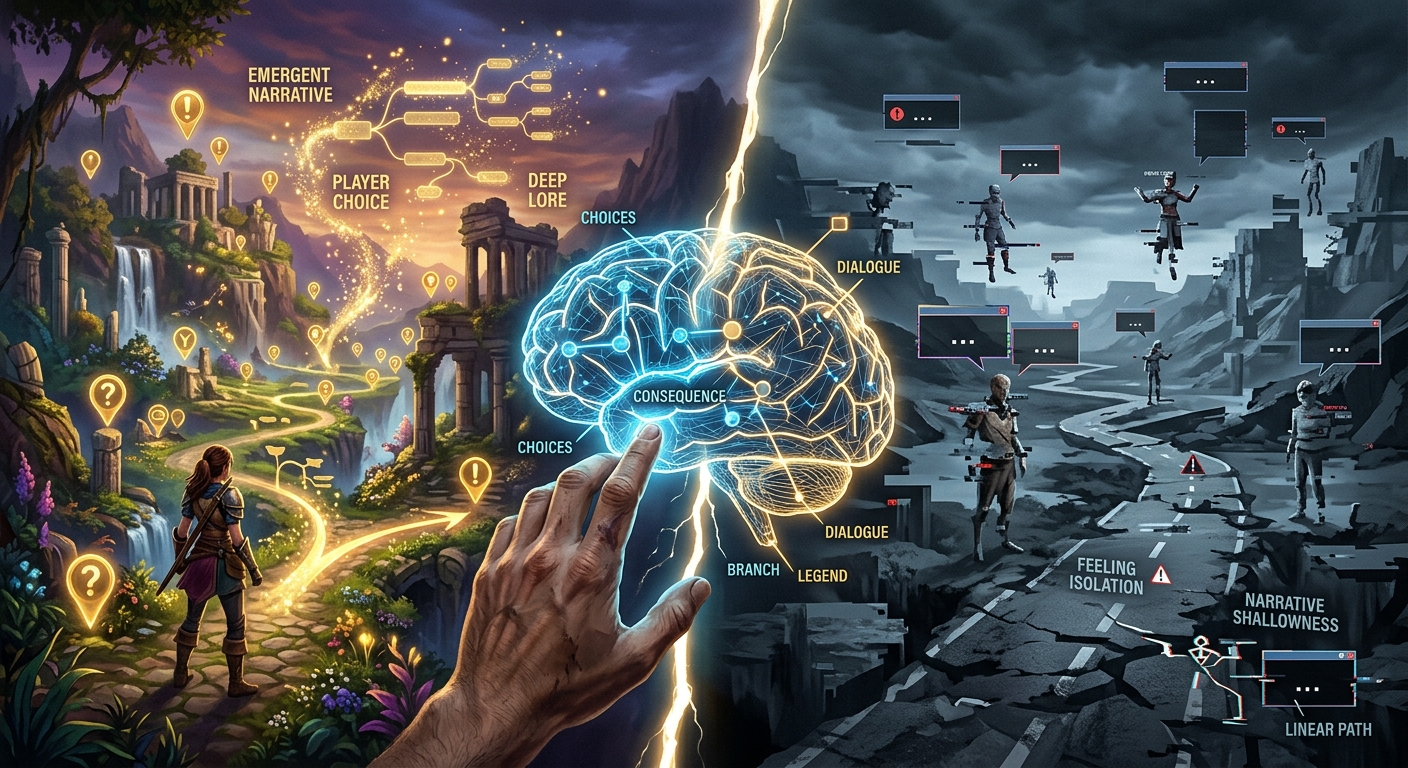
AI tools are changing how games tell stories. Developers and players have mixed feelings about whether this creates richer worlds or leads to shallow experiences.
What's Changing in 2025
- AI-driven narrative engines now generate branching dialogue, quest lines, and world lore dynamically, reducing the need for large writing teams.
- Self-generating worlds mean no two playthroughs are alike, with AI adapting plot points to individual player behavior in real time.
- Studios of all sizes are experimenting with AI co-writers, using large language models to create NPC backstories and enhance environmental storytelling.
The Creative Upside
- Smaller studios now have access to narrative depth traditionally reserved for AAA budgets, lowering entry barriers for ambitious game concepts.
- Dynamic storytelling can increase a game's replayability significantly, keeping players engaged long after a handcrafted story would have ended.
- AI can rapidly prototype narrative ideas, allowing human writers to focus on high-level creative direction and emotional nuances.
The Risks and Pushback
- Critics warn that AI-generated narratives may feel generic or tonally inconsistent, lacking the unique voice that defines memorable game writing.
- Writers and developers have expressed concerns that AI narrative tools could threaten jobs, although specific union positions vary and are evolving.
- Ethical questions around training data continue. Many AI models were built on existing game scripts and fiction without clear licensing agreements.
- Players have begun calling poor AI outputs in games "AI slop": repetitive language, logical inconsistencies, and emotionally flat moments. A related "gameslop" phenomenon, in which low-quality AI games prompted platform curation efforts, has been noted by industry observers tracking AI adoption in gaming.
What It Means for Arcade-Style Games
- Arcade games have typically prioritized mechanics over narrative, but AI tools are now adding minimal story contexts to score-chasing gameplay.
- Even simple narrative elements can enhance player investment in otherwise straightforward action games.
- The danger for arcade-adjacent titles is that unnecessary AI narrative embellishments might impede interfaces designed for immediacy and simplicity.
AI narrative engines promise limitless game worlds, but quality and authorial voice are still the most challenging elements to generate automatically.


For more on AI's role in game development, see Vocal Media's 2025 overview.

Eliot Reed
Eliot Reed writes about the intricacies of virtual worlds, blending analysis with storytelling. As a house writer for GoAndGame, he delves deep into game mechanics and narratives, offering thought-provoking insights for players and developers alike.