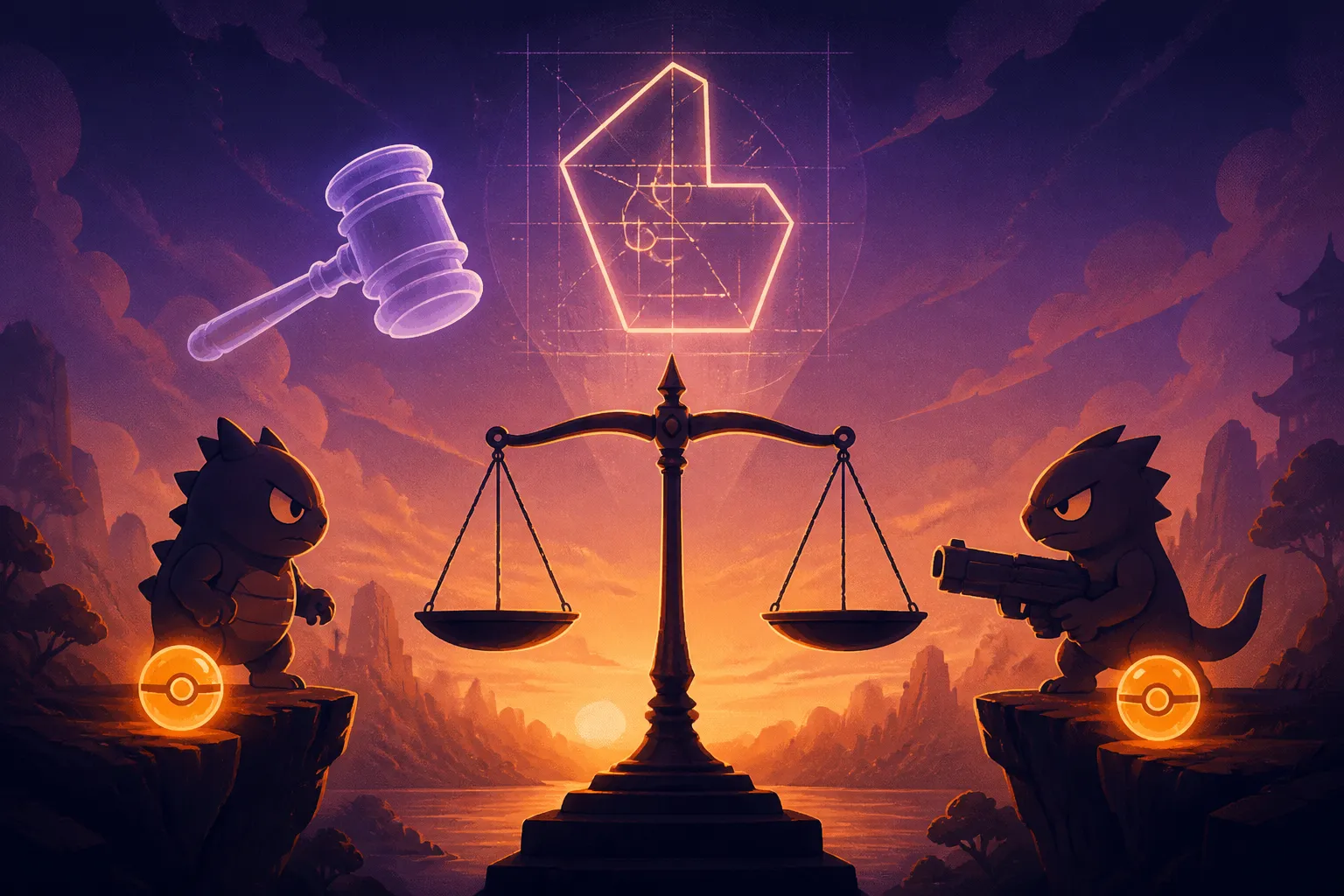
The sudden rise of Palworld, dubbed by many as "Pokémon with guns," ignited a familiar debate in the gaming world: where do homage and inspiration end, and copyright or patent infringement begin? This question, far from new, finds itself tested again as Nintendo and The Pokémon Company pursue legal action against Palworld developer Pocketpair. The dispute asks more than whether monsters look similar; it challenges the very nature of protected gameplay mechanics and the creative freedom within an increasingly interconnected digital space. It is a case that could reshape how game developers approach established genres, pushing the boundaries of what constitutes original work in a medium built on iterated ideas.
The Tokyo Lawsuit and Its Patent Focus
Early in 2024, Nintendo and The Pokémon Company initiated legal proceedings against Pocketpair at the Tokyo District Court. The core of their claim centers on alleged infringement of several patents covering creature capture and combat mechanics. This emphasis on patents, rather than solely copyright, shifts the legal landscape. Copyright protects expression; patents protect inventions. The suit therefore scrutinizes whether specific gameplay systems, rather than just creature designs or narrative elements, constitute protected inventions. Pocketpair, for its part, contends that Palworld does not infringe these patents and has additionally argued that some of the asserted patents may be invalid, which places the validity of Nintendo's own intellectual property under scrutiny. The Tokyo case remains ongoing, its outcome keenly awaited by an industry that often builds on shared mechanical foundations.
Why the "Pokémon With Guns" Label Stuck
Palworld's early access launch on January 19, 2024, was nothing short of a phenomenon, quickly amassing over eight million downloads and attracting more than two million concurrent players on Steam. This explosive popularity brought immediate and intense scrutiny. Critics quickly drew parallels, noting not only the concept of weakening and capturing creatures in special balls but also specific monster designs that seemed to echo those from the Pokémon franchise. This "Pokémon with guns" moniker, while catchy, highlights a crucial distinction: similar mechanics and visual tropes are not the same as copied assets. Pocketpair's CEO publicly stated that the game underwent legal review and that the company had no intention of infringing existing intellectual property. The public discourse, however, often conflates inspiration with direct appropriation, making the court's nuanced interpretation even more critical for the industry's future.
Patents Enter the United States Dispute
The patent dimension of this conflict extends beyond Japan. The United States Patent and Trademark Office (USPTO) has recently granted Nintendo two relevant patents: US patent 12179111B2 on December 31, 2024, and US patent 12220638B2 on February 11, 2025. Both cover gameplay systems for capturing creatures. The language used in these patents is notable. The February patent, for instance, employs more abstract terminology like "virtual character" and "obtaining item," potentially allowing for a broader interpretation of its scope compared to the December filing, which more specifically distinguishes between "capture-by-throwing" and "battle-launch" modes. This abstract phrasing raises concerns across the industry, as broad patent claims could be interpreted to cover a wide array of similar gameplay systems, potentially stifling innovation. Not all Nintendo's patent efforts are equally strong; a December 2024 USPTO action rejected 32 of 33 claims in application 18652883 regarding real-time mount switching, illustrating the challenges of securing broad protections for game mechanics. Meanwhile, the Japan Patent Office approved an amendment to JP7528390, reformulating claims without adding new technical subject matter, indicating a parallel but distinct legal evolution in Japanese patent law.
Copyright, Similarity, and Cross-Border Uncertainty
Beyond patents, copyright remains a central, if less defined, aspect of the Palworld debate. Copyright infringement hinges on whether Pocketpair directly reproduced Pokémon assets or merely borrowed general mechanics and visual tropes. The Pokémon Company has historically shown a willingness to act decisively against clear-cut copying, such as a first-person shooter featuring Pokémon monsters that was shut down pre-release. However, in cases like Temtem or Ni no Kuni, where similarities were less about direct asset copying and more about shared mechanics or thematic elements, the Pokémon Company has not always pursued legal action. This suggests a practical threshold for enforcement, where the line between inspiration and infringement is not always clear-cut. The international nature of the game market further complicates matters; a ruling in Japan might not automatically apply to claims in the United States or other jurisdictions, necessitating a country-by-country analysis of IP protections and legal precedents. The nuances of "substantial similarity" and the varying copyright statutes across nations add layers of uncertainty to any potential global resolution.
Lingering Questions and Industry Implications
The Palworld legal dispute highlights several critical, unanswered questions for the gaming industry. Are the Japanese patents asserted against Pocketpair identical to those granted or pending in the United States, and how do their claims differ in scope? The outcome of pending USPTO applications could well determine Nintendo's strategy for potential litigation in the United States. Moreover, the prevalence of broad, abstract patent language, if upheld, could significantly restrict future game design, potentially limiting the common practice of iterating upon successful mechanics. This legal battle forces developers to confront a challenging reality: the line between innovation and imitation is constantly shifting, defined by judicial interpretations that may not always align with creative freedoms. The absence of a definitive ruling on whether Palworld infringes copyright or patents leaves the industry in a state of flux, grappling with the implications of a case that could redefine intellectual property in the digital age.
Sources

Julian Thorne is a seasoned house writer for GoAndGame, known for his deep dives into obscure game mechanics and industry trends. He often explores the sociological impact of gaming, blending critical analysis with historical context.


