
The headline promises a guide to segment splits and dense waves. The only usable source behind this piece is a reference article on splitting storms, the weather kind. So this article reads that source closely, says what it supports, and marks where it stops. No gaming tips are invented here.
What a splitting storm is
A splitting storm is a convective thunderstorm that separates into two supercells. One drifts left of the mean wind shear direction across a deep layer of the troposphere. The other drifts right. They are called the left mover and the right mover.
The useful part is orientation. In most cases the mean wind shear direction is roughly the same as the mean wind direction. A reader who can see the wind on a forecast can therefore make a rough guess about which way the pair will fan out. Radar first revealed this behavior in the 1960s, which is why the idea is a fairly modern one in storm science. When a split happens, it tends to come within an hour of the storm forming. That makes the window to watch short.
How the two movers differ
Rotation is the cleanest cue. The left mover has a clockwise-rotating updraft. The right mover has a counterclockwise-rotating updraft. Same parent storm, opposite spin.
Hemisphere matters too. In the Northern Hemisphere, hodograph curvature tends to be clockwise, and right-moving cells tend to be stronger and more persistent. In the Southern Hemisphere the pattern runs the other way, with counterclockwise curvature. The source states this rule by hemisphere and nothing finer, so check where a storm sits before assuming which cell will win.
One more caution. The weaker split can fade fast, or be so weak that it never shows on radar imagery. A single visible cell does not prove a split never happened.
Wind shear and hodograph clues
Splitting is most favored when the wind shear direction lines up with storm motion. The source calls this crosswise vorticity. By the right-hand rule, the ambient rotation then sits perpendicular to the storm's motion.
The hodograph is a plot of how wind changes with height. It gives the quick read. The source draws a clear contrast between two shapes:
- Straight hodograph: large crosswise vorticity, and left and right movers of similar strength.
- Curved hodograph: streamwise vorticity, one strongly favored updraft, and a weaker split that dissipates quickly.
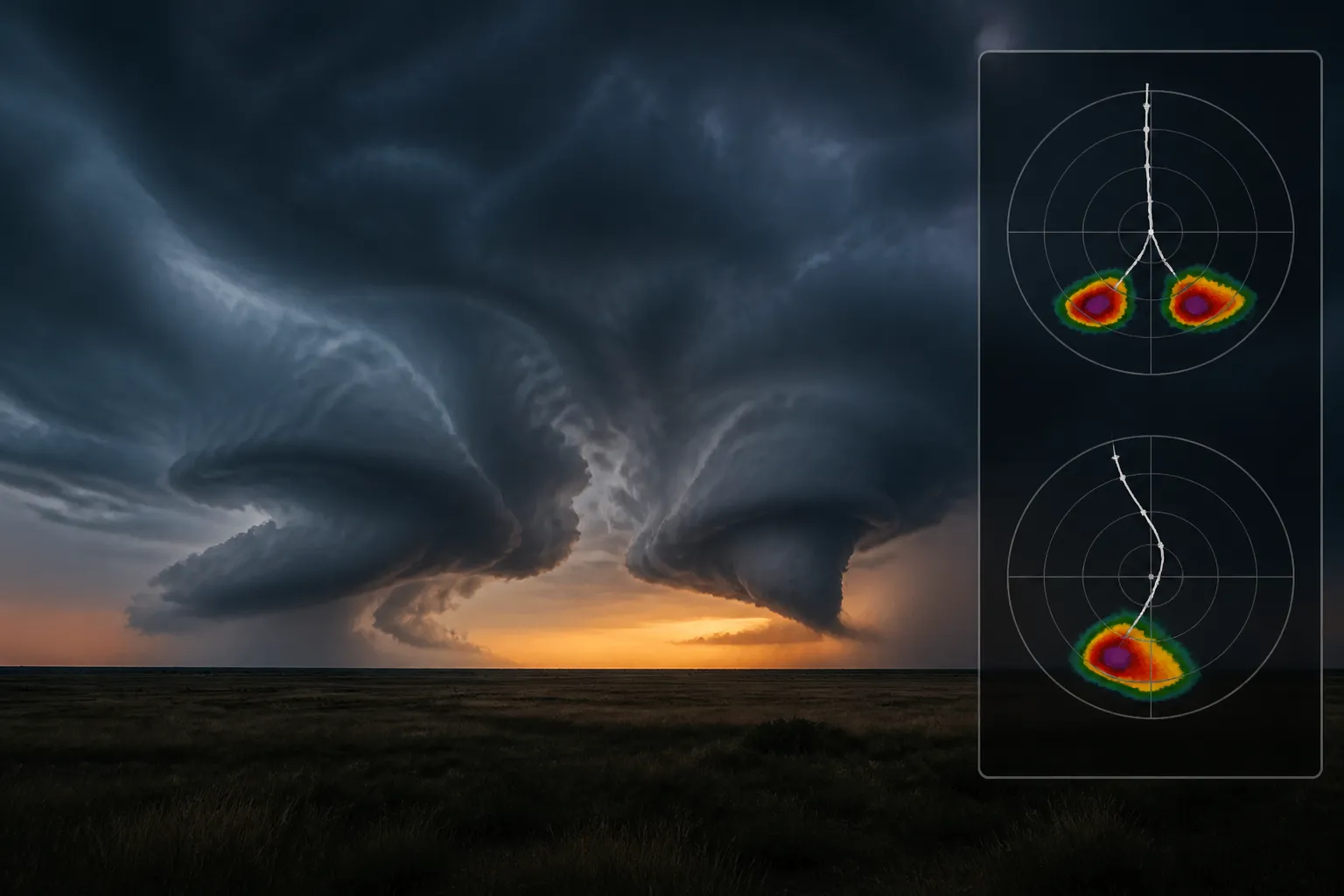
Those two questions, straight or curved and which hemisphere, are the whole decision tool the source offers for judging which split will last. If the hodograph is straight, expect two cells of similar strength. If it is curved, expect one to win, and let hemisphere tell you which one.
Formation sequence in four beats
The source also gives an idealized sequence for how a split forms. It runs in four beats.
- A formative updraft tilts horizontal environmental rotation into the vertical.
- That produces counter-rotating vortices on either side of the updraft.
- The vortices generate new updrafts.
- A developing downdraft pushes the two new updrafts apart.
The word idealized matters. Real storms are messier, and the source describes the textbook case. Still, the sequence explains why the two movers spin in opposite directions. Each one inherits one of the counter-rotating vortices.
What the source leaves out
Now the gaps, stated plainly. The source does not teach step-by-step reading of splits on a radar display. It does not say how to tell a split from other storm features. It gives no thresholds for shear, helicity, or curvature, so everything above is qualitative. The passage on storm-relative helicity is cut off mid-sentence, and later sections on dynamics are missing.
It also never defines dense waves or how to clear them. Nothing in it covers panic or staying calm under pressure. The promise in the headline has no support here, and I will not fake it. The source offers no safety guidance, warning procedures, or actions for people in a storm's path either. It is a reference entry, not a forecasting manual.
If you landed here looking for the arcade game, Segment Storm is in the catalog. This article says nothing about how to play it. For real storms, follow your local forecast service and official warnings, not a single encyclopedia entry.
A short, honest outline beats a padded guide. What the source supports is narrow but concrete: two cells, opposite spins, one hour, and a hodograph shape that tells you whether the pair stays even.
Sources
- Splitting storm - Wikipedia
- https://arxiv.org/pdf/2411.11204
- https://www.fireflyeducation.com.au/downloads/Sound_Waves_Spelling_Segmenting_Guide.pdf
- https://arxiv.org/pdf/1101.0479
- How to Split Audio into Segments Free | Audio Splitter Guide
- Splitting Segments or Branches
- Wave Planning - CubeworkFreight & Logistics Glossary | item.com
- What Is Wave Planning In Warehouse Management System (WMS)? | Extensiv

Priya Nambiar covers competitive gaming and emerging esports ecosystems for GoAndGame, with a particular focus on Southeast Asian scenes and grassroots tournament culture. She came up through community forums before moving into sports journalism, and that background shapes everything she writes.


