I wanted to tell you Dot-Chomper is the perfect five-minute break. I can't, not honestly. The research I had on hand never mentions the game. So this is a different kind of pitch. Here is what the evidence says about games and breaks in general, where it stops, and why a quick trial of Dot-Chomper is still a cheap experiment.
Nothing in these sources mentions Dot-Chomper, or five-minute sessions at all.
What the sources can and cannot say about Dot-Chomper
Three sources, zero mentions of Dot-Chomper. I can't vouch for its controls, its quality, its difficulty curve or how well it fits a short pause in your day. Any general finding below is about gaming as a whole. It is not a verdict on this game.
So the recommendation rests on you. Open it, play a round or two, and see whether you feel better or just annoyed. That test costs five minutes.
What the ESA survey reports about why people play
The ESA released its 2025 Global Power of Play report on Oct. 8, 2025, working with video game trade associations in Australia, Canada, Europe and South Korea. It surveyed 24,216 weekly players aged 16 and older in 21 countries.
The top reasons people gave worldwide were fun (66%), stress relief (58%) and keeping their minds sharp (45%). U.S. players ranked them the same way: 63%, 56% and 47%.
Two limits matter here. The ESA is an industry group, so the report comes from the sector it promotes. And the answers are self-reported perceptions, not measured outcomes. The report also credits play in general, not any title or session length.
Stress, anxiety and loneliness: the headline numbers and their limits
The numbers are big. Globally, 77% of players say games make them less stressed, 70% report less anxiety and 64% say games ease loneliness. In the U.S., the figures are 75%, 67% and 58%.
Notice the verb. Players say. That is perceived change, not a clinical result. Coverage of the report in outlets like Meristation repeats the figures, but it is promotional press, not an independent check.
The bigger gap for our purposes is time. Nothing here tells us whether five minutes does anything, or whether relief builds over a longer evening session. Loneliness is a good example. The survey ties it to connecting with others, which a quick solo round may not do at all.
The same goes for the other claims in the coverage. Among players, 76% say gaming improves problem-solving and 74% cite better teamwork. Those are again self-reports about play in general. Teamwork in particular points to multiplayer habits, which a solo maze round on a break does not resemble.
The EEG study and the gap it leaves open
A longitudinal EEG study in Brain Sciences, December 2025, looked at how video game type affects cognitive performance and brain functional connectivity. It sounds relevant. But the excerpt I had shows only author and affiliation details, so I can't report its methods, sample size or results.
Even if I could, it studies game type, not play duration or break use. It would not settle whether a short session helps a break.
A simple self-test for your own five minutes
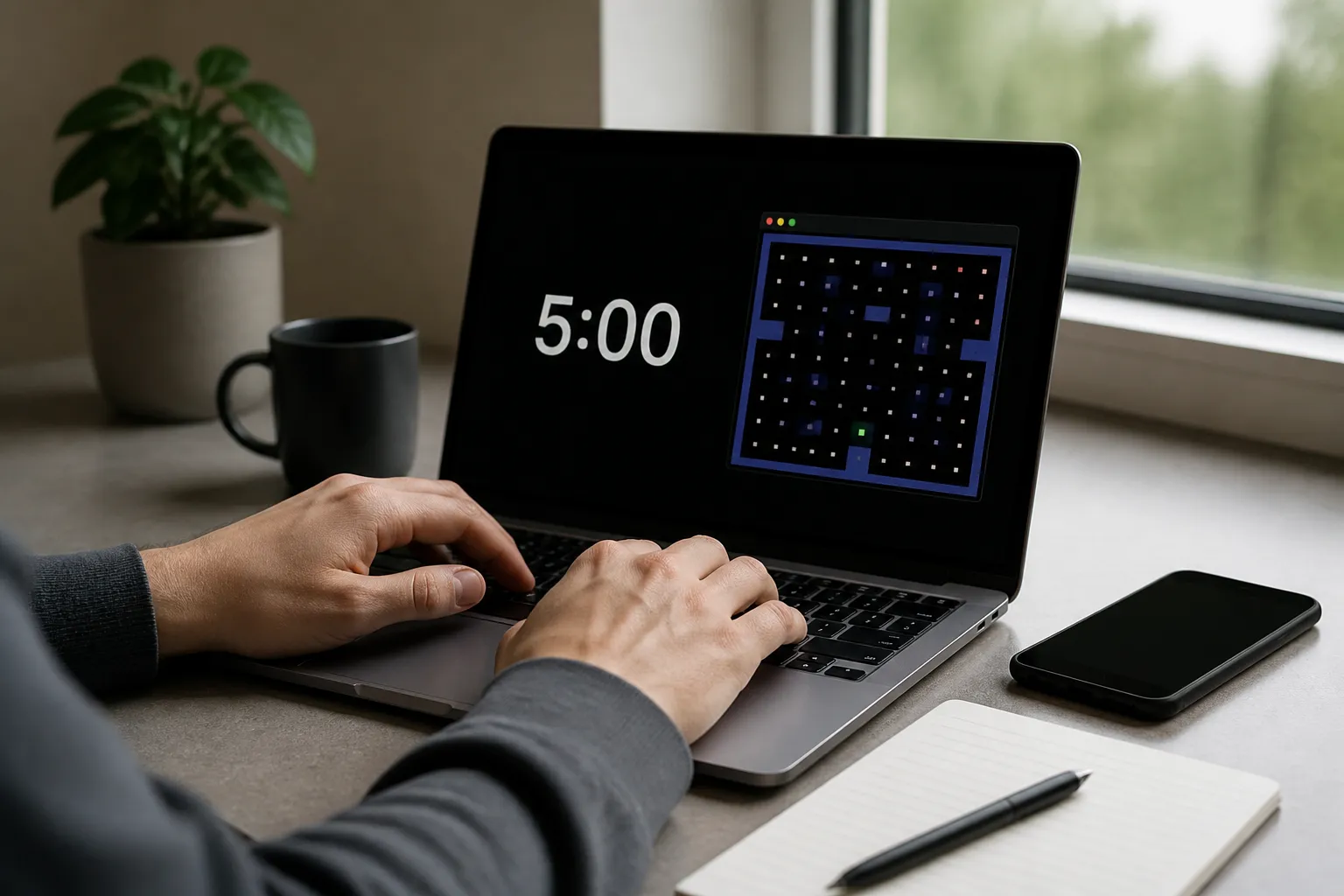
Since no study answers the question, run a small one yourself. Before you start, rate your mood from 1 to 5. Set a timer for five minutes. Play Dot-Chomper until it rings, then stop, even mid-round. Rate your mood again.
Do the same on another day with a walk, stretching or just sitting quietly. Compare the two sets of ratings after a week. This is informal and one person's data proves little. But it is the comparison nobody has handed us.
- Note whether you stopped when the timer rang.
- Note whether you felt calmer, flat or irritated.
Weighing the case for a five-minute break
Here is what is missing. No source compares game breaks with a walk, stretching or plain rest. None discusses downsides, such as a short break running long. That risk is plausible, but the sources don't measure it.
What the research does support is modest. People who play weekly mostly say it is fun and that it takes the edge off stress. If that matches your experience, a tiny arcade game is a low-risk way to test it.
Sources
- Global Report: Video Games Transcend Entertainment, Affect Positive Change in Players’ Lives - the ESA
- New ESA report reveals how gaming boosts mental health, skills, and real-world relationships - Meristation
- Effects of Video Game Type on Cognitive Performance and Brain Functional Connectivity: A Longitudinal EEG Study - PMC

Mara Solis is a staff writer at GoAndGame covering board games, tabletop strategy, and the culture around competitive play. She has spent years logging hours at game tables from local hobby shops to international conventions. Her writing blends practical insight with a genuine enthusiasm for the communities games create.


