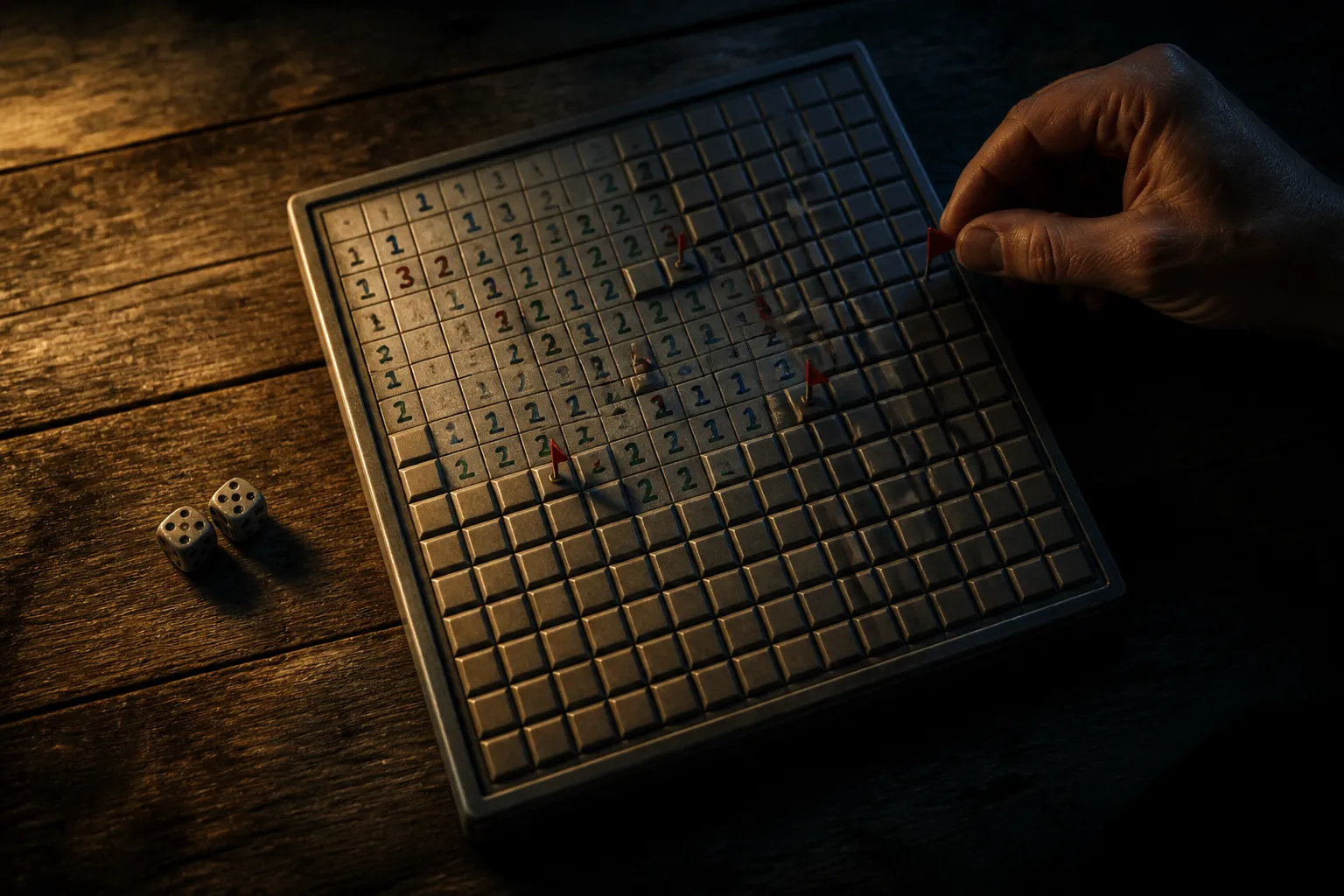
A Minesweeper board can feel like a conversation that suddenly stops. For several turns, each number tells you exactly where to click or where to place a flag. Then the remaining covered squares offer no certain move. The skill at that point is knowing what the board has proved, what it merely suggests, and when it has nothing more to say.
A good guess begins with a careful inventory of everything that is no longer a guess.
Logic gets the first move
Minesweeper can be read through logic or probability, but the two are not rivals. A square proved safe has a mine probability of 0%. A square proved to contain a mine has a probability of 100%. At easier levels, finding those certainties can be enough to finish the board. Reaching for an estimate before checking them gives away the game's most useful advantage: the chance to move without risking anything.
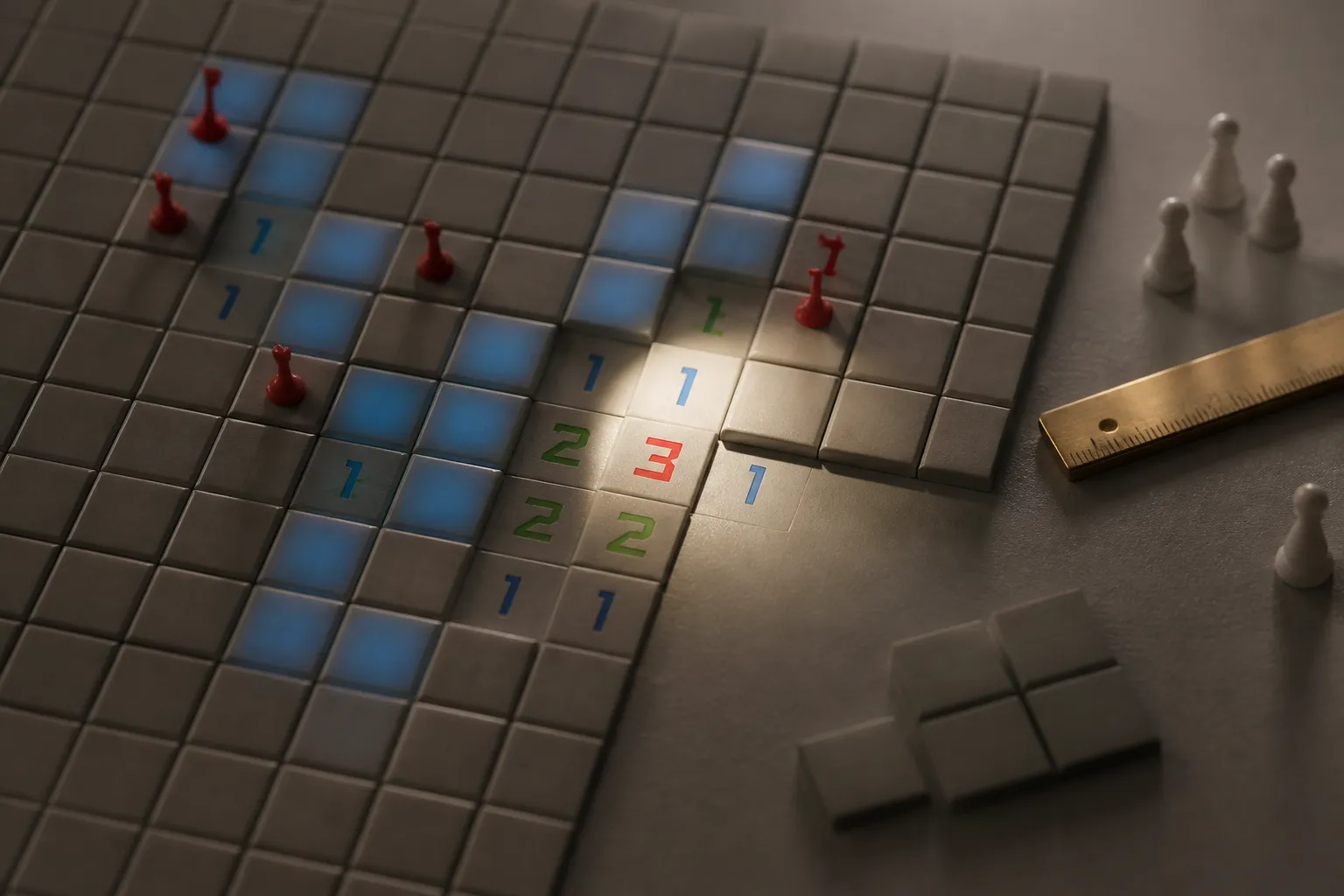
Start small. Look at one exposed number and every covered square touching it, including diagonally. Subtract the mines already accounted for by reliable flags. If the number still needs one mine and touches just one unknown square, that square is a mine. If its required mines are already accounted for, its other unknown neighbours are safe. Then look again. A newly opened square may supply the clue that settles a different part of the frontier. What seemed like a dead end can change after one certain click.
When certainty stops, read the nearby odds
Suppose a clue still needs one mine and has two unknown neighbours. With no other information separating them, each is a 50% risk. One mine among three such squares gives each about 33%; one among four gives each 25%. Change the requirement to two mines among three unknown squares and each carries about 66% risk. The number on the tile has not changed its purpose. It tells you how many mines must fit into the spaces still available.
Those fractions describe a local position, not necessarily the final odds for a click. A covered square may touch several numbers, and another clue may rule out an arrangement that looked possible from the first number alone. Before accepting a tempting 25%, inspect the other clues bordering those four squares. The advanced tactics guide uses these simple fractions to show how probability enters play, but the board still asks you to check the whole frontier. The lowest-looking risk beside one clue may disappear once its neighbours speak.
The mine counter can settle a local tie
The counter above the board is more than a progress marker. Near the end of a game, local clues may permit two arrangements that look equally plausible until you count the mines still unplaced. In one endgame example, a remaining count of two determines which of two configurations fits. With three remaining, the count instead favors the configuration that puts an extra mine in a lower-right cluster. The difference comes from information no single clue can supply.
This is also why treating every arrangement along the exposed edge as equally likely can mislead. The total mine count constrains what can be hiding elsewhere. The Minesweeper Guide solver illustrates the point with a position where only one mine remains: once that global count is included, the centre square is a guaranteed mine. A player staring only at nearby clues could miss that certainty. Before making a marginal guess, check the counter, subtract the mines you have confidently identified, and ask which proposed arrangements still fit.
A true 50-50 asks for a decision, not another deduction
Sometimes the board really has stopped talking. The advanced tactics guide describes a T-shaped position with one mine left in two possible squares and no further information to distinguish them. Each click has the same risk. Looking longer cannot create a clue that the position does not contain.
Still, that is a conclusion to reach carefully. First search for any provably safe square elsewhere. A solver may mark one green at 0% mine probability; clicking into a 50-50 while that square exists throws away a free move. If there is no safe square, choose the available square with the lowest mine probability. This guidance does not supply a universal trick for choosing between equally risky clicks. Sometimes the honest description of the next move is simply a coin toss.
There is a timing choice, too. If an unavoidable 50-50 is already visible, guessing early means a losing click costs less time. Someone who likes completing every solvable part of a board may leave it until last instead. Neither preference changes the odds. A game decided by one such toss exposes a design weakness rather than a failure of concentration, which is good reason to keep guessing moments rare and to value the deductions that precede them.
Check the evidence you supplied
A probability overlay can help, but it takes your flags seriously. It reads each flag as a claim that a mine is there. One mistaken flag can therefore make its advice wrong. Before trusting a surprising 0% square or an alarming 100%, audit the nearby flags against the exposed numbers. The solver cannot correct a premise you have told it to accept.
At the start, even a sound solver has little to work with. Before the first click, no exposed numbers constrain the board, so its overlay is inert. On a beginner board of 81 squares and 10 mines, every square begins with identical odds. That opening click is a guess; the clues that follow are what let the player distinguish risk from certainty.
There is no documented win-rate promise hidden in this advice, nor a reported frequency for how often random boards force guesses. Its practical use is narrower and sharper. Exhaust the certain moves, count what remains, inspect the odds when you must, and check any flags that shaped your view. If the final choice still comes down to two covered squares, you can click knowing exactly what the board did, and did not, tell you.
Sources
Eliot Reed writes about the intricacies of virtual worlds, blending analysis with storytelling. As a house writer for GoAndGame, he delves deep into game mechanics and narratives, offering thought-provoking insights for players and developers alike.


