Every few months a new card roguelike shows up promising the Balatro feeling. I went looking for what that feeling actually is. The honest answer is that the public record tells me a lot about where the game came from and very little about its finished mechanics. That gap matters, so I will mark it as I go.
Origins: from a stalled multiplayer card game to a solo prototype
LocalThunk began work on December 13, 2021. He had abandoned an online multiplayer version of Big Cheat, a card game he and friends had invented, and he started over from a template. By his own account, the road to launch day took about three years. He had saved roughly three weeks of vacation time to get going.
Two details stand out. He had never played a deckbuilder before. And once development began, he deliberately stopped playing roguelikes. That is a strange starting position for a genre hit. The design, in his telling, came from one person poking at poker hands until the poking became fun. I cannot say how that compares with how other developers start, because the sources do not look at anyone else.
Early design choices that shaped the scoring loop
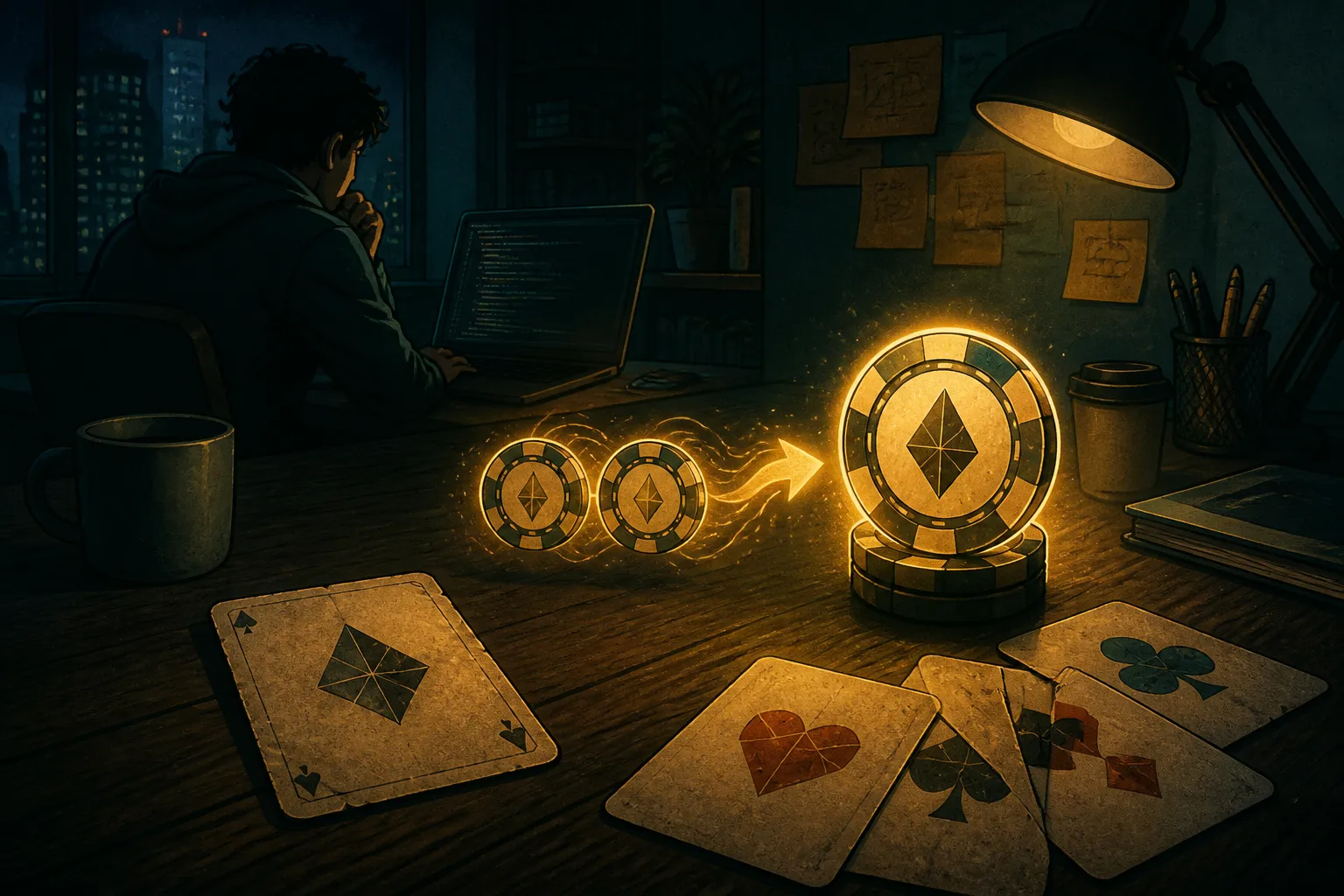
The scoring idea was there early. The prototype already used CHIP X MULT, which he described as a natural way to score. Two small numbers multiply into a big one. On paper, that hook is easy to copy.
The prototype was also thin. It had no Jokers and no blind selection. Its upgrade system picked a random card from your deck and added an enhancement to it. That is a very different shape from the finished game as it is described in the awards coverage, where players build decks of distinct cards to beat blinds inside a roguelike structure.
The score-attack framing owes a debt to Luck Be a Landlord, which he watched while starting out. Watched, not necessarily studied. The sources show an influence on the idea. They do not show how much of the final structure came from it, and they do not say which prototype details survived into the release. I will not treat the early build as the shipped game.
Recognition in 2025 and what the awards do and do not show
Balatro, published by Playstack, launched in February 2024 on PC and consoles. macOS, iOS and Android followed. At the 25th Game Developers Choice Awards, held in 2025, it won four trophies: Game of the Year, Best Debut, Best Design and the Innovation Award.
That is a loud signal of reception. It is not an explanation. The sources do not give the jurors' reasoning or the judging criteria. I can say peers rewarded it heavily. I cannot say which specific design choices earned Best Design, and I would distrust any review, including this one, that claimed to know.
The limits of this evidence for a copycat comparison
So what do copycats miss? I cannot answer that yet. No source names a copycat or sets Balatro beside another card roguelike. None describes the finished game's mechanics in enough detail to draw a line. Any claim about how clones typically begin would be my guess, not a finding.
The numbers are missing too. The sources give no sales, player counts, price or critical review scores. Without them, claims about market impact are speculation.
A fair comparison would need concrete steps. Play the final build for several hours and log each run: which hands you chased, when a Joker changed your plan, how often a blind forced a rethink. Then play two or three named imitators the same way, with the same logging. Finally, read what players say about run variety after fifty hours, and pull sales and review figures from the publisher or storefronts. I am optimistic the answer is findable. I am skeptical of anyone who says it already is.
What the record does support is narrower. A solo developer new to deckbuilders, who stopped playing roguelikes while he worked, shipped something the Game Developers Choice Awards crowned in 2025. Whether that outsider origin explains anything is a question the clones have not yet answered.
Sources

Priya Nambiar covers competitive gaming and emerging esports ecosystems for GoAndGame, with a particular focus on Southeast Asian scenes and grassroots tournament culture. She came up through community forums before moving into sports journalism, and that background shapes everything she writes.


