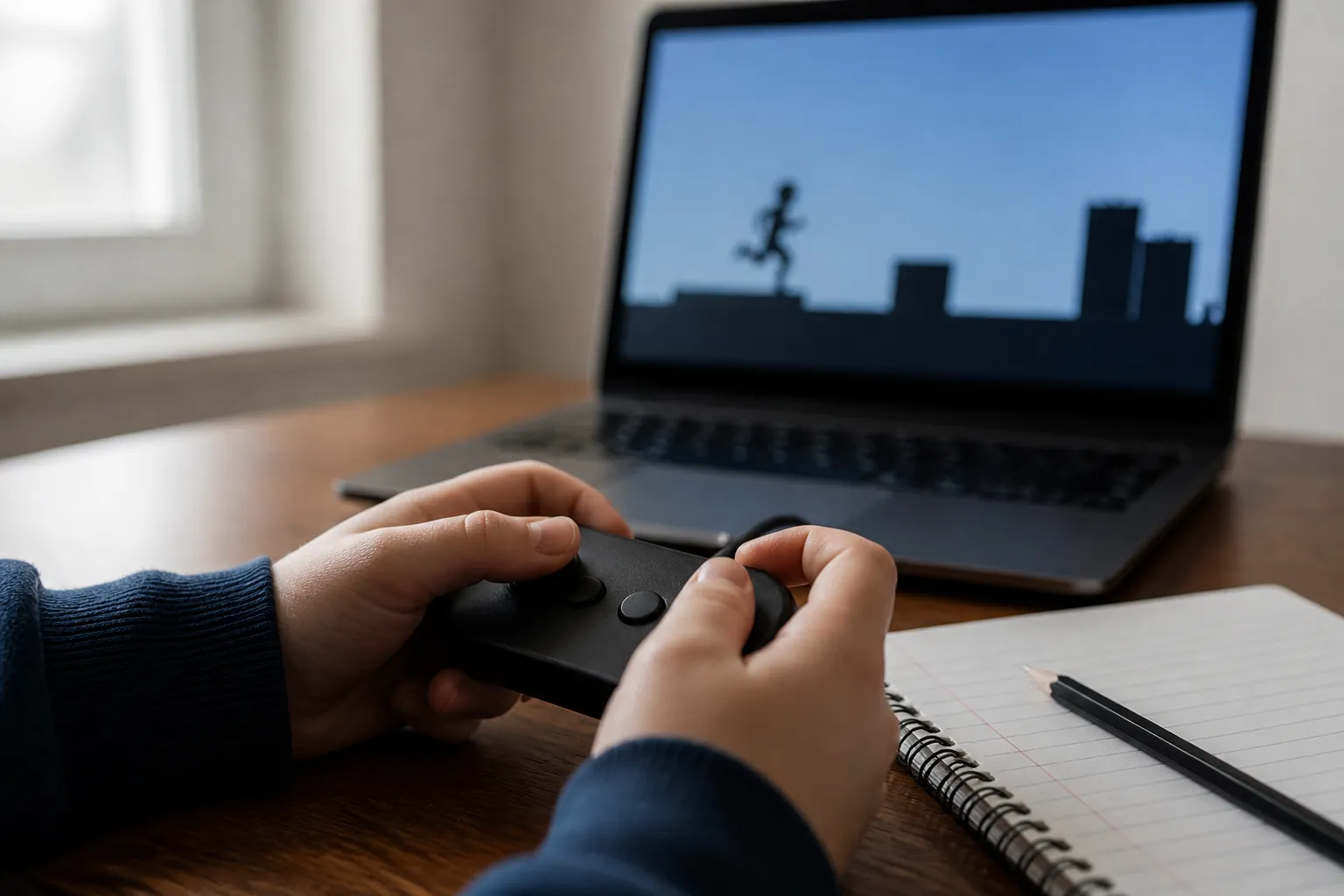
Chrome Dino’s proposed two-button test of attention sounds easy to picture: a small action, a quick response, a number at the end. But the sources available for this piece do not mention Chrome Dino, describe a two-button test, or establish what such a score would mean. They ask a neighboring question instead: what can play do to attention, at least for a short time? Keeping those questions separate matters. A game can demand concentration without becoming a validated measure of it.
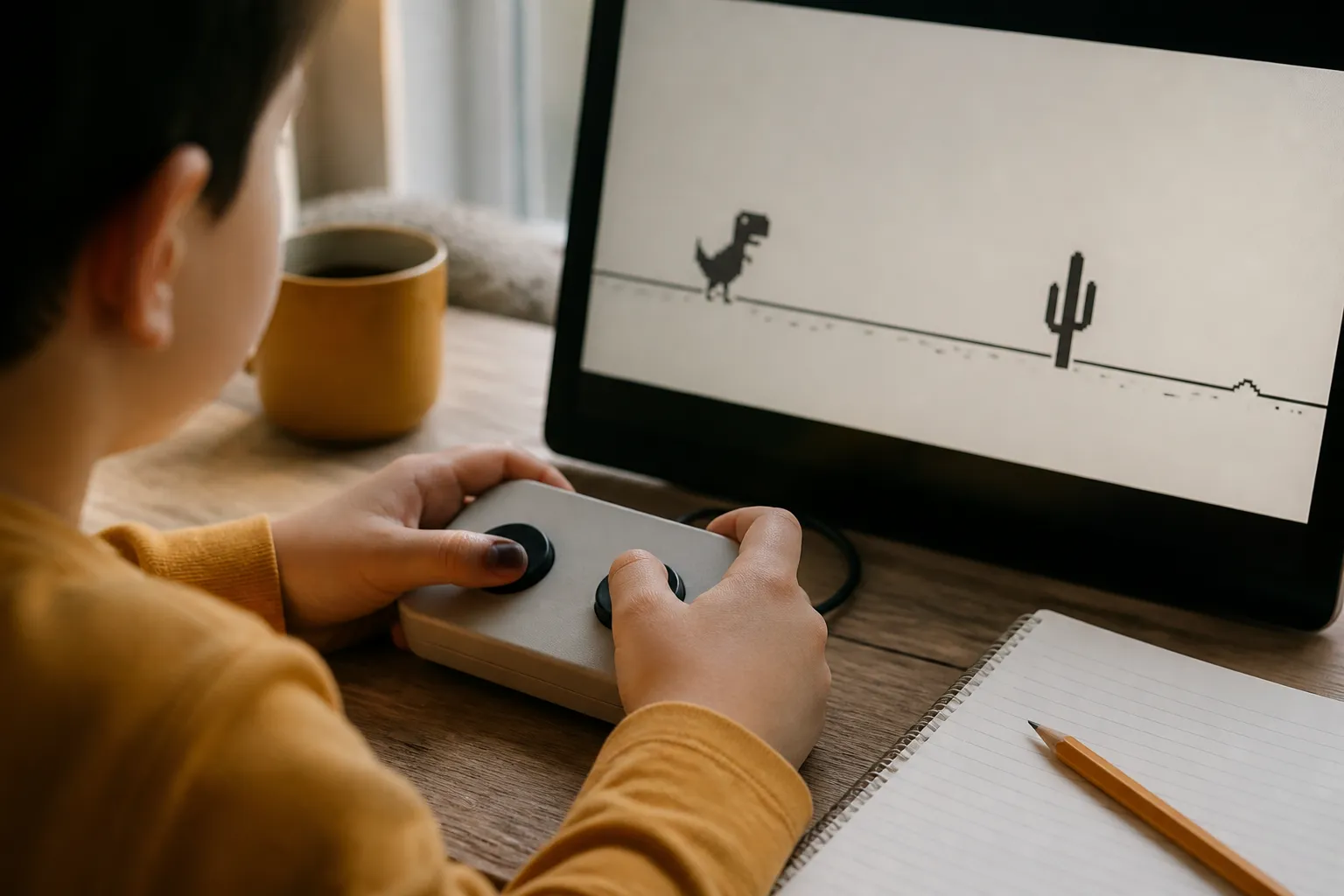
The distinction becomes clearer when we look at the actual comparisons. One source concerns mobile games and people with mild cognitive impairment, but the supplied record gives no results. The other follows preschool children after brief sessions of digital and traditional play. Neither puts Chrome Dino in front of participants.

That second study gives us something concrete to examine, although it cannot answer the Chrome Dino question. Its most useful lesson may be how carefully we need to name the kind of attention being measured. Detecting a target quickly and shutting out a distraction are different demands, and the children did not respond to them in the same way.
What the sources establish, and what they leave open
A PubMed record identifies a study of functional mobile games and attention in people with mild cognitive impairment, using the Montreal Cognitive Assessment. The supplied text does not include its abstract or method details. A report on a University of Padua study describes tests given to preschool children after play. These are two different populations, and neither source reports a Chrome Dino experiment.
That absence sets a firm limit. We cannot say how a Chrome Dino test administers its two-button task, calculates a score, or defines good performance from these materials. Nor can we transfer a finding about play directly to a claim about testing. A change after a game session asks what play did to a participant. A test asks whether its results measure something consistently and meaningfully. Those questions need different evidence.
What changed after preschool play
In the Padua study, 48 typically developing children, whose mean age was 5.4 years, were tested under three conditions: no play, a 30-minute session of Mario Kart 8 Deluxe, and a 30-minute Tangram session. Testing followed each condition and covered attention, speech-sound processing, visual perception, and motor coordination. The comparison is useful because it places a digital game beside a traditional activity rather than treating screen play as the only possible source of an effect.
The reported immediate effects were similar after both forms of play. Children performed better on tasks requiring rapid detection of relevant stimuli, yet worse when they had to ignore visual distractions. That split is more informative than a single claim that play improved or harmed attention. The same period of activity appeared to favor one demand while making another harder, at least in the tests that followed it.
The report says these effects became stronger as task complexity increased. The authors suggest that psychological engagement and attentional activation may matter more than the distinction between digital and traditional play. That is a proposed explanation, not proof that any engaging game will produce the same pattern. The supplied account describes the attention tasks in general terms, without their exact design. We can follow the direction of the reported findings, but not reconstruct what each child saw or did during a trial.
What the mobile-game record cannot tell us
The mild cognitive impairment study sounds closer to a question about games and attention because attention appears in its title. Still, a title is not an outcome. Without the abstract, methods, or results in the supplied text, there is no reported effect size to cite and no attention result to summarize. We cannot tell from this record whether participants improved, how much they changed, or what comparison supported any conclusion.
The Montreal Cognitive Assessment gives the study a named measurement context. It does not, by itself, tell us how the games were used or how any attention finding was isolated. Those missing details matter even before considering Chrome Dino. They determine how much weight a reader could place on a result within the study’s own population. They also prevent a leap from functional mobile games used with people who have mild cognitive impairment to an unspecified two-button test offered to a different group.
The test that still needs testing
The Padua findings have limits of their own: one study, 48 children, and measurements taken immediately after play. They do not show that the effects lasted. Because the participants were typically developing preschoolers, the results cannot simply be extended to adults, older adults, or people with cognitive impairment. The two sources also do not compare attention tests or offer criteria for choosing one.
For a Chrome Dino-based test, the next questions are direct. Is there published validation showing that its score tracks a defined aspect of attention? Are its results reliable when the same person takes it again? Are there norms that make a score interpretable for the people being tested? And does it measure attention in the same sense as rapid target detection, resistance to distraction, or the measures used in the mobile-game study? The provided sources answer none of these questions, so they cannot support a recommendation. The evidence to look for is validation of the Chrome Dino test itself, with its task and scoring made plain.
Sources

Eliot Reed writes about the intricacies of virtual worlds, blending analysis with storytelling. As a house writer for GoAndGame, he delves deep into game mechanics and narratives, offering thought-provoking insights for players and developers alike.


