
A climb asks a simple question before it asks a difficult one: can you trust the next place you put your hand? In Cairn, that question sits at the center of the appeal described by players. Its unusual controls make the act of climbing worth paying attention to, while its art and restrained story give the ascent a reason to linger in memory. Yet the same player responses raise a sharper concern. When grip seems inconsistent, a careful decision can feel less like judgment and more like a guess.
What players are saying
Cairn has a strong, though far from unanimous, reception among users on Metacritic. Its 8.1 user score carries a Generally Favorable label, with 201 positive reviews, 32 mixed and 28 negative. Those numbers establish the broad mood. The individual comments are more useful for understanding why a climbing game might inspire both affection and irritation.
Players praise Cairn’s lovely, distinctive art style. That matters in a game whose central activity asks you to study a route rather than hurry through it. The praise suggests that looking is part of the pleasure, even if these reviews do not give us enough detail to pin that pleasure on a particular visual technique. One player compares Cairn favorably to Grow Up and says it satisfies an appetite for mountaineering and climbing games. It is a revealing comparison: for that player, the climb itself is the draw, not merely a way to reach the next scene.
Story and atmosphere
The emotional response is striking because players describe relatively sparse storytelling. A few cutscenes, voice messages and letters are enough for some reviewers to find Cairn surprisingly touching. Those fragments leave room for the player to carry a feeling forward instead of stopping at every turn for an explanation. A letter can stay in mind long after its words have disappeared from the screen.
There is a temptation to say that each difficult handhold deepens the story, but the available player comments do not establish such a precise relationship between narrative and traversal. What they do support is a quieter observation: reviewers remember both the climb and the heartfelt atmosphere. Cairn seems to earn their attention without relying on long stretches of dialogue. That restraint gives the reported emotional pull its particular shape.
The controls and the climb
Players identify the unusual controls as Cairn’s main hook. That puts a great deal of weight on each attempt to move Aava, its climber, upward. In a game organized around climbing, the sensation of choosing and testing a hold cannot be a small detail. It is where anticipation turns into either confidence or doubt.
One reviewer describes a troubling contrast: Aava can sometimes hold onto smooth walls without upgrades, yet shake while standing on the ground or on a seemingly good platform. The complaint does not tell us exactly how the underlying system calculates grip, and it does not explain the upgrade system. It does tell us what that player experienced. A surface that looks safe did not always feel safe, while one that looked unlikely sometimes worked.
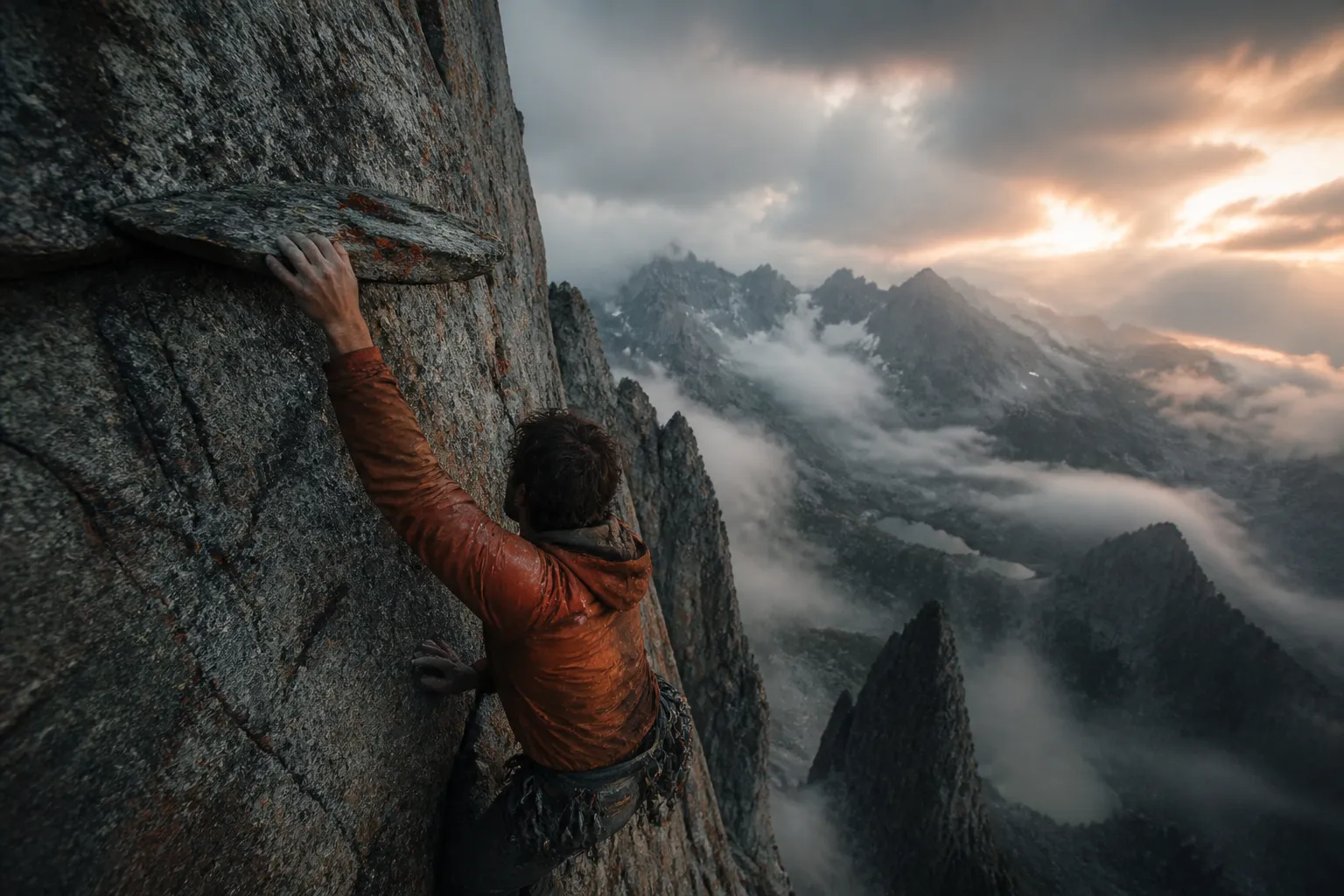
That gap between expectation and response is where Cairn’s most interesting tension lies. A demanding climb can be satisfying when a failed move teaches you what to look for on the next attempt. If the signals seem to change without a readable reason, repetition may teach only caution. The same close attention that makes each handhold compelling can then magnify a moment of uncertainty.
This is also why the control criticism deserves more weight than a passing complaint about inconvenience. Players who come for a climbing game are likely to spend much of their time interpreting Aava’s position and deciding what to try next. The review comments do not provide a detailed mechanical account, so there is no basis for declaring the controls broken. There is, however, a clear account of how inconsistency can interfere with the pleasure those controls promise.
When uncertainty stops being rewarding
One negative-leaning reviewer says Cairn felt unfinished from the start and that they reached the end without fully understanding its mechanics. They found the changing grip behavior increasingly frustrating, to the point that it outweighed their enjoyment. That is one player’s account, not proof of a problem everyone will encounter. Still, finishing a game while feeling unable to read its central action is a meaningful warning.
The available sources cannot settle how common this experience is or whether an update has changed it. They also do not supply a price, playtime, difficulty assessment or professional review scores. Those omissions matter if you are trying to judge the size of the commitment. For now, the user response offers a clearer picture of Cairn’s promise and its risk than it does of the practical details around buying it.
The view from the next hold
Cairn appears to speak most directly to players who want climbing to command their attention. Its favorable user reception, admired art and touching, economical story make a strong case for spending time with Aava. The reservation is equally specific: a climb built around deliberate movement needs its feedback to make sense to the person moving.
Every handhold can be a decision only if the player has some way to learn from the last one. For many reviewers, Cairn makes that attention rewarding. For at least one, uncertainty about grip turned the ascent into a source of frustration. Both responses point to the same small, consequential moment: Aava reaches out, and the player waits to learn what the rock will allow.

Eliot Reed writes about the intricacies of virtual worlds, blending analysis with storytelling. As a house writer for GoAndGame, he delves deep into game mechanics and narratives, offering thought-provoking insights for players and developers alike.


