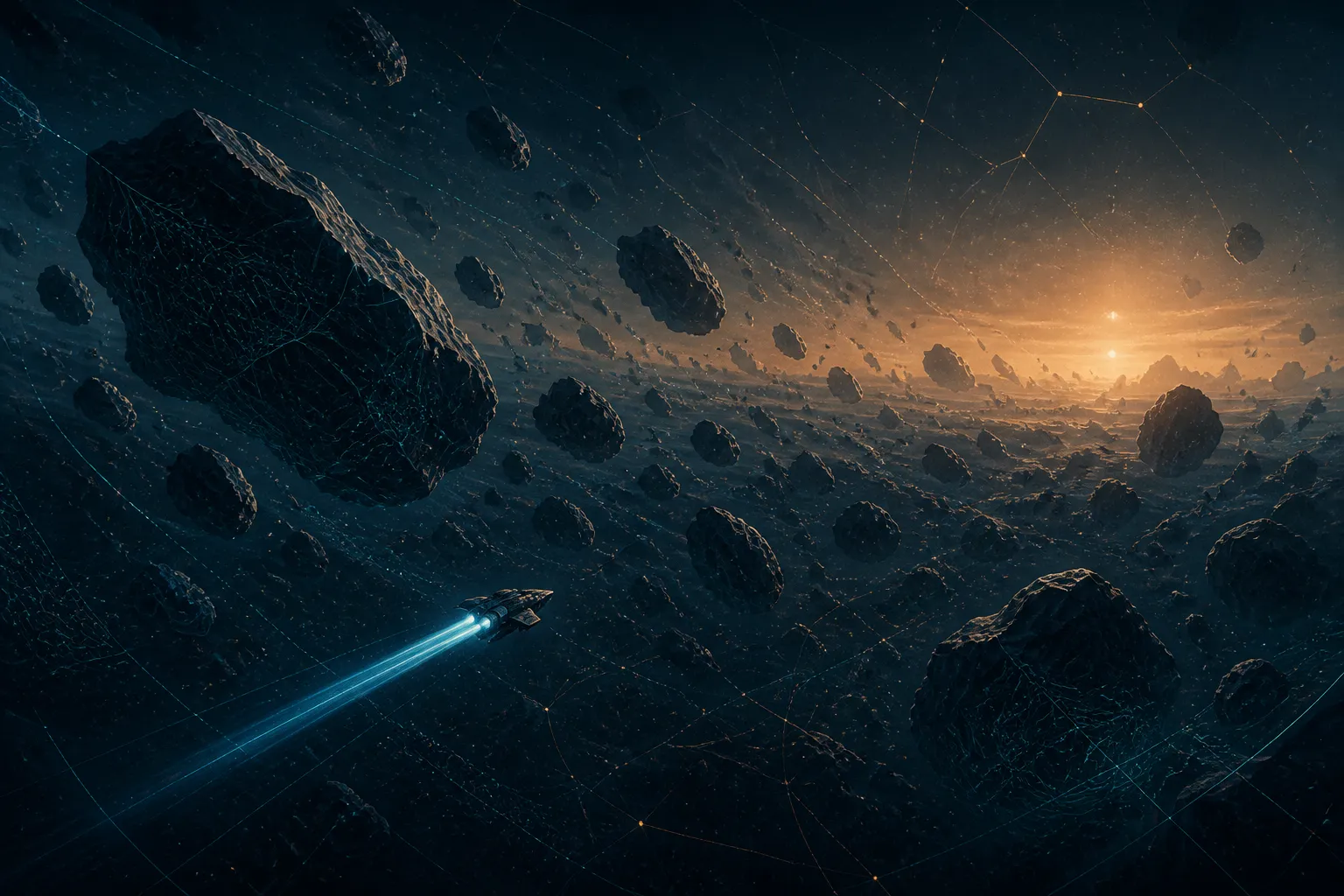
Procedural games sell an easy promise: endless rocks, endless variety, endless challenge. Calm focus is a harder sell. A field that never repeats can feel restful or exhausting, depending on how it is built. Here is what the public sources can and cannot say about Star-Dive and its asteroid fields.
Random is not the same as procedural
Start with the vocabulary. Procedural generation is the algorithmic creation of game content. Difficulty control is the explicit or adaptive regulation of how hard that content is, according to a primer on Emergent Mind. Offline systems follow parameters set in advance. Adaptive systems change online as the player behaves.
Random placement gives every option an equal chance. SUPERJUMP Magazine points out that procedural rules make outcomes predictable to some degree. That gap matters for a game about calm. Pure randomness gives you clumps and dead space. Rules give you a shape you can learn to read.
Most shipped games also mix the two worlds. Game-Ace notes that studios usually place handcrafted set pieces and let procedural systems fill the space between them. Spelunky 2 is the cited example. It stitches handcrafted room templates together under strict solvability rules, so a layout never strands the player.
What a field built from rules looks like
The closest public detail comes from a different game. A 2022 devlog from KAR Games, the studio behind Drift, describes building procedural asteroid fields. The early versions used random noise and felt boring past the first group of asteroids. That is a useful warning for any space game. The first encounter is easy to make interesting. The tenth is the test.
The devlog's fix was Poisson-disc sampling, extended from 2D to 3D with spheres. It spaces asteroids so they never overlap. Radii vary, so the spacing depends on each asteroid's size, and placement points are sampled per section of the field. The developer also planned to shrink spacing near large asteroids to mimic gravitational pull, and to bias sampling toward patterns such as galactic arms.
Treat that as intent, not proof. The devlog describes plans and improvements. It reports no measured player results. It also says nothing about Star-Dive.
Where calm comes from, and what breaks it
The meditation angle comes with its own caveats. Flow, as Mihaly Csikszentmihalyi described it, is complete absorption in a challenge that matches your skill. A blog post from Guul Games links flow to reduced anxiety, better mood, and a pause in rumination. It names three reliable triggers: repetitive pattern recognition, low-stakes nurturing tasks, and intense singular problem-solving. A drifting field of rocks plausibly touches the first and third.
Be careful with that post, though. Guul sells gaming products. It claims benefits "substantially similar" to formal meditation without citing a study for that claim. It also mentions a 2021 meta-analysis on flow and stress, but it names no authors and gives no effect sizes.
The other threat to calm is sameness. The KAR devlog warns that leaning too hard on procedural generation can produce games that are infinitely wide and infinitesimally deep. A field can be endless and still say nothing new after a minute. Authored structure is the usual cure.
The scorecard for any endless field
Research summarized by Emergent Mind describes trade-offs among content diversity, control precision, and computational cost. More variety usually means less fine control over difficulty. Learning-based frameworks try to manage that with layers. One model filters out unacceptable content. Another classifies what remains by features, including difficulty. A third estimates consensus enjoyment from crowds of players. Whether Star-Dive uses anything like this is unknown.
So judge the game by what you can check. These questions come straight from the sources:
- Which parameters control difficulty, and are they set offline or adjusted online?
- How is unacceptable content filtered before it reaches players?
- Does the generator guarantee solvability or playability?
- Is the output deterministic for a given seed, so it can be tested and shared?
- Do the fields stay varied past the first encounter?
Seeds matter more than they sound. Game-Ace says a seed makes the same world appear every time, which helps QA and lets players share a run. If you can replay a field you loved, you can also study why it worked.
What we still cannot say about Star-Dive
None of the sources describe how Star-Dive generates its asteroid fields. No source ties procedural asteroid fields to meditation outcomes in a controlled way. No one supplies difficulty curves, retention, or pacing data for space games. Two sources, a flow-in-games PDF and a Game Developer page, were unreadable, so they add nothing here.
That leaves the Zen claim as a hypothesis. Test it yourself. Play Star-Dive for ten minutes, then ten more, and note when the field stops surprising you. Compare how the spacing feels near big rocks and open gaps. If you find a seed option, try it twice. Those notes are better evidence than any claim of infinite challenge.
Sources
- Procedural Generation & Difficulty Control
- Flow state gaming: how games create accidental mindfulness
- Getting Gamers in the Zone: Understanding Flow
- https://vertexaisearch.cloud.google.com/grounding-api-redirect/AUZIYQGkS9pxRwMFfxMBkscEMnCbwmFCny_yMXjPBxXxmZgY69pTAAlkaAHFI4mV82gUnNrKQ7UrQslFIm56geGto-CYoAfCpZZ36ku6j67_uBf1icSd-v8eGZGdkuHqr7gAtRlD9cuJmc3QeoO_VT44IEm4gZnztw==
- Procedural generation in games: methods, tools, studio use
- By Design: Procedural Generation | SUPERJUMP
- Devlog #4: Procedural Asteroid Fields | KAR Games | Creator of Drift
- Procedural generation: a primer for game devs

Julian Thorne is a seasoned house writer for GoAndGame, known for his deep dives into obscure game mechanics and industry trends. He often explores the sociological impact of gaming, blending critical analysis with historical context.


