
A ball rolls downhill. The next turn is still visible, but by the time you reach it, there may be only one useful direction to press. That is the pressure in Slope. Speed makes a choice feel smaller before the course itself has changed. Two questions help here. What room does a route physically allow? And how much of that room can a person use in time?
The turn you can see but cannot save
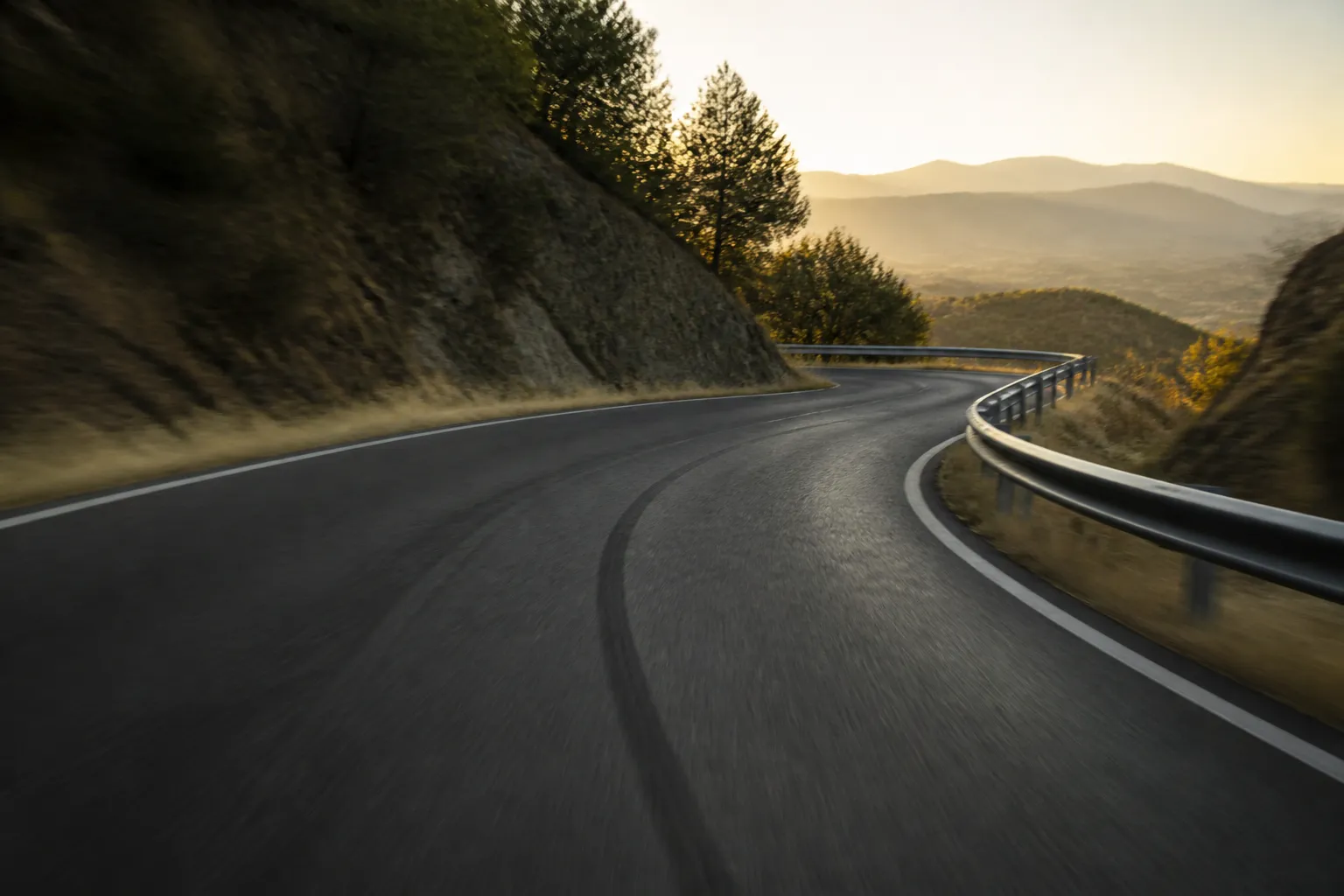
Picture a bend ahead on a descending course. At a gentle pace, you can approach it from several angles and adjust late. At a faster pace, the same bend asks for a decision earlier. You still see the opening, but the path into it is harder to reach. The route has not shrunk. Your usable options have.
That is a reading of play, not a finding. The Federal Highway Administration's Self-Enforcing Roadways guidance covers speed and roadway geometry. It does not study Slope, downhill play, or how anyone experiences a shrinking margin. Its value is narrower. It gives us a vocabulary for the physical room a route provides, apart from the time someone has to use it.
Speed is built into geometry
Road designers make the link between speed and shape explicit. The FHWA chapter quotes the Green Book's definition of design speed as "the selected speed used to determine the various geometric features of the roadway." A Texas DOT manual calls design speed a design control rather than a single design element. It sets the range of values for many other features. Speed is chosen first, and the road is drawn to fit it.
The FHWA chapter lists the connected features: curve radius, stopping sight distance, braking distance, vertical-curve length, superelevation, side friction, and lane and shoulder widths. They answer practical questions. How sharply can the road turn? How far ahead must a driver see? How much space is there across the roadway? The excerpt gives no numbers for them. It still shows that speed is not a figure laid over an unchanged route.
A game course is not built to highway standards. The distinction still carries over. A bend has a shape, an approach, and a visible opening, and the player brings speed to all three. When pace rises, a bend that was easy a second ago may demand a cleaner line now.
What roads teach about feeling fast
Road designers also know that width can be felt as well as measured. A Strong Towns article on optical narrowing says drivers decide from visual cues. Distant objects encourage speed. Close ones encourage slowing. Street trees, painted edge lines, bike lanes, parked cars, and tighter painted turn radii can make a street feel narrower without moving a curb.
The article gives one example: a street posted at 25 mph where drivers instinctively travel near 45. It is an anecdote, not a measured study. The same piece says wide, unobstructed roadways feel fast, and that the sense of open space pulls speed upward whatever the sign says. Narrower lanes or buildings close to the sidewalk make drivers focus because the risk feels higher.
Speed management guidance from ITE makes a related point. Design and operations should do the main work of producing the target speed. Signs, enforcement, and education only reinforce it. A self-enforcing road is one whose geometry and context make the intended speed feel natural.
None of this explains slope. The sources do not say how grade changes perceived speed, and they offer no data on how much optical narrowing reduces speeds. Still, they give a useful habit for play. Ask what the screen is telling you about speed, and what it is hiding.
Questions to bring to the next bend
The road sources suggest questions that translate loosely to a downhill game. They are prompts, not rules from engineering.
- Does my current speed match what this approach can take?
- Which visual cues show where the turn really starts, and which only show where it ends?
- Am I reacting to the opening, or setting up the line before I reach it?
The third question matters most. Looking back after a miss, the opening seems generous. On the way down, it asked for a decision sooner than expected. The next attempt can start earlier, with a line chosen before the ball arrives, rather than a faster reaction at the last moment.
There is also a case for easing off. A route built for one speed can sometimes carry another. The FHWA chapter notes that when recommended values exceed minimums, a road's inferred design speed can exceed its designated one. In play terms, one clean bend says little about the next. Judge each approach at the pace you have actually built up.
What the analogy cannot prove
The FHWA excerpt cuts off mid-sentence as it turns to operating-speed models. The cited Donnell and AASHTO works are not available here. The report is archived and warns that its technical information may be dated, so anyone applying road standards would need to check later Green Book editions.
Most of all, none of these sources shows that a slope makes a lane feel narrower. They give no evidence about perception on a downhill grade, and none about how people play. The claim about Slope stays an interpretation of one kind of moment. The turn is in view, and the time to choose a good approach is running out.
Sources
- Chapter 3. Relationship Between Speed and Geometric Design - Self-Enforcing Roadways: A Guidance Report , January 2018 - FHWA-HRT-17-098
- https://vertexaisearch.cloud.google.com/grounding-api-redirect/AUZIYQHrf9YEUeOsS0IJv01_h2pkzzGDmne4SplWF-aBy0AvkGomC1G5dBSvhA7Dmxo4oLRygKsNWbGlmbgUm4FcPYVS06ZdQJDR7EDnh0kJa3H7_XcX0gzMqoyrZV2ZovIHF3_Xfm0x1ZMU3MXcjwhSvSOHPFdL5aEt5oDJPd7gdtWVv7ym1nx4jQQmpy5xyim0F1F-Q0xNaAAisAkhktiERngcbZm9E5vfRcEvXXljDZNwXvvD2Sq6KssoBYPCwLKAd54=
- 4.2.3 Design Speed
- Measures for Managing Speed - ITE-A Community of Transportation Professionals
- How to Use Optical Narrowing to Make a Street Safer
- SKIING NEUROSCIENCE - Speed Perception

Eliot Reed writes about the intricacies of virtual worlds, blending analysis with storytelling. As a house writer for GoAndGame, he delves deep into game mechanics and narratives, offering thought-provoking insights for players and developers alike.


