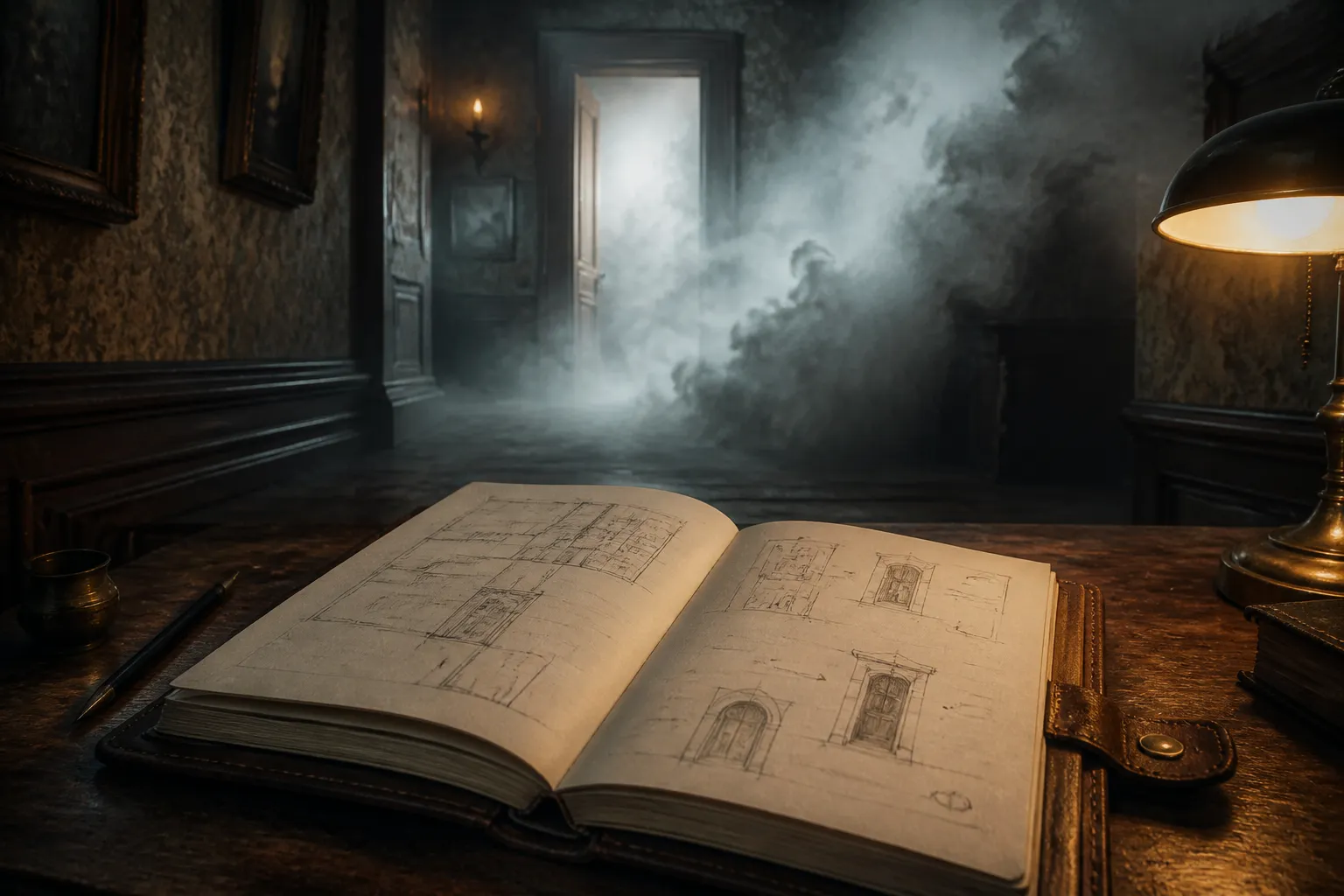
A door in Blue Prince does not promise a familiar room. It offers a choice from a random selection, and that choice may change what Simon can reach before the day ends. Tomorrow, the Mount Holly Estate will reset to an unbuilt state. The route will be gone, but the reason for choosing it can survive in a notebook. That small transfer, from a place visited to a fact recorded, is where the game finds its peculiar sense of exploration.
The mansion as a puzzle that rebuilds itself
Simon has inherited his eccentric uncle’s mansion, along with a will that sets a stipulation and a tantalizing goal: find the estate’s 46th room. The premise gives the house the shape of a mystery, but its daily reset changes how that mystery can be approached. You cannot simply walk yesterday’s route again and expect the same sequence of rooms. At each door, you select from a random draft, building a path through the estate as you go.
That makes a doorway more than a test of direction. A room might help with the question you came in hoping to answer, or it might suggest a question you had not thought to ask. The mansion asks you to remember patterns without letting you rely on a fixed floor plan. A useful note might concern a room’s contents, a clue’s wording, or a connection worth testing on another day. Exploration continues after the physical route disappears.
Knowledge as the real currency
In the Room Escape Artist review, the player’s growing spreadsheet and screenshot collection become evidence of progress. The reviewer identifies knowledge as the game’s real currency. That feels exact because an item may help on a particular run, while an observation can change decisions across many runs. Recording what happened is a way to make the next day more deliberate.
There is a difference between writing down a solution and keeping an investigation alive. Blue Prince encourages the second kind of record. A clue can remain unresolved for hours, waiting beside another observation that has not yet found its purpose. When a later room gives an old entry new meaning, the notebook becomes an extension of the mansion. Its pages hold the corridors the game has erased.
This also changes what counts as a productive session. You can fail to reach the room you wanted and still leave with a detail that sharpens your next choice. That is a generous idea, though it places a quiet demand on the player: pay attention now, because the house may not offer the same opportunity tomorrow.
What to do when one mystery stalls
The estate contains multiple open mysteries, and that breadth matters when room drafts refuse to cooperate. The Room Escape Artist reviewer found that, if one puzzle lacked a needed room or item, there was usually another investigative angle to pursue. A stalled plan could turn into a search for context. The notebook helps make that pivot practical, since it keeps unfinished threads visible instead of asking memory to juggle them all.
There is also a reason to keep recording after the obvious destination comes into view. The reviewer describes reaching room 46 as only the beginning of a larger mystery. Without giving away what follows, that observation reframes the first major goal. The notes are not merely a ladder to one locked door. They are a record of how the estate has taught you to read it, ready for questions that extend beyond that milestone.
When the draft gets in the way
The same uncertainty that makes each run worth examining can make a focused evening frustrating. If you have a promising theory about a specific puzzle, the room draft may not provide the components needed to test it. Taking notes does not remove that obstacle. It can tell you precisely what is missing, which is useful, but it cannot make the missing room appear.
One critic cited a lack of save options in the Metacritic review listings. The available sources do not describe the save system closely enough to say how that concern will affect a particular player, and they offer little detail on difficulty or accessibility settings. Reception also deserves more than a single headline number: Metacritic lists a 92 Metascore from 57 critics, while its 7.7 user score includes 23% mixed and 11% negative ratings among 691 ratings. The gap does not settle a verdict. It does suggest that a design built around uncertainty can be admired and resisted at the same time.
Who should bring a notebook
Blue Prince is easy to recommend to someone who enjoys following several questions at once and does not mind letting a discovery mature over multiple runs. The Room Escape Artist reviewer names story seekers, puzzle and investigation lovers, roguelike and metroidbrainia fans, and organized note takers among its potential audience. Organization helps, but elaborate spreadsheets are not the point. The important habit is noticing what you learned, including on a day when your preferred plan went nowhere.
The review lists a $29.99 price on Steam, Xbox, and PlayStation and estimates 15 to more than 80 hours of play. That is a wide range for a reason: the experience depends on how far you pursue the estate’s questions, not just on reaching its first major destination. The reviewer also recommends discussing the game with others. Comparing a stubborn clue with a friend can feel like opening another door, provided you agree on how much each person wants revealed. In Mount Holly, a useful discovery is something you can carry out of the house and bring back another day.
Sources

Eliot Reed writes about the intricacies of virtual worlds, blending analysis with storytelling. As a house writer for GoAndGame, he delves deep into game mechanics and narratives, offering thought-provoking insights for players and developers alike.


