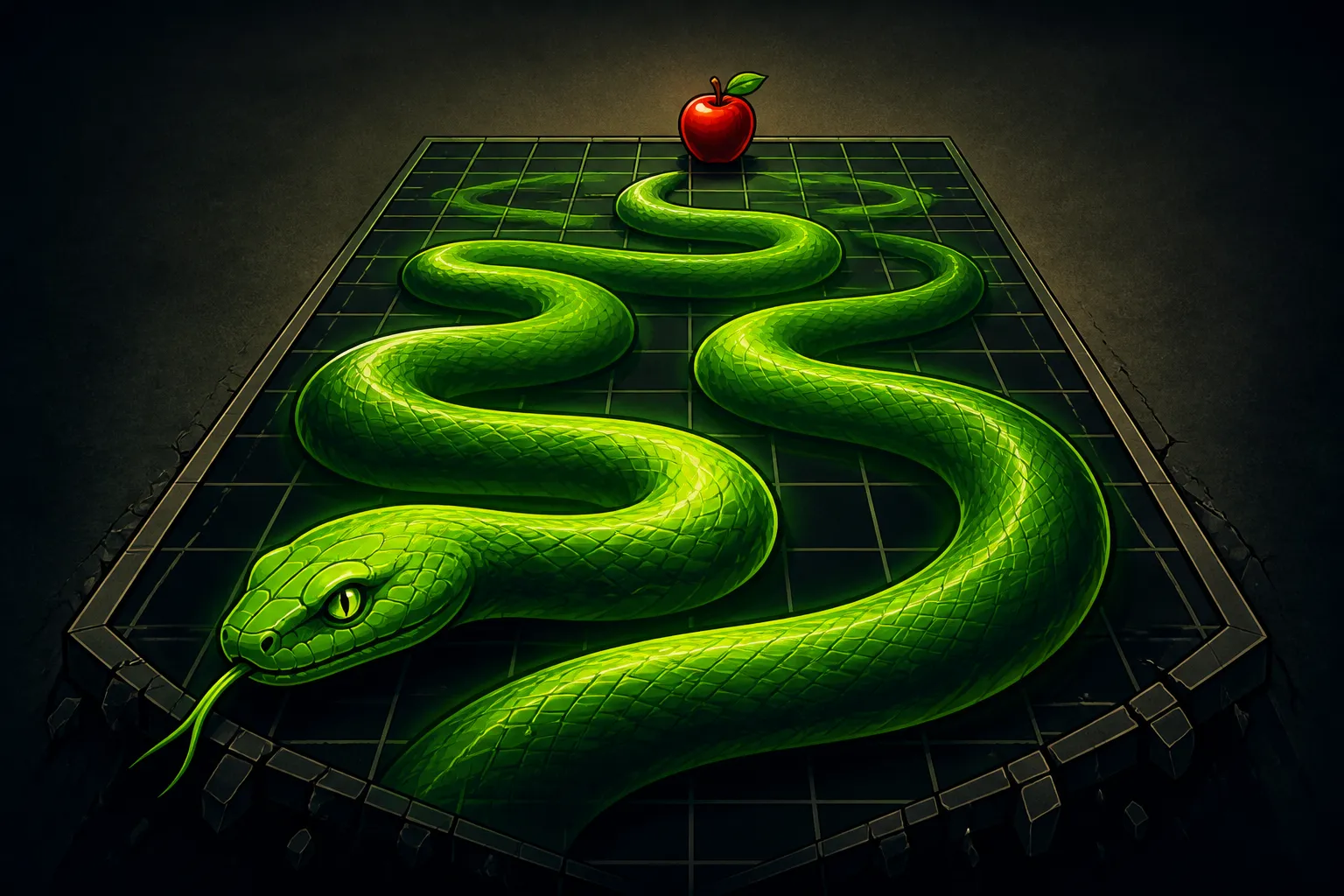
An apple appears across the board. The snake can reach it, but the route matters as much as the prize. Every square it crosses will soon be occupied by its body, and eating the apple will make that body longer. In Google’s Snake, a successful trip changes the board the player must navigate next.
The snake never stops
The head moves forward continuously. There is no pause in the basic rules for weighing one route against another. On a keyboard, the player turns with the arrow keys; on a phone or tablet, a swipe gives the direction. The input is simple, but it must arrive before the moving head reaches a wall or a section of its own body.
That timing gives an ordinary-looking turn some weight. A player might steer around a corner safely, then discover that the body following behind has closed off the way back. The head occupies one square at a time, while the rest of the snake preserves a recent history of where it has been. A wall ends the run. So does contact with the snake’s body or tail. The same path that brought the player this far can become the next hazard.
What an apple leaves behind
Food, usually apples, appears at random locations. Eating a piece makes the snake at least one square longer. The reward is visible and immediate, but it also takes up space. Early in a run, a broad turn may leave several ways out. Later, the body can divide that same open area into narrow passages. The player still has to pursue the next piece of food, even as each previous meal makes the trip less forgiving.
This is the curious bargain at the center of Google’s Snake: progress remains on the board. The player cannot collect an apple and return to the smaller, easier snake that approached it. A useful route toward one piece of food may put the head on the wrong side of its own body when another appears. Growth therefore asks for more than quick reactions. It asks the player to picture where the tail will be after the next few turns, while the head keeps moving.
Different rules, the same growing body
Google’s Snake offers more than its basic setup. Its options include Brick Wall, Continuous, Mirror, Instant Death, Timed Fruit, and Fruit Blender, with 40 combinations of modes described in a guide to the game. These variations change how players move and eat. They can alter what demands attention from one run to the next, while the familiar act of steering toward food remains the point of return.
The available descriptions do not say that any named mode changes the rule by which food adds length, so the names alone cannot support a claim about a gentler or harsher growth curve. Adjustable food quantities offer a clearer way to change the feel of a run. More opportunities to eat can bring more growth into play sooner. That changes how quickly the player must begin accounting for a longer body, though the sources give no measurements for how much harder any setting becomes.
Another game lets the player take a turn back
Snake Rewind, released in 2015, offers a useful contrast. When its snake dies, the player can rewind time. A collision can become a moment to reconsider a route rather than the final record of the attempt. The game also leaves a trail of where the snake has been, making the choice of path conspicuous. It recognizes the same problem Google’s Snake presents: the route to a reward has consequences after the head has passed through it.
Rewind changes the cost of a mistake, but it does not remove the need to choose a path. The ability is paid for with fruit, the game’s currency, through a Fruit Store. Without a fuller account of rewind costs, there is little basis for calculating how often a player could rely on it. What the comparison does show is a difference in emphasis. Google’s Snake lets a collision settle the run, then permits another free restart. Snake Rewind gives the player a way to revisit the fatal decision within a run.
What the growing snake can, and cannot, tell us
Google’s Snake was featured as a home page doodle on September 27, 2017. It is free to play, can be restarted without limit, and is now described as an archived doodle that has not been updated in years. Those details matter to the reading of its difficulty. A failed run carries no purchase cost, and a restart returns the player to a small snake with room to move. Growth can feel punishing within a run without making failure a lasting setback.
There are no survival statistics or score-to-length data in the available sources. The claim that growth becomes a liability is an interpretation of the rules, not a measured difficulty curve or a report of how most people play. Snake Rewind is no clean solution to that liability, either: its reception was positive and mixed, with criticism tied in part to glitchy controls. What remains striking in Google’s simpler version is the small change after each apple. The head continues forward, and there is one more square of snake to remember.

Alexandra Rivet explores the intricate interplay of games and culture for GoAndGame. A passionate storyteller, she delves into narratives with depth and curiosity. Her pieces often highlight the stories behind the pixels.


