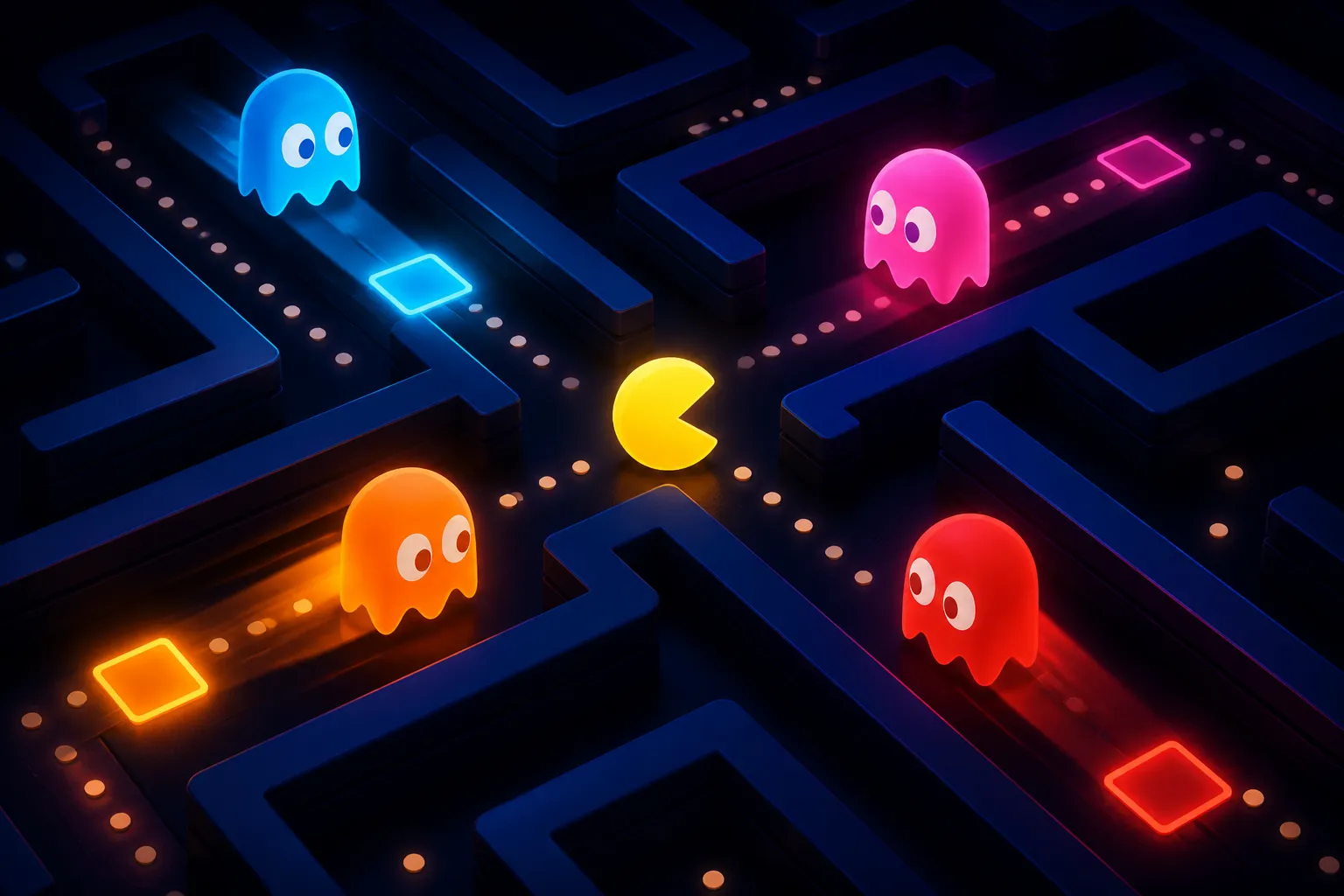
Ask a room of arcade regulars whether the ghosts cheat and you will get an argument. Ask whether they are random and most will say yes. Neither is right. Outside frightened mode, the ghosts have no memory, no pathfinding and no randomness. They run a handful of fixed rules. Players still feel fairly hunted, and that gap is worth explaining. You can test it yourself in Dot-Chomper.
Why the ghosts feel like individuals
Toru Iwatani wanted each ghost to have, in the words of one write-up, a specific character and its own particular movements. So the four ghosts, Blinky, Pinky, Inky and Clyde, do not chase the same way. Yet they share the same basic movement code. The personalities come almost entirely from how each one picks a target tile.
That sharing was not a style choice. The design had to fit in about 2KB of memory. Compact rules, reused four times with four different targets, are what that budget allowed. The sources say little more about how the limit shaped the code, so I will not pretend to know.
How a ghost chooses its next step
At each intersection a ghost looks at the tiles it can enter, drops the one it just came from, and picks the one with the shortest straight-line distance to its target. That is the whole decision.
Straight-line distance is the catch. Corridor distance would be smarter. Because ghosts ignore walls in the measurement, they sometimes take a turn that looks wrong. Players learn to read that as pattern, not mistake. Ties break in a fixed order: up, left, down, right. Even a muddy junction has one answer, and it is the same answer every time.
The four targeting rules
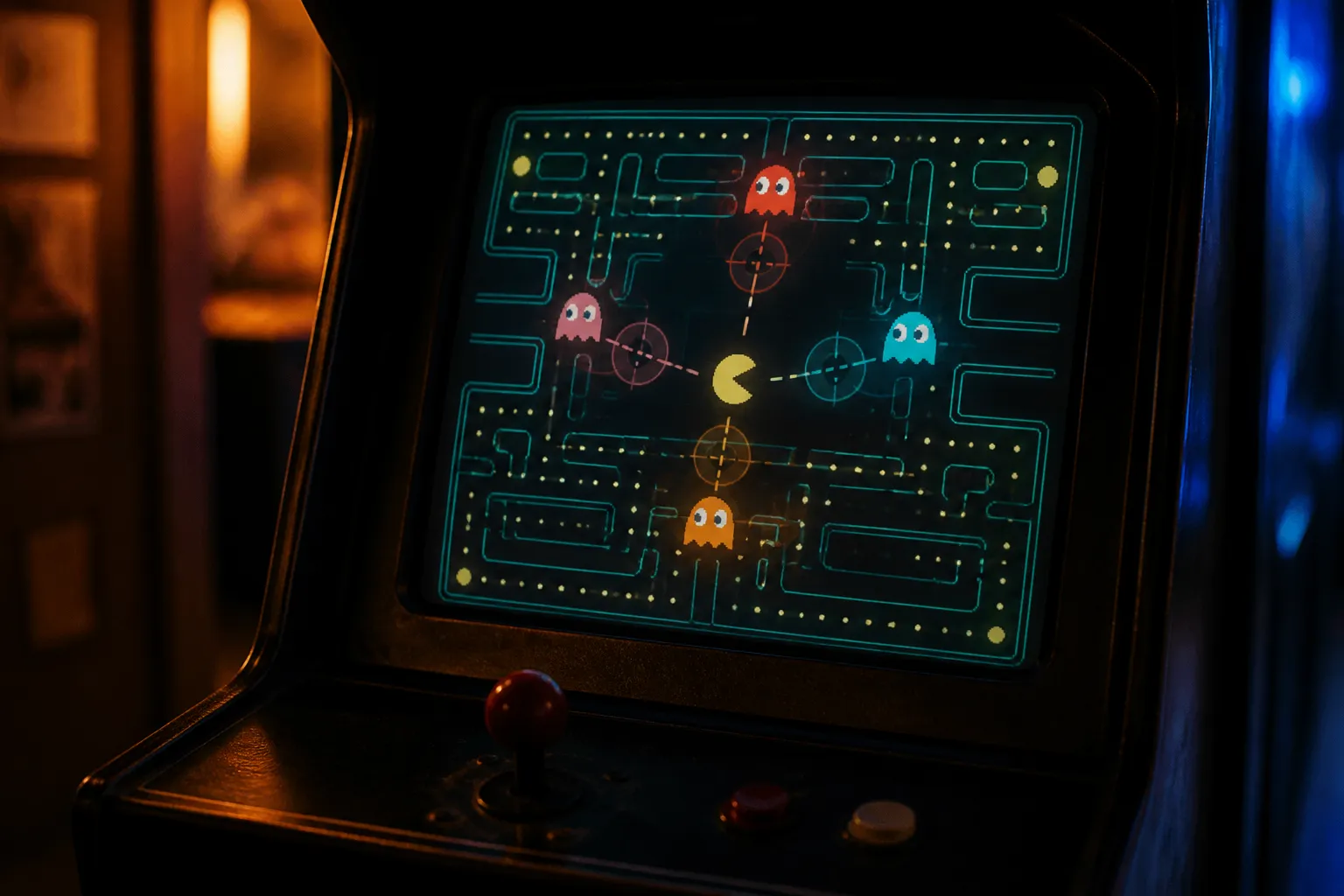
Here is the first scorecard. Each line is one ghost and the question it answers.
- Blinky: targets Pac-Man's current tile. Plain, persistent pressure.
- Pinky: targets four tiles ahead of Pac-Man's facing direction. She ambushes, so she punishes players who run in straight lines.
- Inky: takes the tile two ahead of Pac-Man, draws a vector from Blinky to it, and doubles it. His path depends on where Blinky is.
- Clyde: chases Pac-Man's tile only when more than eight tiles away. Closer than that, he heads for his scatter corner. He looks hesitant.
Now the second scorecard, which is about what the player can count on. These are the timing facts that make pressure legible.
- Level 1 timer: scatter 7 seconds, chase 20, scatter 7, chase 20, scatter 5, chase 20, scatter 5, then chase indefinitely.
- Reversals: every mode change forces all ghosts to turn around. Skilled players watch for it.
- Scatter corners: they sit outside the maze, so ghosts circle the nearest loop. That is a clear window of safety.
- Cruise Elroy: Blinky hits 75% of max speed on level 1, 80% at 20 dots left and 85% at 10. The trigger is the dot count, which you can see.
Timing, reversals and the illusion of fairness
Look at the lists together. Every rule is either a target formula or a clock. Nothing is hidden. From level 5 the scatter phases shrink to 5 seconds, and the third chase phase runs past a thousand seconds, so later levels are harsher, but harsher in a known way.
The only pseudo-random behavior is frightened mode. Ghosts reverse, slow, turn blue and wander at junctions. That is a single, loudly signaled state. Casual summaries often blur this and call the whole system random. The sources push back on that, and so should we.
One quirk even became canon. When Pac-Man faces up, an overflow bug shifts Pinky's target four tiles left. Faithful ports keep it, because players built habits around it. A bug that repeats is just another rule.
What the sources leave open
Some things I cannot tell you. The sources do not give frightened-mode durations by level, so check a primary reference before quoting any. They do not trace how the 2KB limit shaped particular code decisions. Two of the six sources gave nothing usable.
The biggest gap is the psychology. None of the material shows why predictability reads as fairness. My argument rests on the rules themselves, not on player research. It fits what I hear in community threads, where people trade ghost patterns like route notes. I would still like someone to test it properly.
Sources
- Pac-Man: Personality by Algorithm · The Art of Code
- How Pac-Man Ghost AI Works The Classic Chase Algorithms
- Pac-Man Patterns — Ghost Movement (Strategy Pattern) - DEV Community
- Pac-Man Ghost AI Explained: Targeting, Scatter & Chase Modes
- The Pac-Man Dossier
- https://vertexaisearch.cloud.google.com/grounding-api-redirect/AUZIYQEqh_iORwWErVQl2EHMFqS-ncRdbGABwcpJR_oKkXBos3y1MAwZeYdCtg_kQ-8K4iLAkB32WyNd-NLAmRb8581wg8cfJ3rdq2Lko3rp9mrMdL1ysNh3LlWgCsaheNSHBff4FgGyEFE6k3rH3QSruPFa0QJ3xJo=

Priya Nambiar covers competitive gaming and emerging esports ecosystems for GoAndGame, with a particular focus on Southeast Asian scenes and grassroots tournament culture. She came up through community forums before moving into sports journalism, and that background shapes everything she writes.


