
Space is too big to look at directly. Anything that works in it, a rover or a player, needs a simplified version first. Two recent papers show what that simplification costs and what it buys. One is Space-LLaVA, a 2024 arXiv paper on a vision-language model for extraterrestrial work. The other is Abstract 3D Perception for Spatial Intelligence in Vision-Language Models, from late 2025. Neither mentions games. Both are useful for asking how any picture of space, including the one in Star-Dive, decides what to keep.
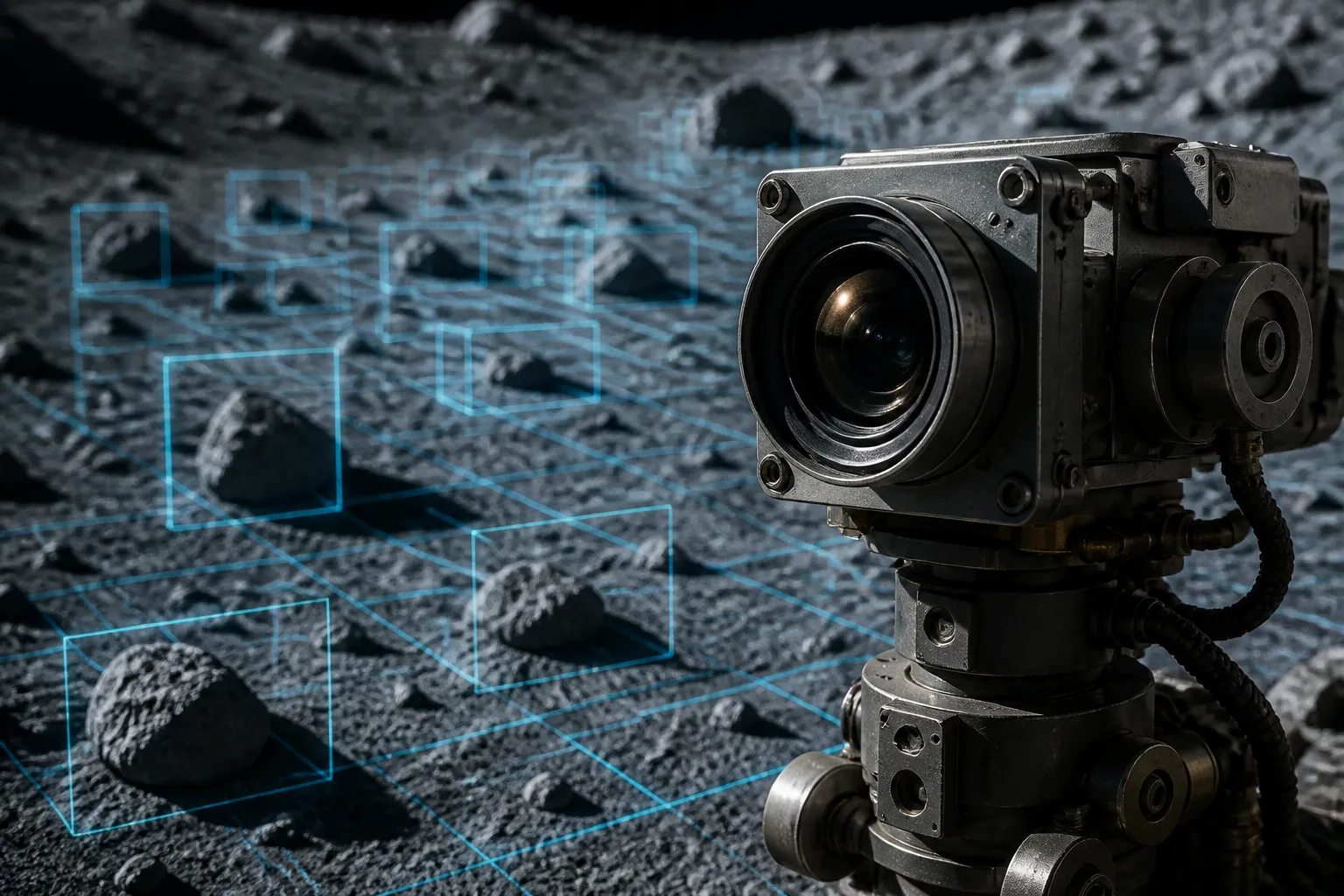
What Space-LLaVA Actually Does
The Space-LLaVA authors start from a pre-trained LLaVA 13B checkpoint. They fine-tune it on question-answer and instruction-following tuples built from three extraterrestrial datasets. Two of those are AI4Mars and MICD. The third is a SpaceScienceQA set. The tuples are generated programmatically, with GPT-assisted annotation doing the writing.
That pipeline is an abstraction step in plain view. A raw planetary image becomes a handful of questions and answers. Whatever the annotators did not think to ask about is not in the training signal. The model can only get good at the questions that were written down.
The paper frames its goal around three problems in space robotics. Ground-in-the-loop operations do not scale. Prior knowledge has to generalize to new environments. And tasks and sensors come in many modalities. To test transfer, the authors evaluate on an out-of-distribution orbital task and a lunar simulation task. The excerpt available here does not include the benchmark numbers, so this piece cannot say how well it worked.
When the Abstraction Is the Method
The SandboxVLM paper pushes the idea further. Its authors argue that vision-language models struggle with 3D tasks because of a modality gap. The models learn from 2D images, then get asked about 3D structure. Pulling 3D information out of 2D input is inefficient.
Their fix is to hand the model a 3D abstraction. Abstract bounding boxes encode geometric structure and physical kinematics. No extra training is needed, and the evaluation is zero-shot. The pipeline has four stages: multi-view priors with abstract control, proxy elevation, multi-view voting and clustering, and 3D-aware reasoning.
The reported gain is 8.3% on SAT Real over baseline methods, for one instance. That is a single figure from one benchmark, not a general guarantee. Still, it is a concrete case where a cruder picture of the scene beat a richer one. The boxes throw away texture and keep geometry. For spatial questions, geometry was the part that mattered.
The Map Is Not the Territory
An abstraction can also mislead. A blog essay on latent-space visualization makes the point with the old line that the map is not the territory. A map is a static, simplified picture of a place. The essay warns that diagrams of AI internals can push viewers into a Euclidean mental model. A vertical stack of layers looks like a physical tower. In the essay's account, it is a sequence of operations over time. Neuron indices have no spatial neighborhood meaning either, so two neurons drawn side by side are not neighbors.
This is the cost side of the ledger. A good abstraction drops detail on purpose. A bad one adds structure that was never there. A reader looking at a diagram, a bounding box or a game screen can mistake the drawing for the thing.
The sources suggest two questions worth asking of any abstraction:
- Does it preserve the geometry the task actually depends on?
- Does it still hold up in zero-shot settings, outside the data it was built from?
The first question is the SandboxVLM test. The second is the one Space-LLaVA tries to answer with its orbital and lunar evaluations.
Where Star-Dive Fits
None of the sources discuss Star-Dive. The film pieces in the research set cover Star Trek, Diva and Star Wars, and they do not describe the game. So this piece makes no claims about how Star-Dive draws its stars, hazards or distances. Anything more would be guessing.
What the papers do give is a way to look. Play a round of Star-Dive and pick one object on screen. Ask what the game kept about it, such as size, speed or direction. Ask what it dropped. Then ask whether the player's task depends on what was dropped. The same exercise works on any cabinet in the catalog, including the Asteroids remake.
A rover model fails when its annotations skip a hazard. A diagram fails when it implies a corridor that is not there. A game can fail the same way, if the picture suggests a rule the code does not follow. The check is cheap. It takes one object and one question about what was thrown away.
Sources
- Space-LLaVA: a Vision-Language Model Adapted to Extraterrestrial Applications
- https://arxiv.org/pdf/1910.03310
- Visualization of Latent Space - Panspermia by CriaFaar
- [2511.10946] Abstract 3D Perception for Spatial Intelligence in Vision-Language Models
- Star Trek: The Motion Picture (1979) - A Deep Dive Review & Analysis - Adam David Collings
- Star-struck: Celebrity, obsession, and film. Diva | IU Libraries Blogs
- The Evolution of Film Style in Star Wars – F for Films

Julian Thorne is a seasoned house writer for GoAndGame, known for his deep dives into obscure game mechanics and industry trends. He often explores the sociological impact of gaming, blending critical analysis with historical context.


