
Most amateur scrims I have sat in on have the same problem at minute nine. Five players drift toward the Lord pit, and nobody can say who was supposed to be where. The roamer is usually the missing piece. Here is a way to fix that, built from two public guides and a few of my own scrim habits. I will flag which is which.
Roamer rotation is about being in the right place at the right time. The roamer should almost never sit in one lane farming.
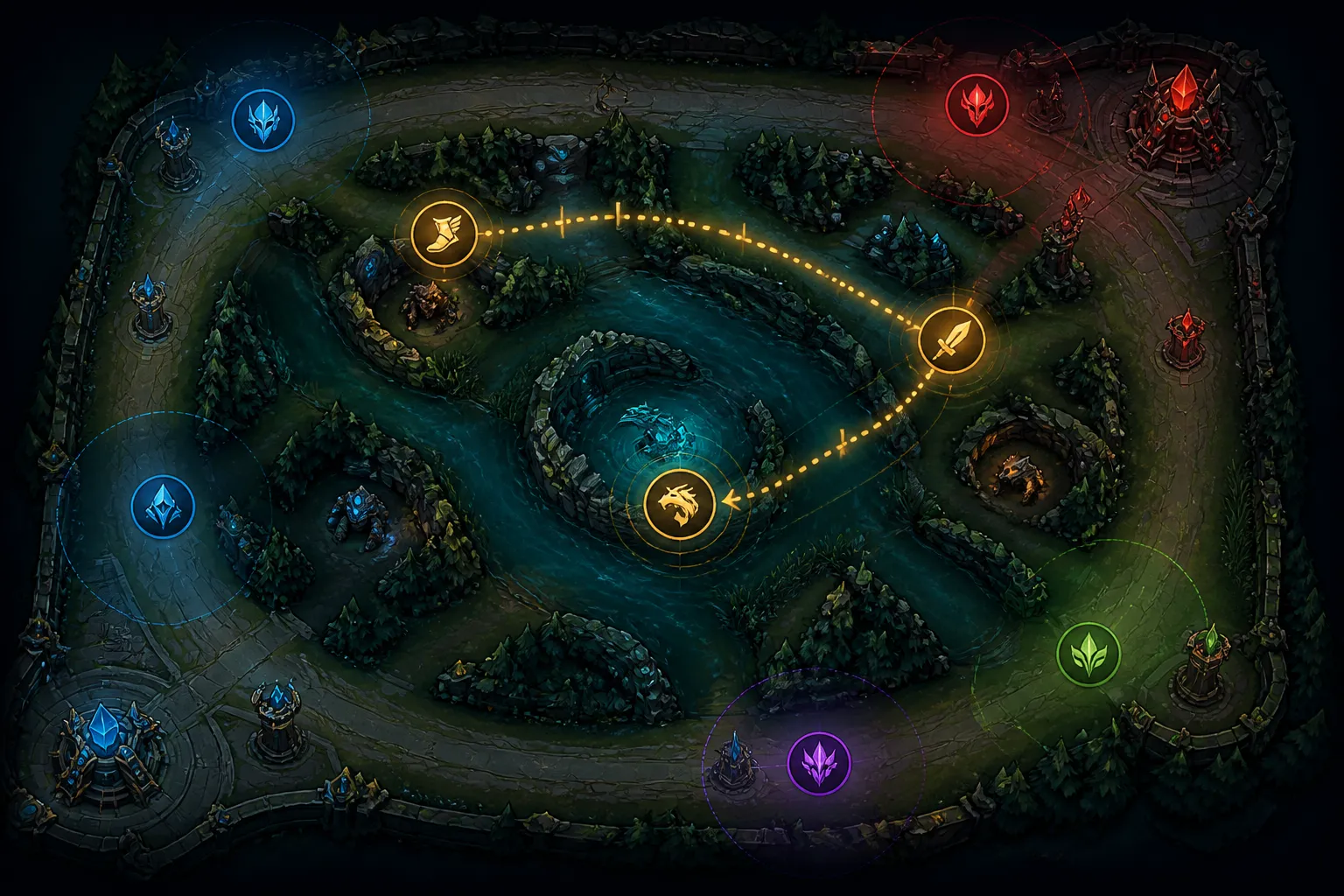
Why the roamer's position matters more than its farm
The Rivals roaming guide puts it plainly: the job is presence, not income. A roamer parked in one lane leaves the rest of the map open to enemy rotations and gives up vision control. Vision is the main responsibility, and what you see should decide whether the team fights, farms or takes an objective.
The roamer also has to fit around the jungler. BitTopup frames the jungler as the tempo controller, with a target of roughly 60% jungle farming and 40% lane interaction in the first eight minutes. So your rotations should feed that plan. If you pull the jungler into a lane fight he did not want, you are competing with your own tempo.
Early-game rotation timing from minute 0 to 4
The opening sequence is short. Escort the jungler to the first buff. Then either support mid or gank the gold lane. Then contest the Lithowanderer, the river crab, between minutes 2 and 4.
The economics explain why. Small jungle camps drop 50 to 80 gold each, and major buffs give around 120 gold plus stat bonuses. Early rotations should protect or enable those gains. Chasing a low-value kill across the map while the jungler loses a buff is a bad trade.
Escort or gank? Look at the lane. If it is pushed and safe, that is your signal to rotate. If it is not, stay and keep the lane stable.
Protecting the carry and deciding when to stay
The core rule from the Rivals guide: if your carry is being dove or zoned off creep score, you stay. Protecting a farming carry outweighs ganking another lane. Never leave the carry exposed to go looking for plays.
Bushes are the second rule. A squishy carry that face-checks a bush alone gets killed. The tank or support checks first, then the team walks through.
After minute 4, back the lane with the most carry potential. Keep the gold laner alive if they are ahead. Enable the mid laner's roams if they are snowballing. Lane minions after the 5-minute mark are worth only 30 to 50 gold, which is why pro players often cut lanes instead of sitting in them.
Turtle and Lord: making the roamer present for objectives
Both guides treat objectives as non-negotiable. Rotate for Turtle at 2:00 and Lord at 9:00. If the team is fighting for Turtle, the roamer must be there.
I need to be candid about the gaps. The sources give the 9:00 timing and little else. They do not cover the Lord buff, how it is contested or how it is secured. BitTopup lists a Lord preparation section, but the excerpt cuts off before the content. Anything I say about Lord setup below is my own scrim practice, not sourced fact.
Buff control is the sourced example of why timing matters. The Purple Buff gives 10% cooldown reduction, 50% mana cost reduction, 20% energy cost reduction and HP restoration per target killed, for 75 seconds. A team holding that buff fights differently. My practice recommendation: have the roamer place vision around the pit a minute before the call, and have the team agree who steps in first.
Choosing a roamer and running the scrim
Match the hero to the player. Chou suits someone who wants to make plays and dictate pace. Rafaela fits a supportive, sustain-first style. Khufra is an anti-dash tank with a reliable CC chain. Atlas works with AoE mages and fighters because his ultimate pulls enemies together. Estes brings heavy sustain, but anti-heal items counter him, so check what the enemy builds.
The sources say nothing on scrim structure, so this part is mine. Name one roamer and one shot-caller before the first game, and make them different people if you can. Keep calls short: rotate, hold, Turtle up, Lord up. Then debrief each rotation against four questions:
- Was my carry being dove or zoned off farm?
- Was my lane pushed and safe?
- Was the team fighting for Turtle or preparing for Lord?
- Which lane had the most carry potential?
Watch for three red flags in the replay. The carry left exposed. A Turtle or Lord fight missed because the roamer was elsewhere. Over-farming instead of ganking. I would be skeptical of any tidy number for success here, since neither source measures rotation quality. Count the misses, and see whether the count drops across a week of scrims.
Sources

Priya Nambiar covers competitive gaming and emerging esports ecosystems for GoAndGame, with a particular focus on Southeast Asian scenes and grassroots tournament culture. She came up through community forums before moving into sports journalism, and that background shapes everything she writes.


