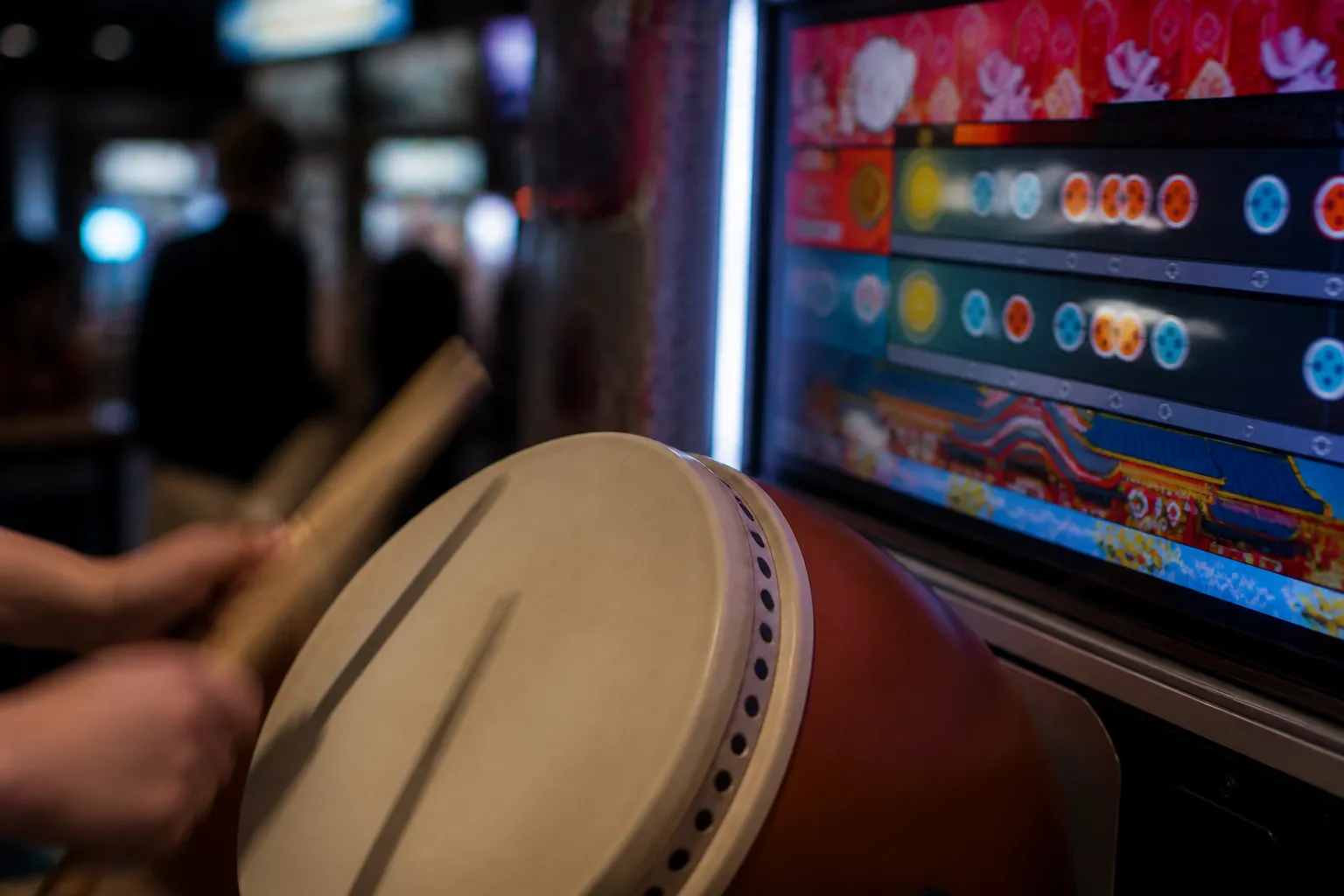
A player chooses a song, lifts two sticks, and waits for the first notes to arrive. In Taiko no Tatsujin, practice has a physical shape: arms move, sticks meet a drum, and the music keeps going. That makes the idea of practicing in public compelling. But a compelling image is not the same as a documented one. The available sources describe the game and the shared space of an arcade. Neither establishes that everyone nearby can see a player practice.
- Choose a piece of music and a difficulty that suits the attempt.
- Watch notes scroll in from the right, then strike the simulated Taiko drum with sticks called bachis.
- Follow the notechart, or fumen, the sequence that sets out the notes for the level.
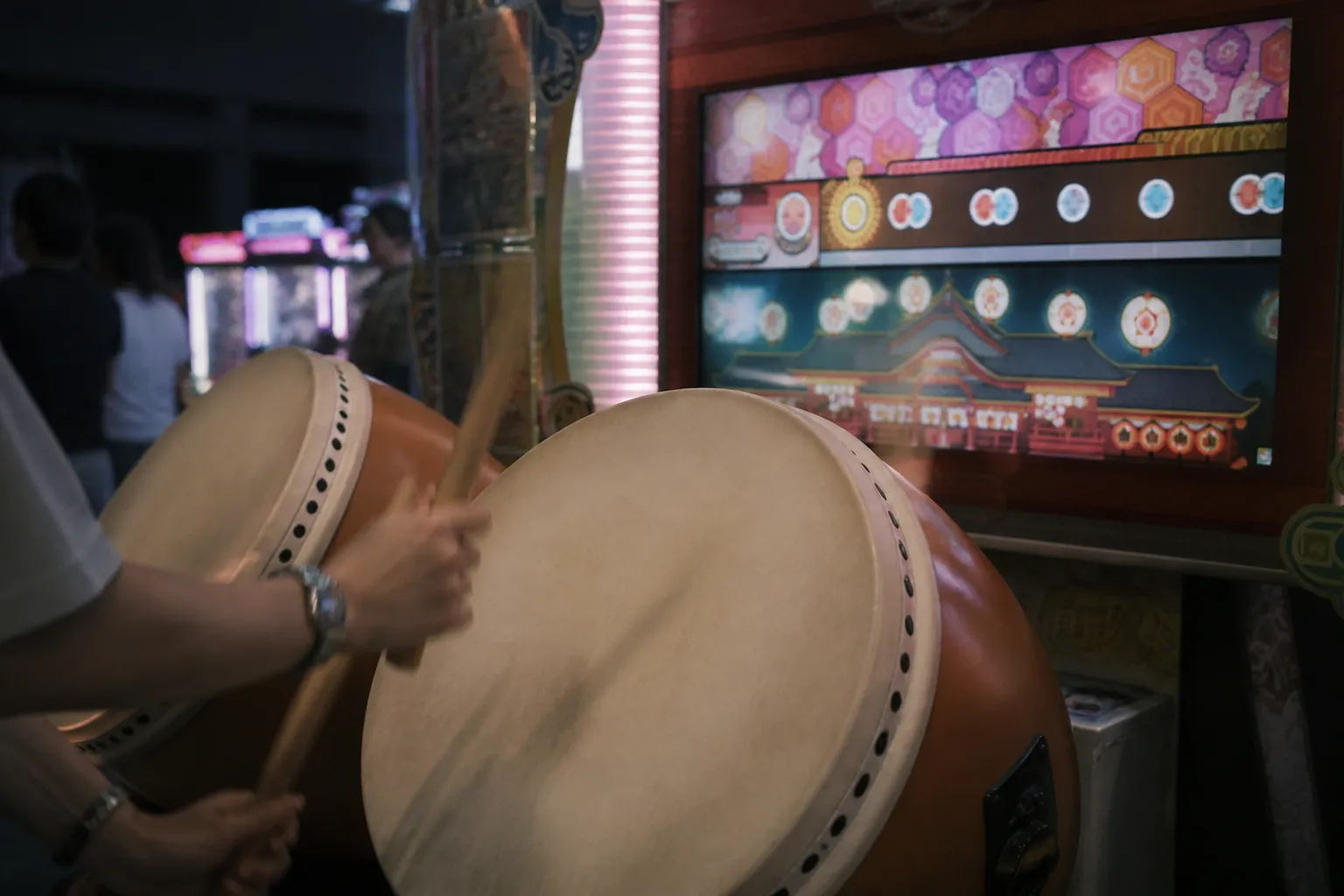
- Play accurately enough to fill the spirit gauge past its target, the noruma, and clear the song.
- On most games in the series, the difficulty choices run from Easy (kantan) through Normal (futsu) and Hard (muzukashii) to Oni, the highest level.
What can a nearby player actually see?
The Arcade Club listing gives us a firm starting point. Namco created Taiko no Tatsujin, the listing dates it to 2001, and it identifies the arcade game as a two-player rhythm game. Those details explain why the cabinet invites play alongside someone else. They do not tell us where an observer can stand, what the screen shows from that position, or how clearly a stranger could distinguish practice from an ordinary round.
A Taiko Time essay on arcade ethics comes closer to the social question. It describes arcade rooms in which players can see and hear one another. In a room like that, a repeated song or an attempt at a harder chart might be noticeable. That is an inference, though. The essay does not say that practice is visible to everyone nearby, and neither source establishes that spectators can watch a particular machine. The more interesting question may be what a player chooses to reveal by continuing after a difficult round, with other people sharing the room.
The drum makes effort legible
Taiko no Tatsujin asks players to keep time with a chosen song by striking a simulated drum. Its moving notes give each hit a moment to arrive, and the spirit gauge gives accurate play a cumulative result. A player can understand a missed note privately as something to work on. At a cabinet, the attempt also involves audible, visible movement. That contrast helps explain the appeal of the public-practice idea, even though these sources cannot tell us how much of any one attempt reaches a bystander.
The four difficulty names also give practice a vocabulary. Easy and Normal offer different demands from Hard and Oni; choosing a level is part of deciding what to try next. Yet the choice alone tells an onlooker little about the person holding the sticks. Someone on Easy may be learning the controls, testing a song, or simply enjoying it. A player on Oni may still be working through a particular passage. The chart measures notes, not motives.
The room has its own conditions
Arcade Club says its arcade games are free to play once a visitor is inside the venue. Its library lists more than 1,000 games, but the listing does not provide a local-currency admission price, a per-play price, or instructions for booking this cabinet. It also does not supply venue locations or opening hours for planning a visit. A large library is no guarantee that a particular machine will be ready on a particular day: Arcade Club says machines rotate in and out of service for maintenance.
That uncertainty matters to anyone hoping to practice. Before making the trip for Taiko, a visitor would need to ask if the machine is in service at that location today. Once there, they would need to see whether the drum is in playable condition. The sources offer no account of a queue or a viewing area, so they cannot settle how a session is shared with others in practice. They tell us the cabinet exists in an arcade collection, not the precise social arrangement around it.
Care for the next pair of hands
The Taiko Time essay describes regular Japanese players caring for cabinets, including draping a cloth over the drum. According to the writer, the cloth helps with drumrolls, reduces noise, and protects the surface for the people who play later. That small act puts another person into the story of a single round. Even when a player is focused on their own timing, the drum remains a shared object.
The essay also warns about broken drums and excessive force, particularly strikes to the sides where wiring and sensors sit. A damaged surface or sensor area is a reason to check the machine before starting; an out-of-order cabinet cannot offer a useful practice session at all. These are observations from an opinion piece written from Malaysia, and the available text is partly truncated. They are worth taking seriously as concerns about cabinet care, but they are not formal etiquette rules for every arcade.
What remains to ask at the cabinet
A visitor can leave the sources with practical questions. Is the Taiko machine working today? Is its drum surface or sensor area damaged? If the game is in Japanese, is there guidance for using this cabinet? Answers from the venue would be more useful than assuming that every listing describes the machine as it stands now.
The headline question remains open, too. The sources do not explain how practice becomes visible to bystanders, who can watch, or what they can make out from a nearby spot. Arcade Club has a Live Streaming service in its site menu, but the supplied material does not explain what it offers, and it gives no basis for connecting it to this game. What we can say is narrower: Taiko no Tatsujin turns musical effort into repeated physical actions in a shared arcade setting. How public a particular practice session feels is a story the available sources have not finished telling.

Alexandra Rivet explores the intricate interplay of games and culture for GoAndGame. A passionate storyteller, she delves into narratives with depth and curiosity. Her pieces often highlight the stories behind the pixels.


