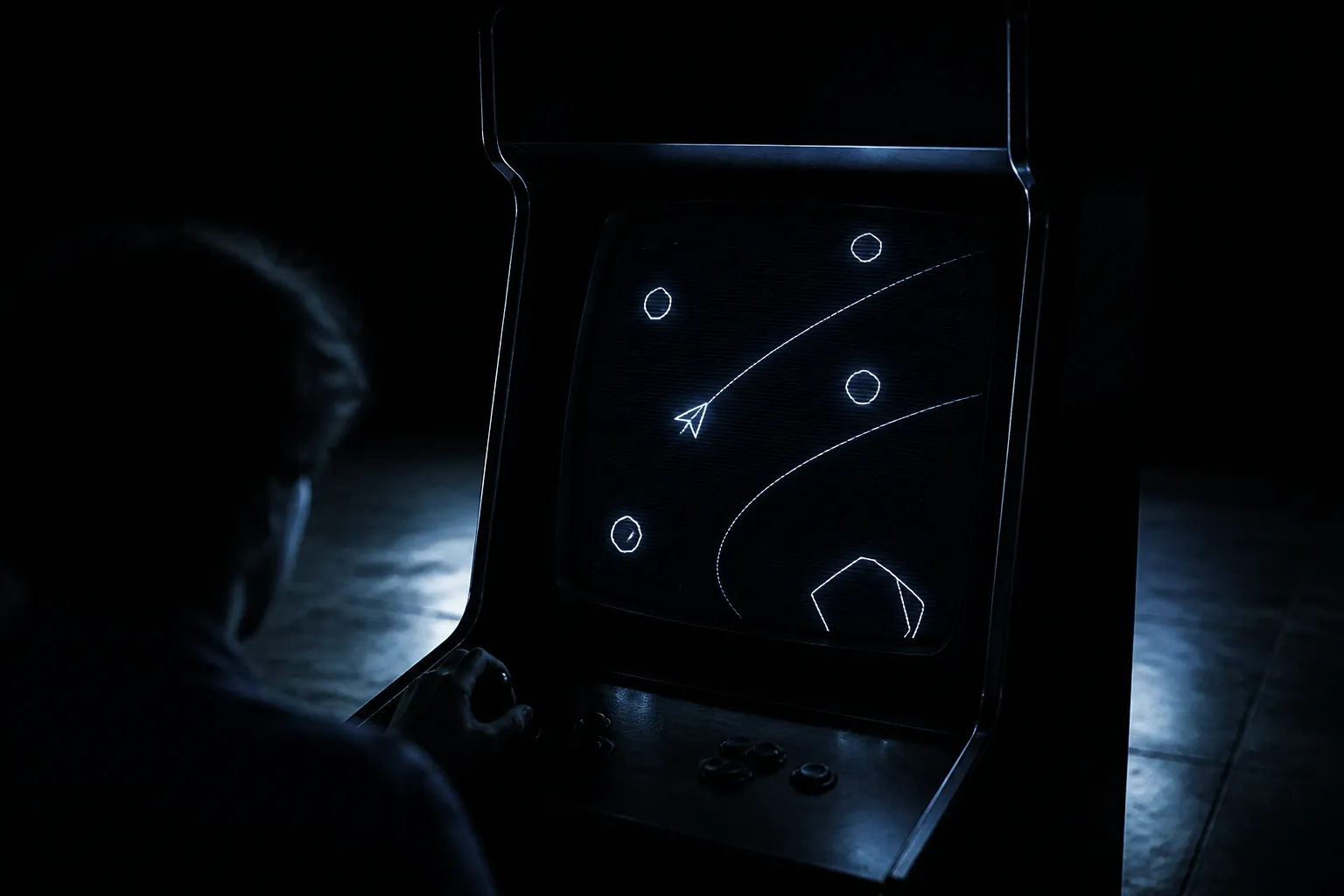
Asteroids, released in November 1979, was more than a successful arcade game; it was a foundational text in spatial interaction. Its stark vector graphics presented a universe defined by angular momentum and precise trajectories. Players were not merely dodging rocks; they were engaging in a rigorous exercise of orbital destruction, mastering the subtle physics of a simulated vacuum. This immediate feedback loop of movement, mass, and impact codified a demanding logic that subsequent games have struggled to emulate, let alone surpass.
To speak of remaking a classic like Asteroids without first reckoning with its fundamental, almost brutal elegance, is to misunderstand the very nature of enduring design. The original did not simply exist; it challenged players to comprehend a new kind of spatial reasoning, etched onto a screen by the direct pulse of a cathode ray. Modern facsimiles often miss this core, mistaking surface for substance.
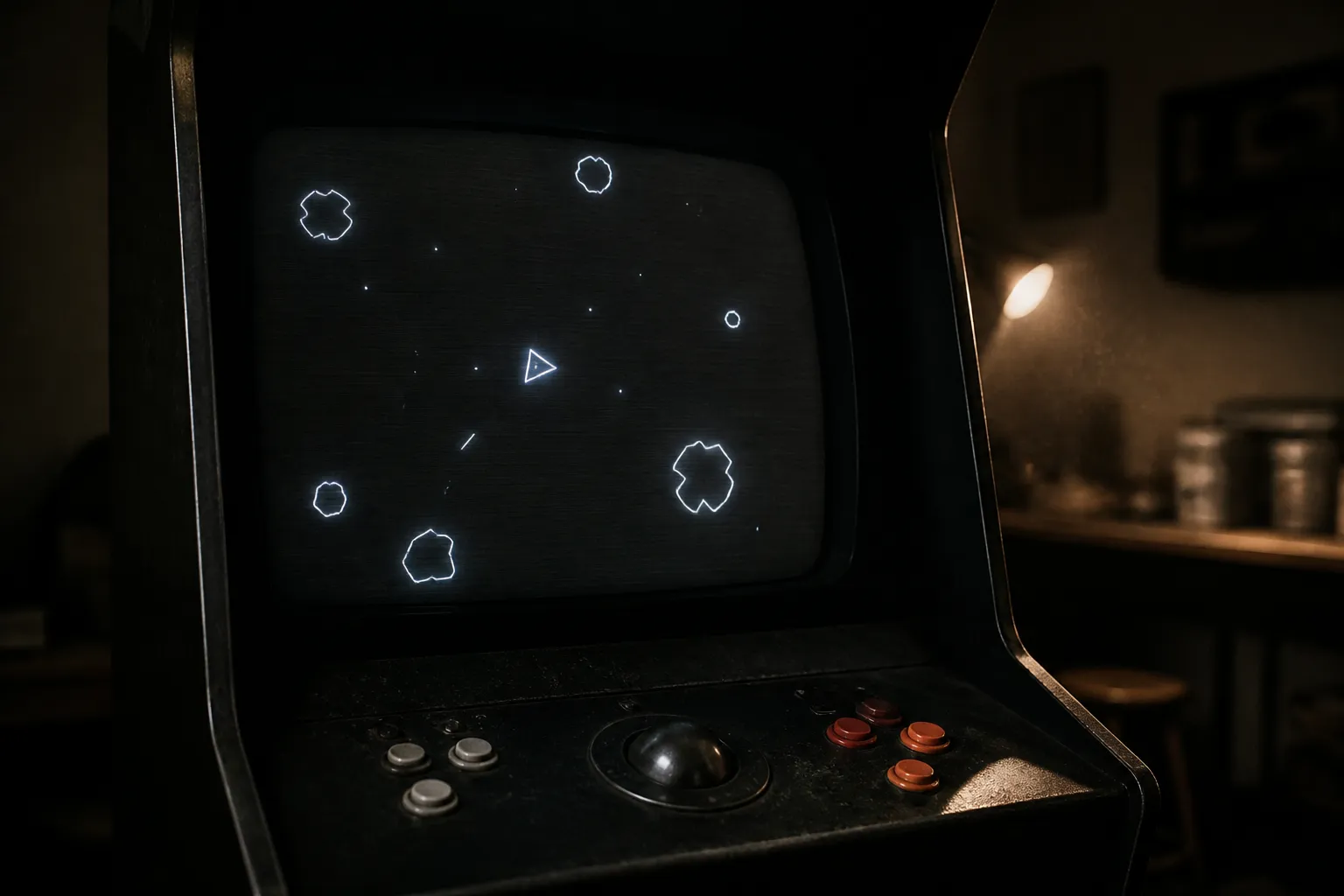
The Original Premise and Its Place in Arcade History
The arrival of Asteroids in North America in November 1979, followed by Europe and Japan, marked a pivotal moment in arcade culture. It emerged alongside Space Invaders as a defining experience of the "golden era," but its lineage traced far deeper, back to Spacewar! at MIT in 1962. This historical thread reveals a sustained inquiry into interactive space, a legacy rarely acknowledged in contemporary design discussions. Designers Lyle Rains and programmer Ed Logg crafted a system that distilled complex gravitational concepts into immediate, visceral play. This was not just entertainment; it was a philosophical statement on the player's capacity to impose order on a chaotic, abstract environment. The game's historical placement demands a critical view of its continued relevance, not just as a nostalgic artifact, but as a blueprint for spatial computation.
The Silent Language of Spatial Mastery
The core gameplay loop of Asteroids appears deceptively simple: steer a spaceship, avoid collisions, destroy floating debris. Yet, this simplicity belies a profound demand for spatial mastery. Players were forced to anticipate trajectories, manage inertia, and execute precise cannon fire, all within the constraints of continuous movement. The game's abstract representation of space, governed by its unique physics, created a dynamic puzzle where survival hinged on understanding the interplay of velocity and mass. This "orbital destruction" was not merely about blasting objects; it was about controlling the flow of potential impacts, orchestrating a ballet of deflection and disintegration. While the foundational mechanics are clear, the deeper implications of its "lurking exploit" or specific "quirks" are often lost without access to comprehensive historical documentation. A contemporary reimagining, such as the proposed Asteroids Remake, would need to engage with these undocumented facets to truly honor the original's challenging design.
Vector Aesthetics and the Logic of Representation
The unique visual identity of Asteroids stemmed directly from its vector screen hardware. Unlike raster displays that build images from a grid of pixels, vector monitors drew luminous lines and points directly onto the screen's surface. This technological constraint was, paradoxically, its greatest asset. The crisp, geometric forms of the asteroids and spaceship provided unparalleled clarity, where every line held critical spatial information. There was no visual ambiguity, no blurry textures to obscure the player's immediate read of the environment. This directness of representation was integral to the game's spatial logic, making instantaneous decision-making possible. Visitors to The Strong National Museum of Play can experience a playable arcade cabinet firsthand, offering a tactile connection to this distinct visual paradigm. Understanding Asteroids requires grappling with how its hardware fundamentally shaped not just its look, but its very language of interaction.
Ed Logg's Enduring Influence and the Unseen Archive
Ed Logg, famously known as "Super Duper Game Guy," stands as a titan in early video game development, credited alongside Lyle Rains for Asteroids and as programmer for the title. His prolific career includes other seminal works like Centipede, Millipede, Super Breakout, and Gauntlet. Logg's contributions earned him a Pioneer Award from the Academy of Interactive Arts and Sciences in 2011, a recognition of his profound impact on the industry's formative years. Yet, accessing the full breadth of his design philosophy remains a challenge. An interview with Logg discussing both Asteroids and Gauntlet exists, but only its introduction is publicly available, found at Game Developer. This restricted access is a historical void. It prevents a comprehensive understanding of the intricate decisions that forged Asteroids's unique spatial logic and Logg's personal reflections on the mechanics of "orbital destruction." Without direct insight from such primary sources, critical analysis risks becoming incomplete.
The Phantom Remake: A Critical Absence
A fundamental issue arises when considering an Asteroids Remake: the available sources provide no information on its existence, design, or intended changes. This critical absence forces a re-evaluation of the entire premise. Without details on modern development tools, projected costs, target platforms, or criteria for success, any discussion about a remake becomes pure conjecture. We cannot articulate what a new iteration might "change, add, or keep" from the original because no such project is documented. This gap highlights a significant challenge in game preservation and contemporary criticism. To evaluate a remake, one must first possess a tangible object of analysis. The "enduring logic of orbital destruction" is undeniably present in the 1979 original, but its application to a hypothetical remake remains an unwritten chapter. The task of revisiting a classic demands rigorous engagement with both its historical context and the practical realities of its potential future development, neither of which can be addressed without concrete information.
Sources
- Asteroids (video game) - Wikipedia
- The TDE Podcast Ep 19: Asteroids Creator Ed Logg – The Arcade Blogger
- Arcade Games in Infinity Arcade - The Strong National Museum of Play
- Rethinking the Sound of Early Video Games - The Strong National Museum of Play
- Asteroids | ZKM
- Gamasutra Is Now Game Developer
- Outstanding Ideas: Ed Logg on Asteroids and Gauntlet

Julian Thorne is a seasoned house writer for GoAndGame, known for his deep dives into obscure game mechanics and industry trends. He often explores the sociological impact of gaming, blending critical analysis with historical context.


