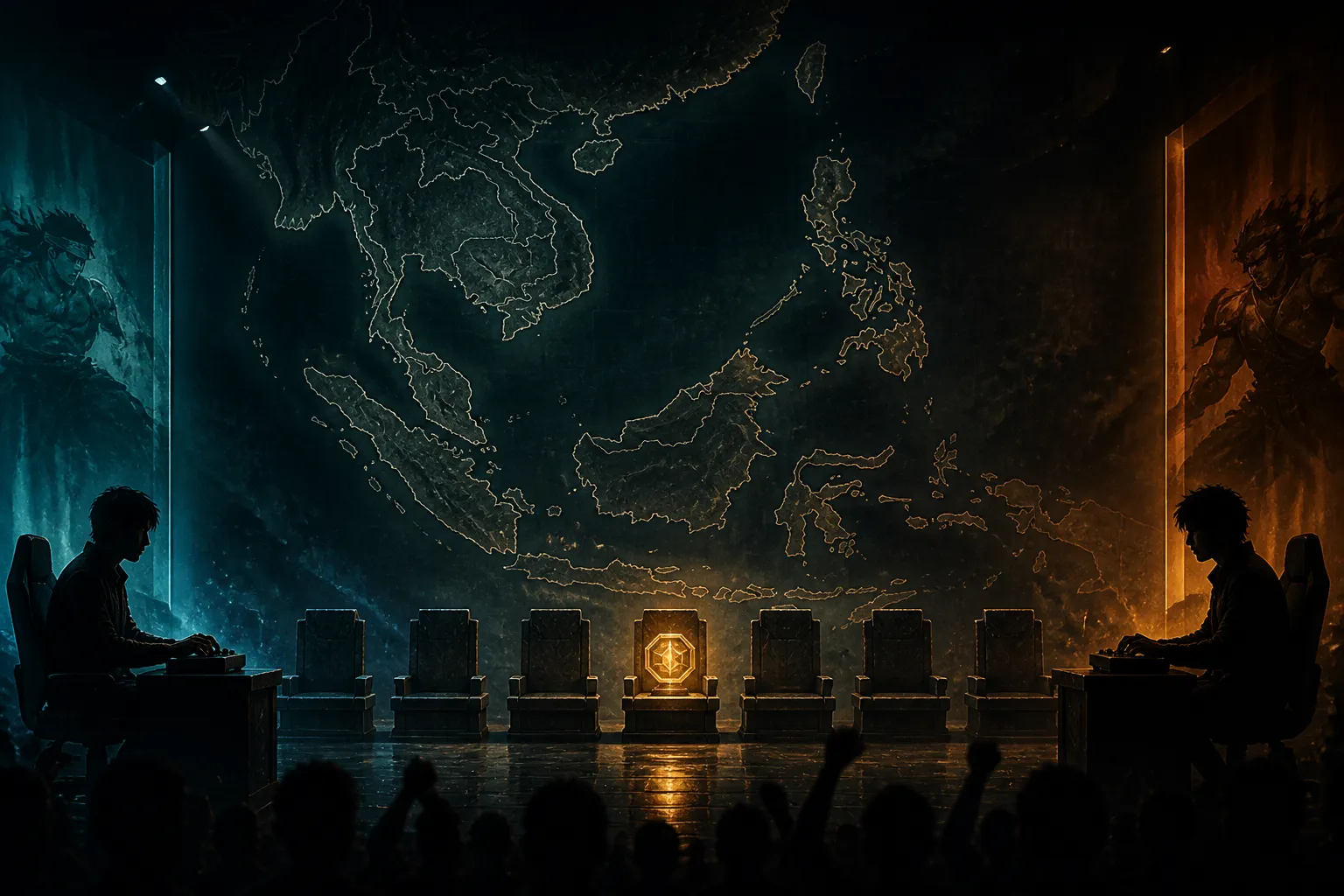
A Street Fighter 6 player in Cebu or Surabaya who wants a shot at Capcom Cup does not need a sponsor first. They need a path. In 2026 that path runs through a regional qualifier, and the public record shows very little money pointed at the people walking it in the Philippines and Indonesia. This piece makes the case for changing that, and marks where the evidence stops.
One qualifier slot per region. A $1,000,000 grand prize at the end. The local scene is the only thing a player can still change in between.
What the regional qualifier actually unlocks
The 2026 World Warrior regional finals are underway, and the qualifier is the gate to Capcom Cup, not a side event. Players get in through offline Premier events and an attached leaderboard, plus invited champions from prior seasons and teams. The World Warrior circuit is the other door.
The 2024 season shows the shape of it. The online side was split into 24 regions, each running five tournaments before a regional final. The champion earned a seat at Capcom Cup 11. Of the 48 players who qualified that season, 10 came from Premier events and 38 from World Warrior tournaments. Most of the field came through the regional door.
Capcom Cup 2026 carries a $1,000,000 grand prize. For a player outside the top tier, that number makes a regional win feel less like a trophy and more like a career change.
Why the one-per-region rule makes Southeast Asia a funding question
This year Capcom scaled back the Super Region system. Only Japan counts as one now. Every other region sends a single qualifier from its World Warrior circuit. That means Southeast Asian players compete for one slot per region, not a share of a bigger multi-country pool.
One slot raises the value of depth. If the local scene is thin before the final, the player who reaches it has fewer strong opponents to sharpen against. Local investment becomes a lever, not a luxury. I read it as the cheapest place to move the odds.
Region-locking has done similar work before. In 2017, regional finals were open only to residents of a region, and Capcom said the goal was to show the best player from each one. The top seven on each regional leaderboard advanced, and winning a ranking event also counted. Each final had a $30,000 purse split among the top 8, with $12,000 to the winner. Local pools have shaped qualification before. They just were not funded as if they mattered.
One caution. The sources confirm the one-per-region rule. They do not confirm that the Philippines or Indonesia has its own regional final in 2026. That needs checking before anyone writes a cheque.
What national esports bodies are already building
The Philippine Esports Organization, or PeSO, was named the country's National Team Partner for the Esports Nations Cup 2026, set for Riyadh from November 2 to 29. It will lead formation of national teams across multiple titles, oversee player selection, and set the operational framework for participation.
PeSO also says it targets activating a National Esports Training Facility in 2026, funded through a partnership with e-gaming platform Arena Social. Its grassroots program aims to find untapped talent in the provinces and decentralize opportunities. That last part matters most for a scene where talent is spread across islands.
Treat all of this as aims, not results. The reporting covers plans and a partnership announcement, with no measured outcomes. It does not say whether Street Fighter is included or whether the program is multi-title. It gives no budget for the facility. Indonesia has no comparable item in the sources at all.
What local-scene funding should cover, and what evidence is missing
Three uses come to mind.
- Entry fees for local and online events.
- Travel to Premier events, where leaderboard points are earned.
- Prize purses that make regular local tournaments worth entering.
Travel likely matters most. Point accumulation is the main qualification route, and Premier and Evo results are weighted heaviest. In 2018, a Premier win paid 700 points and an Evo win paid 1,750. One trip abroad can outweigh months of local play on the leaderboard.
For scale, the 2017 Hong Kong Esports Festival got HK$35 million from the Hong Kong government and expected 50,000 visitors, 10% from overseas. That is a festival model, not a qualifier model, but it shows what public money can buy when someone commits.
Now the gaps. No source gives Philippine or Indonesian World Warrior results, player counts, or local scene size. None gives Indonesia-specific funding or compares cost against benefit for qualifiers. So treat this as questions to test:
- How many Philippine or Indonesian players reach a regional final each year?
- How many of them got there through local events rather than Premier invitations?
- Does PeSO's facility or grassroots work include Street Fighter at all?
Answer those and the funding case either sharpens or falls apart. I am optimistic, but I would like the numbers first.
Sources
- Capcom Pro Tour 2026 World Warrior Finals early results, streams
- Capcom Pro Tour 2024 - Wikipedia
- Stunfest 2016 - Wikipedia
- Capcom Pro Tour 2018 - Wikipedia
- Capcom Pro Tour 2017 regional finals - Wikipedia
- Hong Kong Esports Festival - Wikipedia
- Philippine esports body announces plans to put up national training center | Philstar.com
- Philippine esports body named National Team Partner for Esports Nations Cup 2026 | Philstar.com
Priya Nambiar covers competitive gaming and emerging esports ecosystems for GoAndGame, with a particular focus on Southeast Asian scenes and grassroots tournament culture. She came up through community forums before moving into sports journalism, and that background shapes everything she writes.


