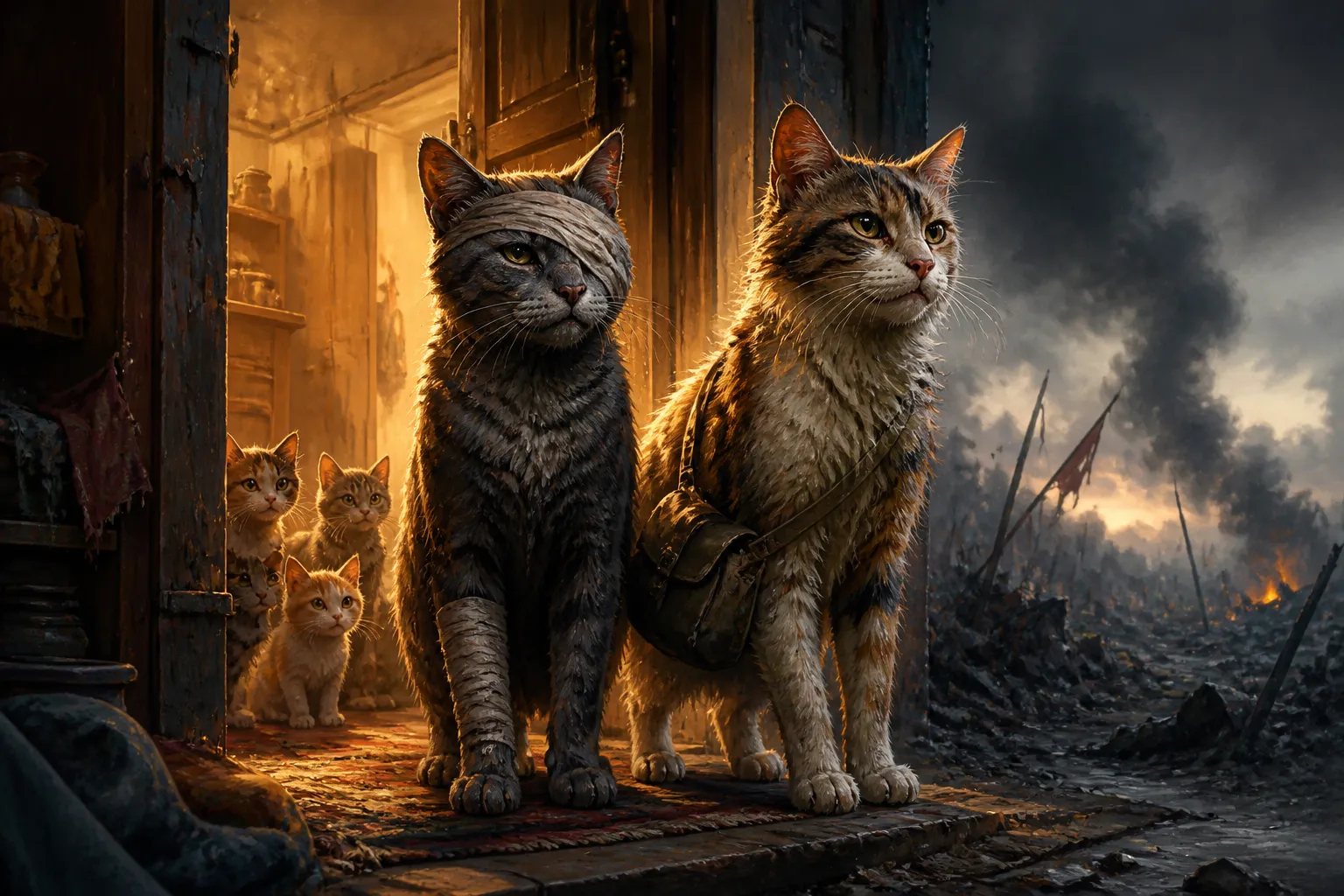
A cat comes home from an adventure with loot, an injury, or not at all. In Mewgenics, that result matters beyond the next battle. Cats can pass abilities to their offspring, turning each expedition into a wager on both the current squad and the one that might follow it. The appeal lies in that long view: build a team from an unruly household, send it into danger, and live with what returns.
- What works: Breeding gives tactical decisions consequences that can carry into another generation.
- What keeps it lively: Randomized skills and attributes demand improvisation rather than one reliable squad plan.
- What may sting: A bad run can permanently remove a cat you had grown attached to.
- Best fit: Players who enjoy turn-based tactics, roguelite repetition, and plans that change mid-run.
- Think twice if: Heavy randomness or permanent losses make a strategy game feel less rewarding to you.
What Mewgenics asks of its cats
Developed and published by Edmund McMillen and Tyler Glaiel, Mewgenics was released for Windows through Steam on February 10, 2026. It is a turn-based tactical RPG with roguelike structure, fought on a 10x10 grid. Familiar classes, including Fighter, Mage, Hunter, Tank, and Necromancer, offer an initial way to understand a squad. The cats filling those roles are less predictable than the labels suggest.
The household supplies adventurers. You breed cats, send a team through a campaign of connected encounters, and hope to bring home its loot and its members. Rock Paper Shotgun describes the result as a collision of multipart roguelite adventures, streamlined turn-based combat in the vein of Divinity: Original Sin, and a hierarchical breeding simulator. That combination makes the preparation feel unusually personal. A class tells you what a cat might do in battle; its place in the household tells you why bringing it back matters.
Inheritance gives a run its afterlife
Inheritance is the idea holding those systems together. A special ability can pass from a cat to its offspring, giving a survivor a possible role in raising the next generation of adventurers. That changes the meaning of a successful trip. Loot is useful, but a cat that returns can also contribute to a future team. Losing one may close off a possibility you had started to imagine.
There are limits to what the available reviews establish. They do not spell out the exact rules for selecting or passing down traits, so it would be misleading to promise a precise breeding strategy. The more important observation is about attention. In many roguelites, a promising build ends when its run ends. Here, the prospect of inheritance invites you to think about what a cat might leave behind. It gives the roster a memory, even as the next adventure threatens to cut that memory short.
The grid does not promise control
Combat unfolds through turn-based fights against squads of mutant cats, with encounters linked into longer adventures. A 10x10 grid sounds compact enough to master, but the team you bring onto it is not wholly yours to design. As IGN's review notes, many skills and attributes are randomized and largely outside the player's control. You can plan around the cats you have; you cannot assume the next team will arrive with the same answers.
That tension is where Mewgenics earns its tactical identity. The interesting question is often not which ideal combination to assemble, but what this particular group can do now. Randomness can make a useful skill feel like a gift and an awkward squad feel like a problem worth solving. It can also frustrate someone who wants careful preparation to produce consistent results. The game asks for tactical judgment, then keeps changing the materials on which that judgment depends.
Losses make the household feel fragile
The stakes are not merely theoretical. Cats can be lost permanently on a bad run. In Rock Paper Shotgun's review, a favored cat falls to a boss-level enemy. The detail lands because a cat in this system is more than a set of combat numbers. It may have survived earlier fights, carried a useful ability, or become part of a plan for the next generation.
That severity gives the breeding loop weight, though it narrows the audience. Players looking for forgiving campaigns may find a permanent loss hard to accept, particularly when the squad's makeup is partly determined by chance. For others, the risk is what makes a safe return satisfying. An expedition does not have to go perfectly to leave behind a story. Sometimes the memorable outcome is the cat that barely gets home.
Depth, price, and the limits of this verdict
There are signs of considerable staying power. The IGN reviewer reports more than 100 hours of play and says new enemies, skills, mutations, and loot were still appearing after more than 150 hours. That is a compelling prospect for someone who enjoys learning a tactical system over many runs. It does not, by itself, tell us how evenly the challenge rises or how satisfying the several endings are; those details remain unclear in the available excerpts.
The timing of the reviews also matters. Rock Paper Shotgun's review was published on February 6, 2026, and IGN's was last updated on February 9, just before release. Rock Paper Shotgun listed the price as TBC at the time, so those sources do not establish a final price or clarify any launch-version or early-access details. Its stated test rig was an Intel Core i5-12600, 32GB of RAM, an Nvidia GeForce RTX 3060, and Windows 11. That is one configuration, not evidence of performance across other PCs or platforms. The available IGN excerpt gives no final score, and the supplied PC Gamer excerpt contains no review discussion to weigh against it.
What can be judged is the game's central bargain. Mewgenics offers a deep, punishing loop in which tactics help you survive the present and inheritance gives you a reason to care about the future. If you want full command of a carefully built roster, its randomness may wear on you. If you can grow fond of an imperfect team and still send it out, the household is likely to keep pulling you back.
Sources

Eliot Reed writes about the intricacies of virtual worlds, blending analysis with storytelling. As a house writer for GoAndGame, he delves deep into game mechanics and narratives, offering thought-provoking insights for players and developers alike.


